This guide covers the ISO standard behind 1 DIN and 2 DIN. It also compares retractable and fixed-screen units. We explain what it takes to fit a single DIN unit into a double DIN opening. You will learn where single DIN still earns its keep in classic vehicles. Finally, we show you how to avoid sourcing traps that show up after a container’s already shipped.
What Are 1 DIN & 2 DIN? Core Definition & ISO Standard Sizes
DIN sizing isn’t a marketing term — it’s a formal specification. ISO 7736, established by the Deutsches Institut für Normung, defines the physical dimensions car stereo manufacturers build to. This makes cross-brand compatibility possible in the first place. Before diving into the comparison, it helps to understand the underlying standard — for a clear definition of the DIN specification, see our guide: What is Double DIN.
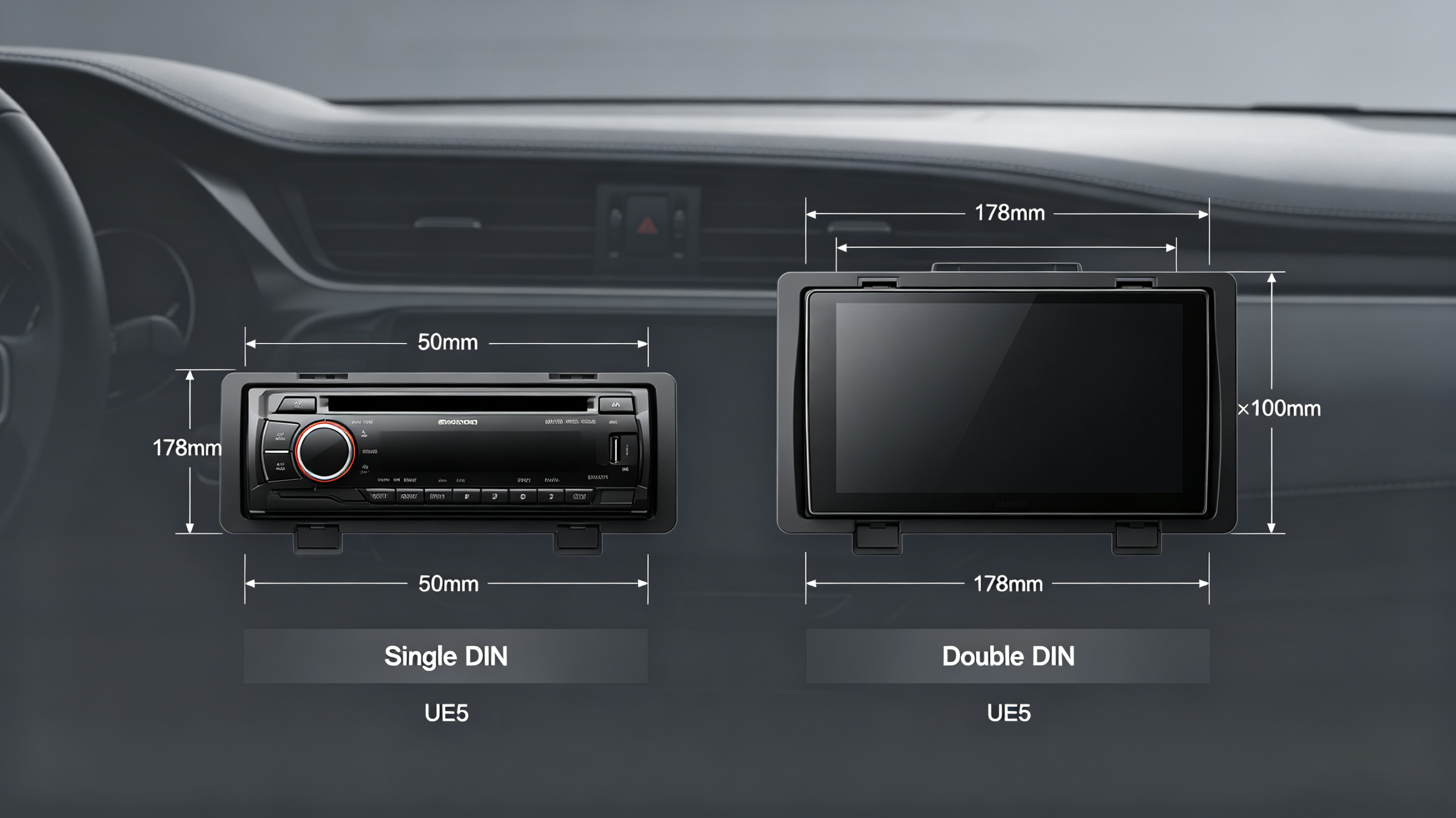
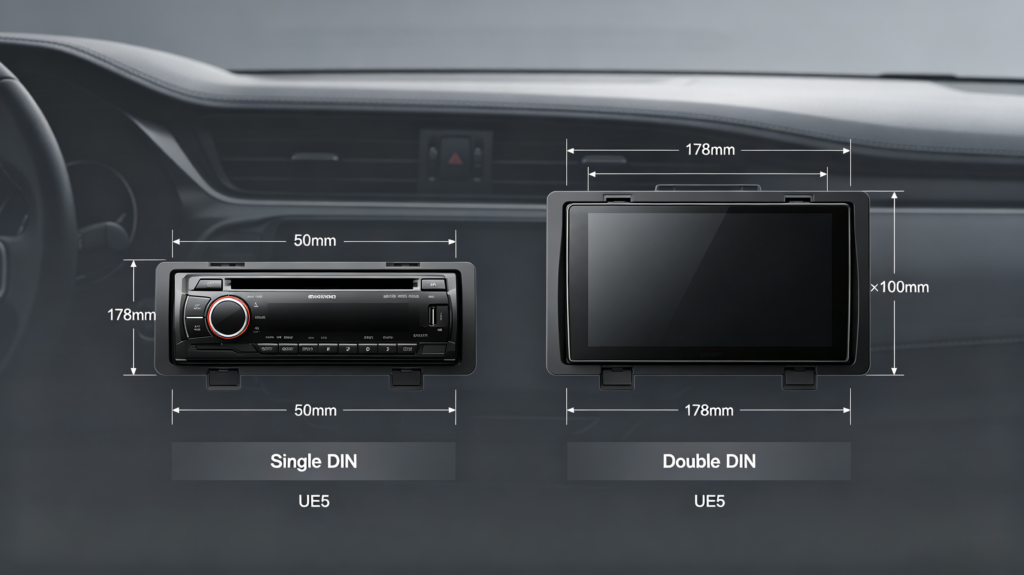
1 DIN (Single DIN) measures roughly 178mm wide by 50mm tall. This is the original “one-height” standard for car radios. 2 DIN (Double DIN) shares that 178mm width but doubles the height to roughly 100mm. This gives it the “two-height” designation.
The core difference comes down to height alone: 50mm versus 100mm. Width and depth are essentially the same across both. That single dimension determines whether a head unit physically fits a given dashboard opening. Get it wrong, and good specs elsewhere won’t save the order. It’s one of the more preventable causes of installation failures and after-sales returns. This is precisely because it’s such a simple thing to verify upfront.
Single DIN Retractable vs Double DIN Fixed Screen: Core Comparison
Once you’re past basic sizing, the real product decision is between two mechanical approaches.
1 DIN Retractable Units
A 1 DIN retractable unit hides its screen inside the chassis. It then deploys it — motorized, or via a button press — once powered on. It saves dashboard space, but that motor adds a moving part the alternative doesn’t have.
2 DIN Fixed Screen Units
A 2 DIN fixed screen sits permanently visible. It is built into the faceplate at sizes typically running 7 to 10.1 inches. It has no moving parts and correspondingly fewer failure points.
Feature Comparison at a Glance
Feature1 DIN Retractable2 DIN FixedScreen visibilityDeploys on power-onAlways visibleMoving partsMotorized mechanismNoneDurabilityRated for 10,000+ open/close cyclesInherently more durableScreen sizeCompact, space-savingLarger (7–10.1″)Best forCompact dashboards, niche appealNavigation, media-heavy use
Durability is where this comparison gets real. A well-built retractable mechanism is rated for 10,000-plus open/close cycles. However, it’s still a wear component in a way a fixed screen isn’t. In exchange, retractable units offer a genuine “modern tech” factor some buyers specifically want. This comes even with a beat of waiting for the screen to rise. Fixed screens skip that wait, at the cost of a larger permanent footprint.
Fitting Single DIN into Double DIN Dashboard: Compatibility & Risk Guide
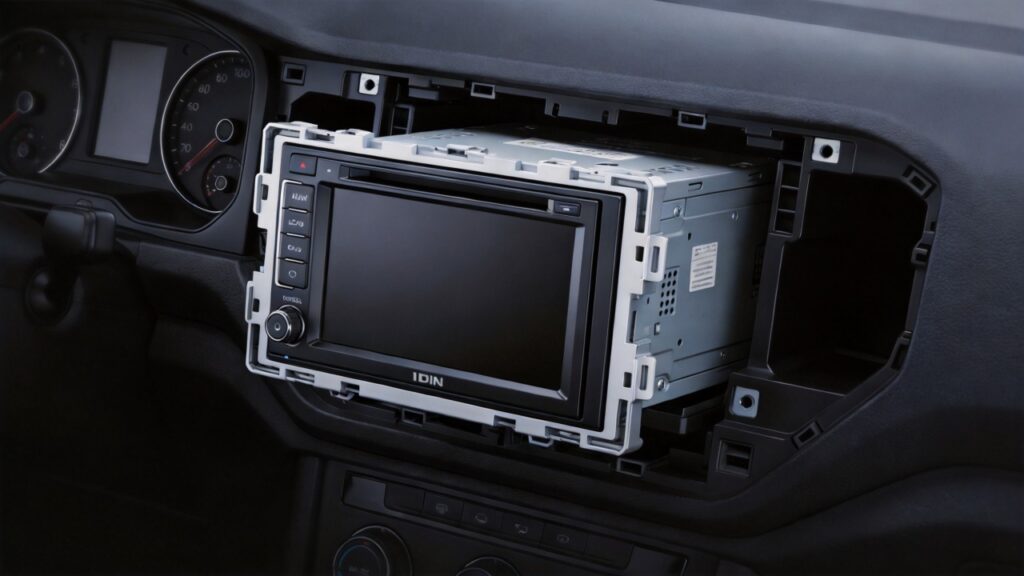
Yes, a single DIN unit can go into a double DIN opening. This is a common ask from buyers working with older vehicle inventory or mixed dashboard fleets.
The Solution: Adapter Kits
The fix is a single-to-double DIN adapter kit. This includes a trim bezel covering the extra gap. It also includes mounting brackets to hold the unit securely. Often, it includes a storage pocket to fill whatever space is left. On the electrical side, wiring harnesses and CAN Bus decoders don’t change based on DIN size. The adapter is purely a physical fitment solution, not an electronics one.
Key Risks to Watch For
A few risks are worth flagging before committing to this route:
- Depth clearance — some vehicles have limited dashboard depth. Confirm the unit’s depth actually clears before ordering in volume.
- Aesthetics — generic adapter kits can look obviously aftermarket. Vehicle-specific kits blend in far better.
- Long-term stability — cheap adapters can loosen with vibration over time. This is why vehicle-specific kits are worth the extra cost.
Single DIN Android Radio: The Go-To Choice for Classic & Vintage Vehicles
Classic and vintage vehicles almost universally shipped with 1 DIN dashboards. Fitting a 2 DIN unit means permanently cutting the dashboard. This is not something most restoration buyers will accept.
Single DIN Android units solve this cleanly. They offer a factory-like fit with no cutting required. This matters to buyers who care about preserving a vehicle’s original character while adding modern features. Retractable screen options split the difference nicely. They offer full Android functionality (navigation, media, phone projection) when deployed. The classic dashboard look is fully restored the moment it retracts. For a detailed guide on how screen size affects both visual experience and installation compatibility, read our guide on Android head unit display sizes.
A few things make single DIN well-suited to this niche:
- Retro-styled interfaces matching a vehicle’s original aesthetic, rather than looking like an obvious modern retrofit.
- Full smartphone mirroring and navigation without disturbing factory appearance.
- A genuinely stable, growing restoration market across Europe and North America.
For B2B buyers building a classic vehicle offering, single DIN Android radios with retractable screens are effectively the only serious option. There is no 2 DIN alternative that doesn’t compromise the vehicle.
Aftermarket Android Car Player: Single DIN vs Double DIN Bulk Procurement Comparison
From a pure procurement standpoint, the two categories behave differently. It’s worth planning inventory around that.
Cost and Market Demand
On cost, 2 DIN units generally run higher due to larger screens and simpler mechanics. 1 DIN retractable lands in between — pricier than basic 1 DIN, but below premium 2 DIN. Market demand skews heavily toward 2 DIN. It accounts for over 80% of aftermarket sales in mature markets. 1 DIN demand is real but smaller, concentrated in classic vehicles and compact cars.
After-Sales Risk and Inventory Strategy
After-sales risk follows mechanical complexity. 1 DIN retractable units carry the highest failure risk given their motorized parts. 2 DIN fixed screens run lower. Basic 1 DIN units — with no moving parts — carry the least risk of the three. Inventory-wise, 2 DIN’s broad compatibility across modern vehicles makes it the safer bulk-stock choice. 1 DIN needs more targeted market planning given its niche demand.
The practical takeaway: build core wholesale inventory around 2 DIN. Keep a smaller, purpose-built 1 DIN allocation for classic vehicle and niche buyers. Avoid stocking both at equal volume.
How to Choose Between 1 DIN & 2 DIN for Your B2B Business
The right choice comes down to a handful of factors working together.
Key Decision Factors
- Target vehicle age is the biggest driver. Modern vehicles, generally post-2000, run 2 DIN. Classic, vintage, and some compact vehicles need 1 DIN.
- Target market segment matters just as much. 2 DIN is the mainstream aftermarket default. 1 DIN serves niche segments like classic restoration and compact cars.
- Budget plays in too. Basic 1 DIN sits at the lowest cost point. 2 DIN offers the best overall price-to-feature ratio. 1 DIN retractable delivers premium features in a compact form for buyers willing to pay for it.
Customer expectations round this out. Most buyers today expect a 2 DIN fixed screen as standard for a modern vehicle. 1 DIN retractable functions almost as a unique selling point for the classic vehicle crowd.
Practical Scenarios by Business Type
- 4S shops stock 2 DIN for modern upgrades and 1 DIN for older vehicles.
- Wholesalers treat 2 DIN as the core line with 1 DIN as a niche offering.
- Classic car specialists prioritize 1 DIN retractable almost exclusively.
Manufacturers supporting OEM/ODM work can also configure custom DIN sizing for buyers dealing with non-standard vehicle fitments. For a complete technical overview of what an Android head unit is and how it is built, see our guide on Android head units.
For a complete framework on matching head unit specs to your business scenario — including 4S dealerships, cross-border wholesale, fleet operators, and OEM projects — read our guide: How to Choose an Android Head Unit for Your Vehicle.
Common DIN Size Sourcing Risks & Installation Red Flags
A handful of patterns account for most DIN-related complaints that surface after a bulk order ships.
- Non-standard size labeling is the most basic trap. Some suppliers advertise “2 DIN” while shipping dimensions that don’t match standard dash openings. Verify physical dimensions directly rather than trusting the label.
- Poor-quality retractable mechanisms are a close second. Cheap motors can fail well under 5,000 cycles versus the 10,000-plus industry benchmark. Ask suppliers for actual durability testing data rather than a marketing claim.
- Adapter kit mismatch causes real headaches too. Generic kits often don’t fit specific vehicle models cleanly. This is why vehicle-specific adapters matter for both fit and appearance.
- Depth clearance issues can sink an order. A unit might turn out too deep for a given dashboard. Check depth specs against your target vehicles before, not after, a bulk order ships.
Before committing to volume: request samples and test-fit them in your actual target vehicles. Verify retractable mechanism durability through cycle testing. Request a vehicle-specific adapter compatibility list rather than assuming a generic kit will do.
FAQ
What is the exact ISO standard size difference between 1 DIN and 2 DIN car stereos?
Both share the same 178mm width. Height is where they diverge — 1 DIN measures roughly 50mm tall, while 2 DIN doubles that to about 100mm. This is defined under ISO 7736, the international standard keeping car stereo sizing consistent across manufacturers. Depth is essentially the same for both. Height is really the only measurement that determines fitment.
Can a single DIN Android head unit fit into any double DIN dashboard, and what adapter kits are mandatory?
Yes, with a single-to-double DIN adapter kit. This includes a trim bezel, mounting brackets, and often a storage pocket to fill the extra space. The kit is a physical fitment solution only. Wiring and CAN Bus compatibility stay the same regardless of DIN size. Vehicle-specific kits are strongly recommended over generic ones for a cleaner, more factory-like fit.
What are the key durability risks of retractable screen mechanisms in single DIN Android head units for bulk orders?
The motorized deployment mechanism is the main failure point. It is a moving part that wears with repeated use. Quality units are rated for 10,000-plus open/close cycles. Poorly made ones can fail well under 5,000. Requesting actual cycle testing data from a supplier, rather than trusting a spec sheet claim, is the most reliable way to catch this before a bulk order ships.
Why is single DIN the only viable option for most classic and vintage vehicle retrofits?
Classic and vintage dashboards were built to the original 1 DIN standard. Fitting a 2 DIN unit typically requires permanently cutting the dashboard. Most restoration buyers won’t accept this. Single DIN units, especially retractable models, deliver modern Android functionality while preserving the vehicle’s original appearance. This is exactly what this buyer segment prioritizes.
What is the typical bulk procurement cost difference between single DIN and double DIN Android head units?
Basic 1 DIN units tend to be the cheapest option. 2 DIN units generally cost more due to larger screens. 1 DIN retractable units fall in between — pricier than basic 1 DIN but usually below premium 2 DIN pricing. The exact gap varies by supplier and configuration. It is worth comparing quotes for your specific target specs rather than assuming a fixed percentage difference.
Conclusion
DIN size looks like a simple spec, but it decides whether a unit installs cleanly or turns into a return. Understanding the ISO 7736 standard is essential. Weighing retractable versus fixed screens is equally important. Matching DIN size to your actual target vehicles and market segment is what keeps a bulk order from becoming a fitment problem after the fact.
Sourcing 1 DIN or 2 DIN Android head units for your business? Contact our team to discuss fitment and adapter options for your target vehicles, or explore our current Android head unit product lineup.