
Future autonomous vehicle. Driverless car interior futuristic autonomous autopilot sensor system gps road, cartoon vector unmanned transport concept
When placing bulk orders, guesswork is a luxury you can’t afford. A unit might look flawless on a spec sheet, but that doesn’t guarantee it will work on the vehicles your customers actually drive. By that point, you’re facing costly returns instead of just a bad batch.
Here is a practical sourcing framework to guide you. It covers matching the head unit to your business scenario. It also walks through verifying hardware specs and vehicle compatibility. You’ll learn how to check compliance, evaluate suppliers, and spot red flags that lead to expensive after-sales problems. Before diving into Android-specific selection criteria, it helps to understand what a car navigation system is at a fundamental level — see our pillar guide for a foundational overview.
Start With Your Business Scenario: Match Head Unit Type to Use Case
The “best” Android head unit isn’t necessarily the one with the highest specs. It’s the one that aligns with your business model.
4S Dealership Retail Upgrades
- 4S dealership retail upgrades: Prioritize branded UI, premium display quality, accessory bundling (cameras, DVR, TPMS), and reliable CAN bus matching across multiple vehicle models.
Cross-Border Wholesale and Import
- Cross-border wholesale and import: Prioritize multi-language support, regional radio frequency adaptation, CE/FCC/RoHS certifications, and competitive pricing on standard configurations with broad vehicle compatibility.
Fleet and Commercial Operators
- Fleet and commercial operators: Prioritize GPS tracking integration, DVR compatibility, durability under heat and vibration, and long-term spare parts availability.
OEM/ODM Automaker Projects
- OEM/ODM automaker projects: Prioritize full customization — UI, logo, hardware configuration, CAN bus protocol development — automotive-grade components, and production capacity for volume.
Get this part right first. Everything below depends on knowing which scenario you’re actually sourcing for.
Core Hardware Specs to Check for High-Quality Android Car Stereos
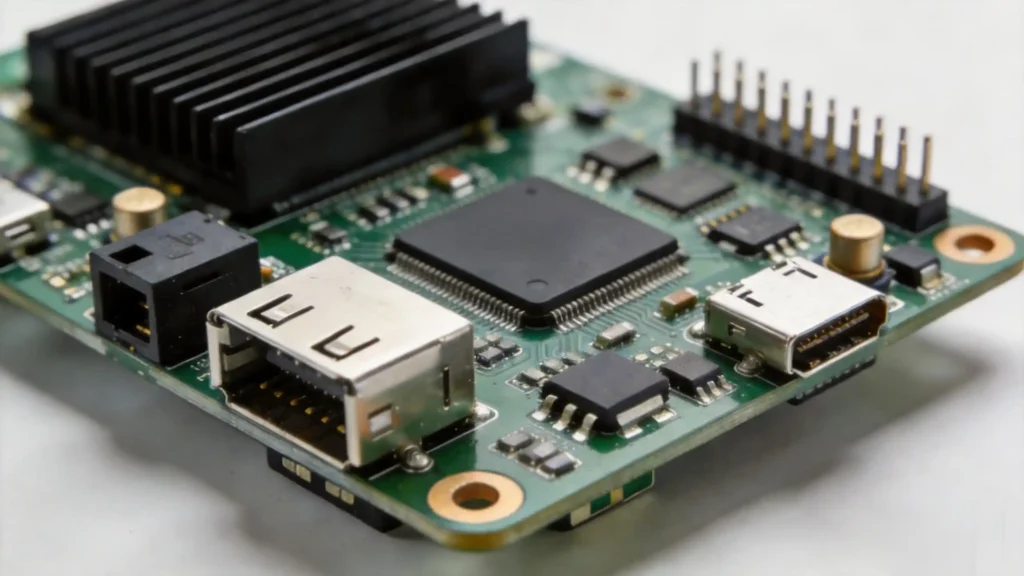
Marketing claims and real-world performance don’t always match. A few areas deserve direct verification rather than blind trust in a spec sheet. For a complete technical breakdown of what an Android head unit is and how it is built, read our guide on Android head units.
Processor (SoC)
- Processor (SoC): Core count and clock speed matter less than actual processing capability. Stick with established automotive-grade chipsets, and avoid outdated or “clone” processors that underperform in daily use.
RAM and ROM
- RAM and ROM: 4GB+ RAM supports smooth multitasking and navigation; 64GB+ ROM covers maps and app storage. Some suppliers inflate these numbers. They claim 4GB while shipping 2GB padded with “virtual” memory. So verify actual configuration rather than the number on the box.
Screen Quality
- Screen quality: Look for HD or 2K resolution, daylight-readable brightness, and an IPS panel for consistent viewing angles. Automotive-grade touchscreen durability matters over years of daily use, not just at unboxing.
GPS Module Sensitivity
- GPS module sensitivity: Multi-constellation support (GPS, GLONASS, BeiDou, Galileo) improves real-world accuracy. Ask suppliers for sensitivity test reports rather than taking spec sheets at face value.
Audio Processing
- Audio processing: A built-in DSP affects sound quality more than raw wattage numbers. Confirm audio output meets your target market’s expectations before ordering at volume.
Vehicle Compatibility & CAN Bus Matching Verification
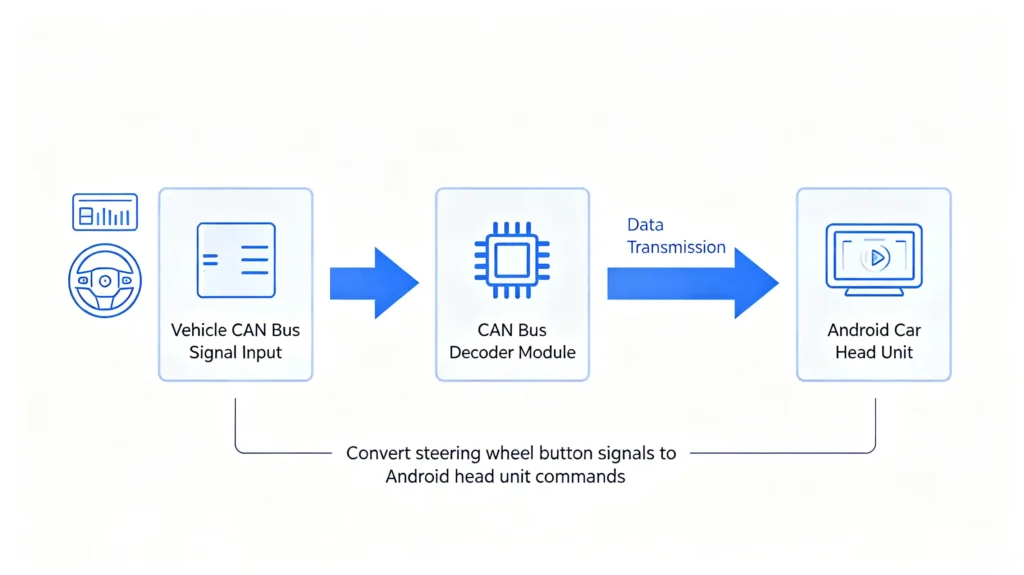
Poor vehicle-function adaptation is the single biggest cause of B2B after-sales headaches. It’s worth understanding this before you place an order.
A CAN bus decoder translates a vehicle’s own protocols into signals the head unit can read. Decoder quality determines which original functions survive that translation. This includes steering wheel controls, the reverse camera trigger, and climate display. It also covers door sensor status, parking sensor audio, and the vehicle speed signal. For a detailed comparison of how Android head units and factory stereos handle vehicle integration differently, read our guide: Android Head Unit vs Factory Car Stereo.
Before ordering, ask suppliers direct questions. Which vehicle models have you already matched? How large is your compatibility database? Can you adapt new models in-house, or do you depend on third parties?
There’s no such thing as a universal head unit that works perfectly with every vehicle. Full function retention requires a decoder matched to that specific model. For high-volume orders, share your target vehicle list with the supplier upfront. Test samples on actual vehicles before committing to bulk production.
Compliance & Certification Requirements for Different Markets
Certification requirements vary by destination market. Getting this wrong stalls shipments at customs rather than on the factory floor.
CE Certification
- CE certification — required for European market entry; covers electromagnetic compatibility and low-voltage safety
FCC Certification
- FCC certification — required for US market entry; covers radio frequency emissions and interference
RoHS Compliance
- RoHS compliance — restricts hazardous substances in electronics; required across the EU and many other regions
E-Mark (E-certification)
- E-Mark (E-certification) — an automotive-specific certification required in some markets, covering vehicle-mounted electronic equipment safety
ISO 9001
- ISO 9001 — a manufacturing quality management certification indicating standardized production processes
Always request current certification documents directly from suppliers. A product description claiming compliance isn’t the same as verified documentation.
Key Supplier Capabilities to Evaluate Beyond Product Specs
Product quality depends as much on the manufacturer behind it as on the component list itself.
R&D Capability
- R&D capability: In-house Android/Linux development and CAN bus protocol adaptation mean faster response to customization requests and compatibility issues. This is far faster than using suppliers without internal engineering teams.
QC Process
- QC process: A full inspection chain — IQC (incoming materials), IPQC (in-process patrol), FQC (function testing), and OQC (pre-shipment sampling) — paired with documented 48-hour aging tests and 60°C high-temperature testing.
Production Capacity
- Production capacity: Monthly output, assembly line count, and lead time for custom orders all determine whether a supplier can actually scale to your volume.
Customization Support
- Customization support: UI themes, boot animation, front panel logo, packaging, regional radio frequency, and language packages — the tools that let you differentiate your brand.
After-Sales Support
- After-sales support: Spare parts availability (touchscreens, motherboards, CAN bus boxes, wiring harnesses), technical support response time, and clear warranty terms. For a complete framework on evaluating the manufacturer behind the product — R&D capability, QC process, production capacity, and red flags — read our guide: How to Choose a Car Navigation System Supplier.
Common Quality Red Flags to Avoid in Android Head Unit Sourcing
Certain patterns show up repeatedly across the wholesale Android head unit market. Each one is worth checking for directly before committing to a bulk order.
Inflated Specifications
- Inflated specifications — suppliers advertising RAM/ROM figures that don’t match actual hardware. Request factory configuration details, or test a sample directly, rather than trusting the listing.
Poor CAN Bus Matching
- Poor CAN bus matching — units that work fine on a test vehicle but fail on a customer’s actual car, usually a sign of shallow decoder development. Ask for a specific vehicle model compatibility list.
Weak GPS Module Sensitivity
- Weak GPS module sensitivity — units that lose signal in urban canyons or tunnels, often the result of cost-cutting on the GNSS module. Request sensitivity test reports or run a real-condition sample test.
Substandard Displays
- Substandard displays — low brightness that’s unreadable in sunlight, poor viewing angles, or touchscreens that degrade within months. Confirm IPS panels and automotive-grade brightness ratings.
No Aging Test or Inadequate QC
- No aging test or inadequate QC — units that pass function testing on the line but fail after weeks of normal use. Verify the supplier actually runs 48-hour burn-in testing, not just final assembly checks.
Unrealistic Pricing
- Unrealistic pricing — prices well below market average usually mean cost-cutting on critical components, or a trading company reselling inventory of unverified origin.
FAQ
What is the standard MOQ for wholesale Android head unit orders?
MOQ varies by supplier and by how much customization is involved. Standard configurations generally support lower minimums than fully custom UI or hardware builds. Confirm MOQ flexibility directly with a manufacturer. Factory-direct suppliers typically offer more room to negotiate smaller trial orders than trading companies reselling fixed stock.
Can suppliers customize Android head unit UI and boot logos for branded clients?
Yes, suppliers with in-house software development can typically customize UI themes, boot animations, and front panel logos for branded orders. The depth of customization support depends on whether the supplier develops firmware internally or relies on a fixed third-party platform. Confirm this capability before finalizing a branding request.
What is the actual performance difference between 2GB, 4GB, and 6GB RAM for Android head units?
2GB RAM tends to struggle with multitasking. Running navigation and media simultaneously can cause lag. 4GB handles typical multitasking smoothly and is a reasonable baseline for most orders. 6GB adds headroom for heavier app use, but the practical difference between 4GB and 6GB is smaller than between 2GB and 4GB for most everyday use cases.
Do I need to provide target vehicle models to suppliers for CAN bus matching before ordering?
Yes, and doing this early avoids the most common source of after-sales complaints. Sharing your target vehicle list lets a supplier confirm existing decoder matches and flag any models needing new development. It also gives you a realistic lead time estimate, rather than discovering compatibility gaps after a bulk shipment arrives.
Can Android head units support both offline local maps and real-time online navigation?
Yes, most Android head units support both. Offline maps stored on the device work without a data connection. Apps like Google Maps or Waze provide real-time traffic and routing when connectivity is available. This dual capability is one of the practical advantages of native Android systems over portable GPS devices with map-only storage.
Conclusion
Choosing an Android head unit for bulk orders comes down to matching product and supplier to your business scenario. Then, verify — not assume — the specs, compatibility, certifications, and QC standards behind it. Buyers who avoid costly after-sales problems usually ask these questions before placing the order, not after.
Sourcing Android head units for your next order? Contact our team to discuss CAN bus compatibility for your target vehicles, or explore our current Android head unit product lineup.