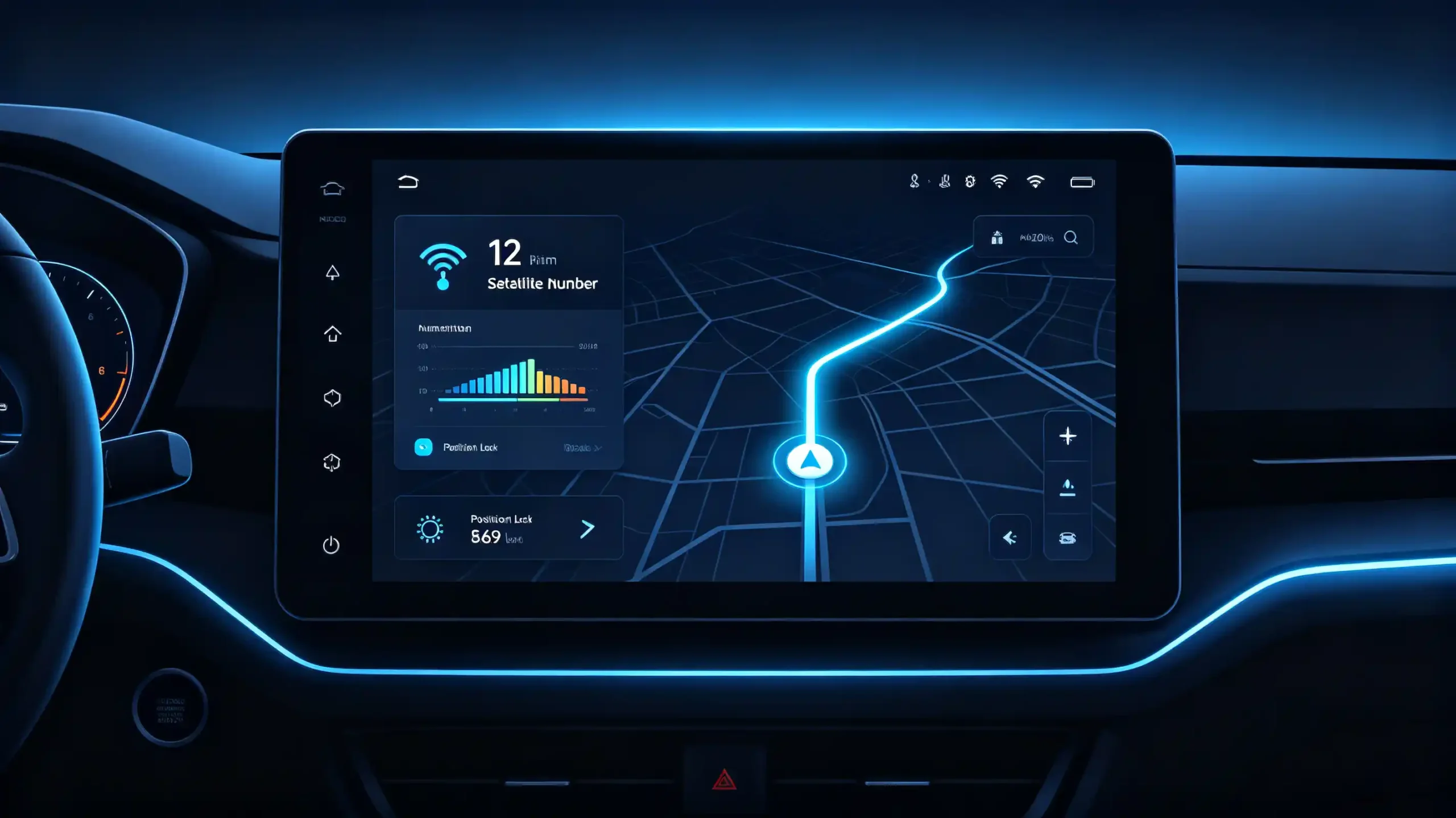
Voice guidance is easy to take for granted until it is not working properly. A prompt that fires too late. Gets buried under music. Mumbles the exit number nobody caught in time. For dealers, wholesalers, and automakers comparing navigation-equipped head units, voice guidance quality is one of those features that barely shows up on a spec sheet. But it generates a disproportionate share of customer complaints when it is poorly implemented.
This guide covers how voice guidance actually works. It also covers what to check before comparing suppliers.
Car Navigation Voice Guidance – Core Definition & Purpose
What Is Voice Guidance?
Voice guidance refers to spoken navigation instructions delivered through the vehicle’s audio system. It guides the driver without requiring them to look at the screen. Its core job is straightforward. Deliver turn-by-turn directions, distance announcements, and route updates through audio. The driver’s eyes stay on the road rather than on a map.
Three Categories of Value
The value this delivers falls into three categories. Safety comes first. Reducing the need to glance at a screen while driving cuts down on a meaningful source of distraction. Convenience follows closely. Drivers get guidance hands-free without adjusting the display. Accessibility matters too. Some drivers simply prefer or rely on audio instructions over visual ones.
Business Consequences of Poor Implementation
When voice guidance falls short, the business consequences show up quickly. Unclear prompts lead to missed turns and driver frustration. Poor audio mixing — prompts too quiet to hear or loud enough to startle — generates complaints on their own. Both patterns tend to translate directly into after-sales support calls. In worse cases, they lead to product returns. Voice guidance quality is not a minor detail. It is a real differentiator between navigation products that otherwise look similar on paper.
How GPS Voice Directions Are Generated and Delivered
A Coordinated Handoff
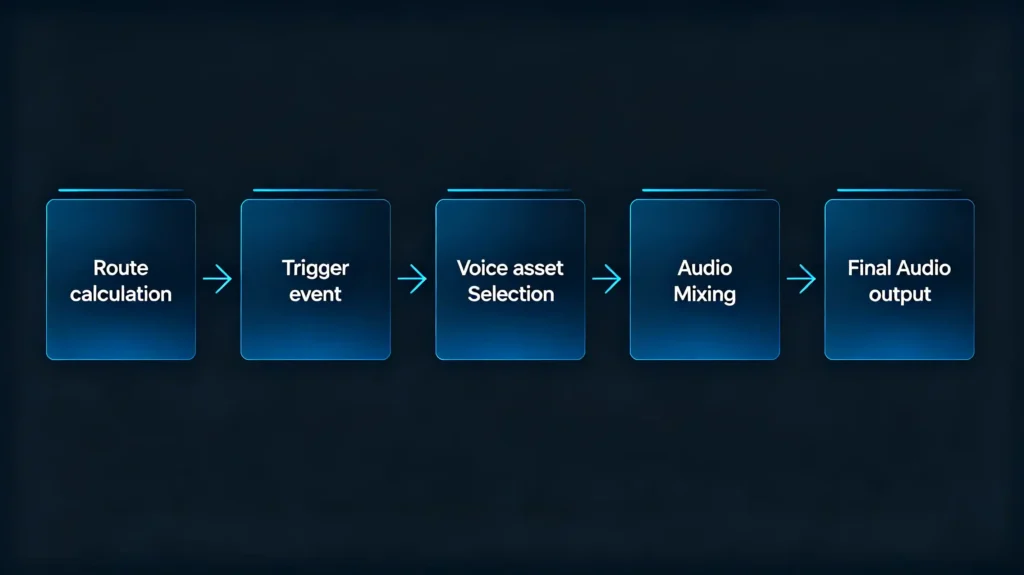
Getting a voice prompt from “nothing” to “audible in the cabin” involves a coordinated handoff between several system components.
The Sequence
- Route calculation — the navigation system calculates a route to the destination.
- Trigger point detection — as the vehicle approaches a maneuver, the system identifies that a voice prompt is needed.
- Voice prompt selection — the system selects the correct audio file or generates the phrase (for example, “In 500 meters, turn left”).
- Audio mixing — the prompt is blended with whatever else is playing — music, a call — using ducking logic to keep it audible.
- Audio output — the mixed signal is sent out to the vehicle’s speakers, through either the head unit’s internal amplifier or an external audio system.
Timing Matters
Timing matters throughout this sequence. Prompts are generally set to fire 500 to 1,000 meters before a maneuver. This gives the driver enough advance notice to react without feeling rushed. The full chain runs from navigation software through a voice engine, an audio processor, and an amplifier before reaching the speakers. The quality of each link in that chain, not just the navigation software itself, determines how clean and well-timed the final prompt actually sounds.
Turn-by-Turn Voice Prompts and Navigation Instruction Logic
More Than Simple Instructions
Voice guidance covers more ground than a simple “turn left.” A complete system handles several distinct instruction types. Each is triggered under specific conditions.
Types of Instructions
Direction commands cover the basics: turn left, turn right, continue straight, make a U-turn. Distance announcements give advance warning (“in 500 meters,” “in 200 meters”). Highway and exit guidance handles more complex maneuvers (“take exit 42,” “merge onto the highway”). Lane guidance goes a step further, specifying which lane to use ahead of a turn. Arrival announcements close out the trip, confirming the destination has been reached.
Timing Pattern
Timing generally follows a layered pattern. An initial prompt 500 to 1,000 meters before the maneuver. A reminder prompt around 200 to 300 meters out. A final prompt right at the maneuver point itself. These triggers are driven by the vehicle’s position, current speed, and remaining distance to the maneuver. This is also why a missed turn typically produces a recalculation prompt. It lets the driver know the system has adjusted course rather than leaving them without guidance.
What to Check
Buyers comparing systems should check that all of these instruction types are actually present. Some lower-cost implementations skip lane guidance or highway-specific phrasing entirely.
Voice Guidance Integration With the Vehicle Audio System
Coexisting With Other Audio
Voice prompts do not play in isolation. They have to coexist with whatever else is already coming through the speakers. How well that coexistence is handled says a lot about system quality.
Audio Ducking
Audio ducking is the core mechanism here. The system temporarily lowers music or media volume when a prompt plays. It then restores it afterward. Two details separate a good implementation from a rough one. Ducking depth — how much the volume actually drops. Ducking speed — whether that transition fades smoothly or cuts abruptly.
Mixing Logic
Mixing logic also has to establish priority between sources. Navigation prompts typically override music. An incoming call generally takes priority over a navigation prompt, not the other way around.
Routing Options
On the routing side, some systems mix audio internally within the head unit before sending a single combined signal to the speakers. Others route navigation audio through a separate channel to an external amplifier.
Speaker Configuration
Speaker configuration adds a final variable. Some systems play prompts through every speaker. Others limit them to the front speakers or, in some designs, a driver-only channel.
The Need for Deliberate Choices
None of these choices are inherently right or wrong. But they do need to be deliberate rather than accidental. A jarring or poorly balanced mix is one of the more common voice-guidance complaints buyers hear about after a product ships.

Factors Influencing Voice Guidance Volume, Clarity and Interruption Behaviour
Beyond Basic Ducking
Beyond the basic ducking mechanism, several finer details determine whether voice guidance actually sounds good in daily use.
Volume Control
On volume, independent control matters. Navigation volume ideally adjusts separately from music volume. Some more advanced systems adjust volume automatically based on vehicle speed to compensate for road noise. Ducking depth should be configurable rather than fixed. The right amount of volume reduction varies by user preference and cabin noise level.
Clarity
On clarity, prompt audio quality itself plays a role. High-bitrate voice files sound noticeably better than heavily compressed alternatives. Both audio processor quality and speaker quality downstream affect how intelligible the final prompt actually is. This holds regardless of how good the source audio was to begin with.
Interruption Behavior
Interruption behavior rounds out the picture. Ducking should transition smoothly rather than snapping the volume down and back up abruptly. Prompts should be able to override music without hesitation. An active call should still take priority over a navigation prompt. It should not get talked over by it. A prompt that gets cut off mid-sentence by another audio source is a small technical detail. It reads as a significant quality problem to the end user.
Multi-Market Language and Voice-Pack Options for Navigation Voice Guidance
Language Coverage Matters
For B2B buyers shipping into more than one region, language coverage is as important as the technical quality of the prompts themselves.
Common Languages
Common languages across this category include English, Spanish, French, German, Arabic, Russian, Thai, and Vietnamese, among others. Regional variants are often available — US, UK, or Australian English, for instance, or European versus Latin American Spanish.
Delivery Methods
On the technical side, voice guidance is delivered one of two ways. Text-to-speech (TTS) dynamically generates spoken phrases. It can handle virtually any text string. Pre-recorded voice packs use fixed audio files. They are limited to specific pre-written phrases but generally sound more natural as a result.
Licensing Costs
Some voice packs carry licensing costs. Depending on the supplier, bulk orders may or may not include that licensing as part of the base package. This is a detail worth confirming upfront rather than assuming.
Regional Accent Matching
Regional accent matching is also worth checking directly. A mismatched accent (British English for a North American product, for example) can read as a quality oversight. This happens even when the underlying navigation functionality is solid.
B2B Evaluation Considerations for Navigation Voice Guidance Capabilities
Evaluation Framework
Turning this into an evaluation framework for supplier comparison and sample testing.
- Prompt clarity — test voice prompts directly for clarity and natural-sounding delivery
- Ducking behaviour — verify music volume reduces smoothly during prompts, without abrupt cuts
- Volume control — confirm independent navigation volume adjustment, and speed-sensitive volume if claimed
- Timing accuracy — verify prompts fire within the expected 500–1,000 meter window before maneuvers
- Multi-language support — confirm coverage for target markets and test actual voice quality, not just a language list
- Instruction completeness — check for direction, distance, lane, highway, and arrival guidance, not just basic turns
- Integration quality — test audio routing and speaker configuration in a real installation
- Sample testing — evaluate voice guidance in a moving vehicle with music playing, not just on a static bench
FAQ
Is audio ducking (music volume attenuation for navigation prompts) controlled by hardware or navigation software?
It is primarily a software function. It is handled by the audio management layer within the head unit’s operating system rather than by dedicated hardware. That said, hardware quality still shapes the result. The audio processor and amplifier determine how cleanly the ducked and unducked signals actually sound. A well-designed software ducking algorithm can still be undercut by weak audio hardware. Both layers matter when evaluating real-world performance.
Can navigation voice guidance work fully offline without internet connection?
Yes, provided the navigation software, maps, and voice prompt data are stored locally on the device rather than streamed from a server. Pre-recorded voice packs are typically bundled with offline map data specifically to support this. Some text-to-speech implementations may rely on an online voice engine, which would require a connection. Buyers targeting markets with unreliable connectivity should confirm the voice guidance system works fully offline rather than assuming this by default.
Why may voice-prompt timing be delayed on some low-cost aftermarket navigation units?
Delayed timing usually traces back to weaker positioning hardware or underpowered processing. The system struggles to calculate trigger points quickly enough as the vehicle approaches a maneuver. A GPS module with a slow position update rate can also introduce lag between the vehicle’s actual location and what the navigation software thinks it is. This pushes prompts later than intended. This is a good example of how voice guidance quality depends on hardware well beyond the audio system itself.
Are multi-language navigation voice packs always included free of charge for bulk-order projects?
Not necessarily. Many suppliers include a standard language set at no extra cost. Some voice packs — particularly premium or licensed pre-recorded options — may carry additional fees depending on the supplier and the specific languages requested. It is worth clarifying language inclusion and any associated licensing costs directly in the quotation stage. Do not assume full coverage is automatically bundled.
Conclusion
Voice guidance quality is hard to judge from a spec sheet alone. It needs to be heard in a moving vehicle, with music playing, the way a real customer will experience it.