Not every signal traveling through a modern vehicle needs the bandwidth or robustness of a CAN network. Pretending otherwise is how sourcing teams end up overpaying for hardware that a simpler bus could have handled.
LIN bus in automotive infotainment covers exactly this gap. It is the low-cost, low-speed network that quietly runs steering wheel buttons, climate panels, and other peripherals. These peripherals do not need CAN’s overhead.
For dealers, wholesalers, importers, and automakers sourcing infotainment hardware, understanding where LIN fits matters. Understanding when it actually matters for compatibility helps avoid both over-speccing and under-speccing a product line.
This guide covers what LIN bus is. It covers where it sits in the vehicle network hierarchy. It covers how it operates at a structural level. It covers its real-world infotainment applications. It covers how it compares with CAN for sourcing purposes. It covers how it integrates with head unit hardware. It also covers what to check when evaluating suppliers for LIN compatibility. For a full view of all hardware decisions, see our car stereo hardware components overview.
What Is LIN Bus in Automotive Systems?
Definition
LIN, short for Local Interconnect Network, is a low-cost, low-speed serial communication bus. It is used to connect simpler vehicle subsystems. These subsystems do not need the bandwidth or redundancy of a full CAN network. It is standardized under ISO 17987. That standard defines the protocol’s physical layer and communication behavior across the automotive industry.
How LIN Complements CAN
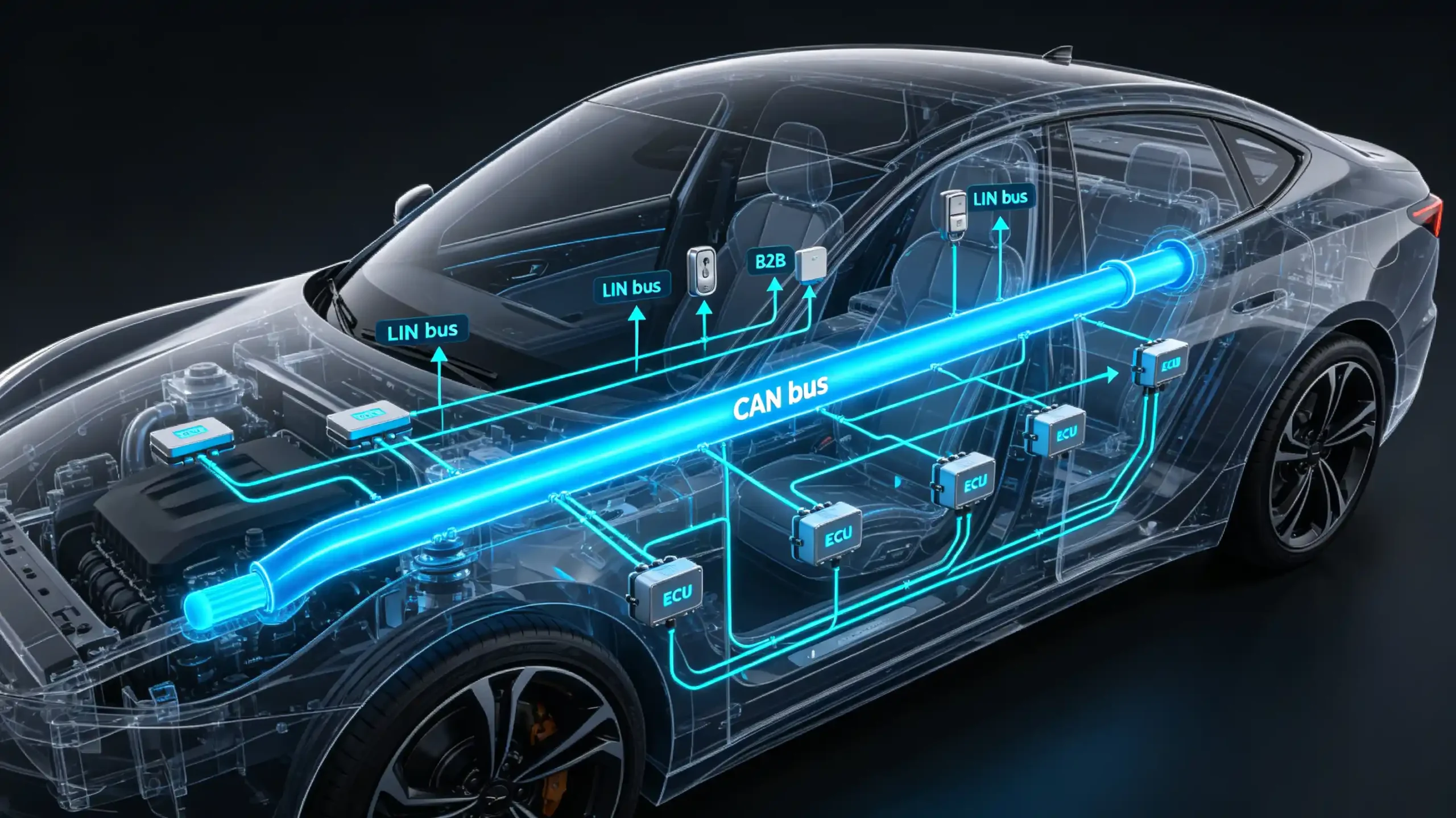
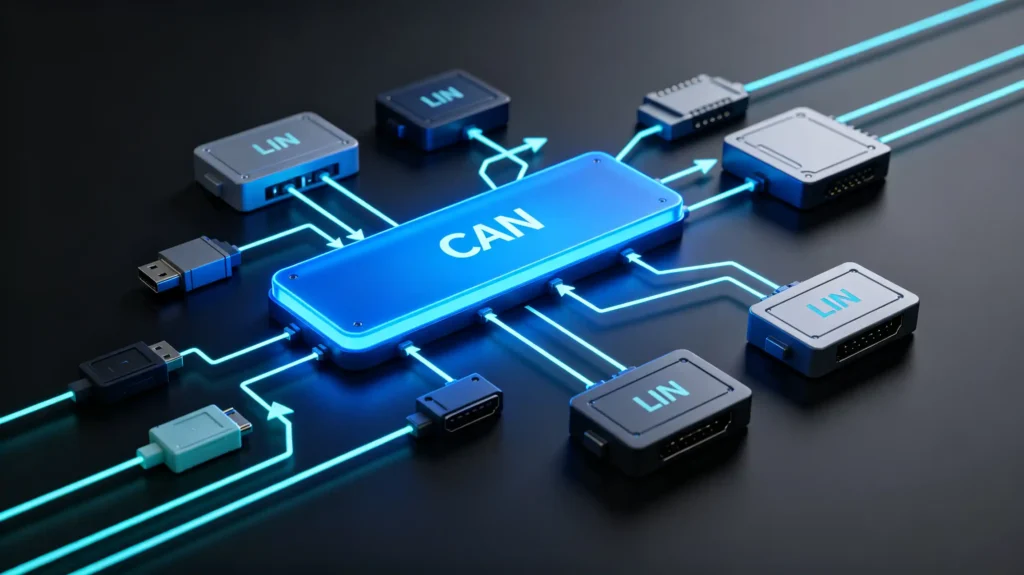
Within a vehicle’s communication architecture, LIN does not replace CAN. It complements it. CAN typically serves as the backbone network. It handles higher-priority, higher-bandwidth communication across critical systems. LIN operates at the edges. It connects simpler, non-critical peripherals where a full CAN node would be unnecessarily expensive.
The Infotainment Hierarchy
In infotainment specifically, this hierarchy shows up in a fairly consistent pattern.
- CAN carries backbone communication between the head unit and core vehicle systems
- LIN handles smaller, cost-sensitive peripherals connected to or near the infotainment system
- The two networks often coexist within the same vehicle, each doing the job it is suited for. For foundational context on CAN Bus, see our what is CAN BUS guide.
What This Means for B2B Buyers
For B2B buyers, the practical implication is straightforward. Not every infotainment-adjacent component needs CAN-level capability. Understanding which peripherals typically run on LIN helps set realistic compatibility expectations during sourcing. Do not assume every connection point requires the same protocol.
Core Principles and Physical Structure of LIN Communication
Master-Slave Architecture
LIN networks follow a master-slave architecture. A single master node manages communication. Multiple slave nodes respond to it. This is a meaningful structural difference from CAN. CAN supports multi-master communication where any node can initiate a message.
Single-Wire Bus
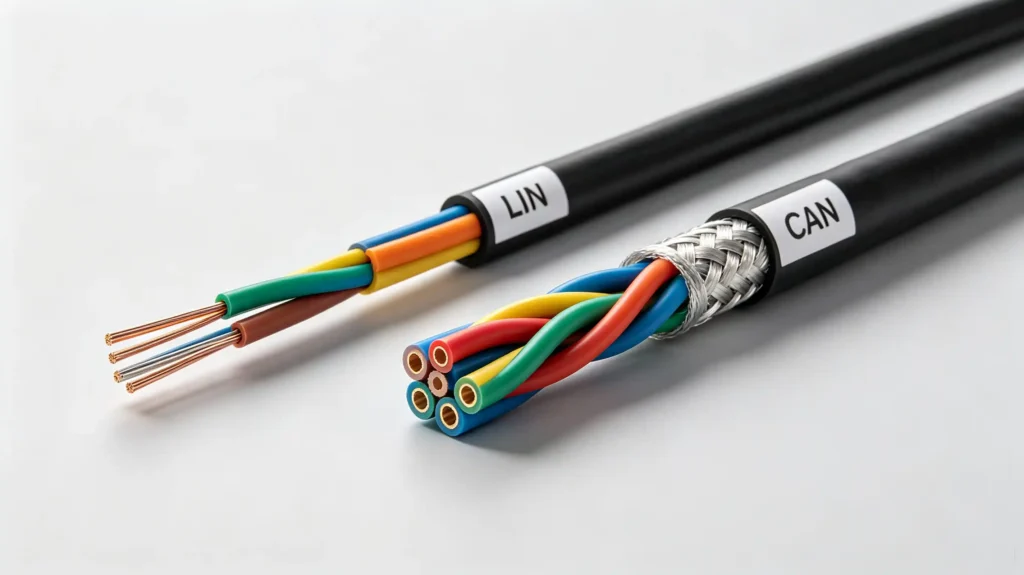
Physically, LIN runs on a single-wire bus, typically at 12V. It does not use the differential signal pair CAN uses. That single-wire design is a large part of what keeps LIN hardware inexpensive. Fewer wires. Simpler transceivers. Lower overall implementation cost.
The Trade-Off
The trade-off is speed and robustness. LIN tops out around 20 kbps, a fraction of CAN’s throughput. That is more than adequate for the kind of simple, infrequent messages LIN peripherals typically send.
LIN Frame Structure
At a conceptual level, a LIN frame consists of several parts. A header, sent by the master to identify which slave should respond. A response from that slave carrying the actual data. A checksum for basic error detection. This structure does not require deep protocol-level knowledge to source hardware correctly. But it is useful context for understanding why LIN behaves differently from CAN in practice.
Core Components
A typical LIN network includes a handful of core components. A LIN transceiver at each node. A master controller, often part of the infotainment system or a body control module. Slave nodes — sensors, actuators, or switches — that respond to the master’s requests.
Deterministic Scheduling
Because LIN scheduling is deterministic and time-triggered, communication timing stays predictable. This suits its role controlling simple, non-urgent functions rather than time-critical data.
Real-World LIN Bus Applications for Automotive Infotainment
Common Examples
LIN’s practical use cases in infotainment tend to cluster around peripherals. These peripherals need simple, reliable control signals rather than high-bandwidth data transfer. Common examples include steering wheel button clusters (volume, track skip, call answer), ambient lighting modules, and small secondary display panels that do not need to render complex graphics. Climate control interface panels frequently run on LIN as well. Seat-position memory switches also use LIN. They communicate infrequent, simple state changes back to the vehicle’s electronics.
Head Unit Connections
Head units also connect to LIN for certain non-critical control signals. An external button pod mounted elsewhere in the cabin, for instance, is a typical LIN-connected accessory rather than a CAN-connected one.
The Consistent Pattern
Across OEM and ODM integration work, this pattern shows up consistently. LIN gets used precisely in the places where CAN would be cost-prohibitive relative to the simplicity of the function being controlled. For a detailed comparison, see our CAN Bus explained guide.
Where LIN Does Not Belong
It is worth being clear about the boundary here. LIN is built for low-bandwidth control signals. It is not for audio or video streaming. It is not for anything requiring real-time responsiveness at scale. Any infotainment function involving actual media data — navigation, audio playback, camera feeds — runs on entirely different infrastructure. LIN’s role stays confined to the simpler, physical-control side of the system.
LIN Bus vs CAN Bus: Key Comparisons for Infotainment Hardware Sourcing
Comparison Table
For sourcing decisions, the practical differences between LIN and CAN come down to speed, topology, cost, and where each one actually belongs in the system.
| Factor | LIN Bus | CAN Bus |
|---|---|---|
| Speed | Up to ~20 kbps | Up to 1 Mbps (higher with CAN FD) |
| Topology | Single-wire, master-slave | Differential pair, multi-master |
| Cost | Lower — simpler transceivers, fewer wires | Higher — more robust hardware required |
| Best fit | Non-critical peripherals, simple switches | Backbone communication, safety-relevant and infotainment-core systems |
CAN’s Role
CAN’s higher speed and multi-master topology make it the right choice for backbone communication. This is the kind of data exchange where reliability and bandwidth genuinely matter. It includes much of the traffic between a head unit and core vehicle systems.
LIN’s Role
LIN’s lower cost and simpler structure make it the more sensible choice for peripherals. CAN’s overhead would be unjustified relative to the simplicity of the signal involved.
The Sourcing Rule of Thumb
For B2B sourcing, this translates into a fairly direct rule of thumb. CAN support should be treated as mandatory for infotainment hardware given its role in vehicle data communication. LIN support becomes relevant specifically when a project involves peripherals — steering wheel buttons, ambient lighting, climate panels — that are commonly LIN-controlled on the target vehicle platform. Requiring LIN compatibility across the board, regardless of the actual peripheral mix in a project, adds cost without a corresponding benefit.
How LIN Bus Integrates With Vehicle Infotainment Systems
Hardware Integration
On the hardware side, integration starts with a LIN transceiver at the head unit. It is wired into the vehicle’s LIN bus alongside whatever peripherals it needs to communicate with.
Master or Slave
Depending on the system architecture, the head unit may act as the LIN master. It issues requests to slave nodes like button clusters or climate panels. Or it may sit as a slave itself within a larger network managed by a different controller.
Gateway Function
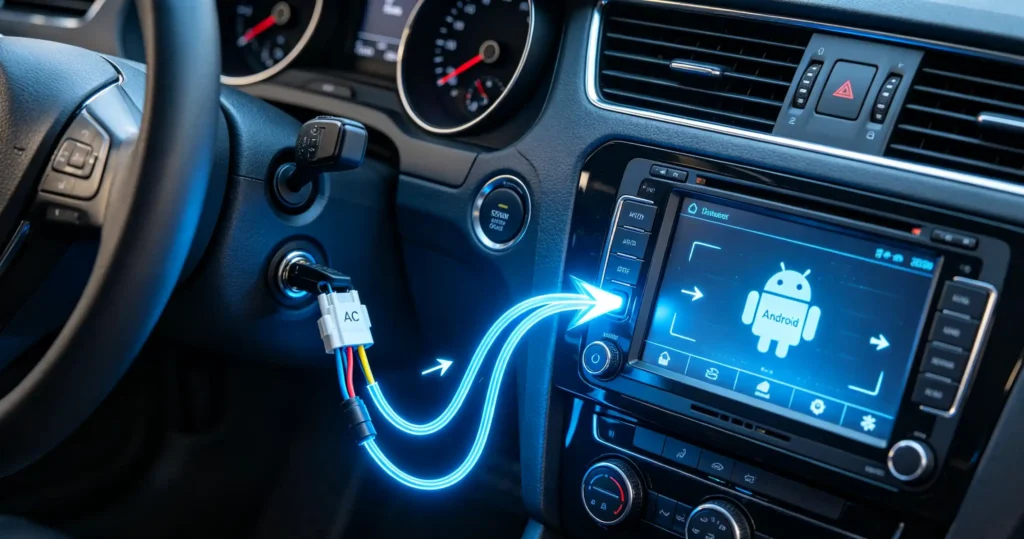
Either way, the head unit frequently functions as a gateway. It translates LIN-level signals into commands the internal infotainment software can act on. A button press on a LIN-connected control pod becomes a volume change or a track skip inside the IVI interface.
The Integration Workflow
The integration workflow itself generally follows three steps. Identifying the vehicle’s specific communication protocol and pin layout. Matching a LIN transceiver to that specification. Adapting the head unit’s firmware to correctly interpret and respond to the vehicle’s particular LIN implementation.
Why Firmware Matters
This last step matters more than it might seem. LIN implementations vary enough across vehicle platforms that firmware tuned for one setup will not necessarily work cleanly on another without adjustment. For more on steering wheel controls, see our steering wheel control integration guide.
B2B LIN Bus Compatibility Considerations for Sourcing Infotainment Hardware
Sourcing Checklist
Turning this into a sourcing checklist, here is what is worth verifying before committing to a supplier for a LIN-relevant project.
- RFQ documentation — request clear LIN transceiver specifications, pin-definition documentation, and the specific LIN protocol version supported
- Sample validation — test actual LIN-controlled peripheral function (steering wheel buttons, climate panel response) on samples before mass ordering
- Supplier LIN adaptation capability — confirm the supplier’s experience adapting LIN protocol implementations and, where relevant, managing CAN/LIN coexistence within the same platform
- Firmware configurability — check whether LIN-handling firmware can be adjusted for vehicle-specific implementation differences
- Vehicle-model variation — LIN requirements differ meaningfully across makes and models, so validation should happen against the specific target vehicle rather than a generic assumption
Documentation Rigor
Clear, accurate pin-definition documentation in the product BOM is the kind of practice that quality-focused suppliers treat as standard. It is consistent with the documentation rigor expected under frameworks like IATF 16949 for automotive component traceability. Given how much LIN implementation varies by vehicle platform, buyers running multi-model or multi-brand projects should build vehicle-specific LIN validation into their sourcing process. Do not treat one successful test as proof of broader compatibility.
FAQ
Does every automotive infotainment head unit require LIN bus support?
No. LIN support is only relevant when a project involves peripherals commonly connected through LIN on the target vehicle. Steering wheel button clusters, ambient lighting modules, or climate control panels are examples. A head unit that only needs to communicate over CAN, without any LIN-connected peripherals in the vehicle configuration, does not need LIN capability at all. Requiring it universally adds cost without a corresponding benefit for projects that do not actually use LIN-controlled accessories.
What risks arise if a replacement infotainment unit lacks correct LIN-bus compatibility?
Peripherals that depend on LIN communication may fail to respond, respond incorrectly, or not integrate with the head unit at all. These include steering wheel controls, climate interface panels, and ambient lighting. In practice, this shows up as a customer complaint that a specific button or panel “stopped working” after a head unit replacement. This happens even though the core infotainment functions operate normally. Confirming LIN compatibility for the target vehicle’s specific peripheral set before replacement avoids this gap.
Can LIN bus hardware work alongside existing CAN-based infotainment networks?
Yes. This is actually the standard configuration in most modern vehicles. LIN and CAN are designed to coexist. CAN handles backbone communication. LIN manages simpler peripheral connections at the network’s edges. A head unit built for real-world vehicle integration typically needs both a CAN interface and, where relevant, LIN transceiver support. Do not treat the two as mutually exclusive options.
What key specifications should wholesalers verify for LIN-ready infotainment hardware?
Confirm the specific LIN protocol version supported. Request documented pin definitions for the LIN interface. Verify which peripherals the hardware has actually been tested against rather than a general compatibility claim. It is also worth asking about the supplier’s experience with CAN/LIN coexistence on the specific vehicle platforms in question. Managing both networks correctly on the same hardware is a real differentiator between suppliers.
Conclusion
LIN bus compatibility is easy to overlook next to headline specs like processor or display quality. But it directly affects whether steering wheel controls, climate panels, and other peripherals work correctly after a head unit is installed.