When sourcing car stereos for bulk distribution, getting the physical dimensions right isn’t just about making the unit look good in the dash — it’s about preventing costly installation returns, avoiding compatibility-related after-sales issues, and ensuring your product line aligns with what your customers actually need. For B2B buyers in the automotive electronics space, understanding the DIN standard is foundational knowledge that directly impacts procurement decisions.
This guide breaks down everything you need to know about the Double DIN specification: what it is, why it matters for Android head units, and how to make smart sourcing decisions that minimize risk and maximize commercial value.
What is Double DIN? Core Definition & Industry Standard Size
The term “Double DIN” refers to a standardized size for car stereo head units that is twice the height of a Single DIN unit. The “DIN” stands for Deutsches Institut für Normung (the German Institute for Standardization), which originally established the standard. In 1984, this standard was adopted internationally as ISO 7736.
Standard Dimensions According to ISO 7736:
| Specification | Single DIN | Double DIN |
|---|---|---|
| Width | 178mm (approx. 7 inches) | 178mm (approx. 7 inches) |
| Height | 50mm (approx. 2 inches) | 100mm (approx. 4 inches) |
| Depth | Not standardized | Not standardized |
The key takeaway: width is identical across both standards. The only dimensional difference is the height — Double DIN is simply double the height of Single DIN.
For a complete technical overview of what an Android head unit is and how it is built, see our guide on Android head units.
Why the Standard Matters for B2B Sourcing
For bulk procurement, the ISO 7736 standard is important because it ensures interoperability across vehicle brands. When a head unit complies with Double DIN specifications, it should physically fit into any vehicle dashboard designed to accept that size. This universality reduces the complexity of inventory management — a Double DIN Android head unit from your inventory can be installed across a wide range of vehicles without requiring vehicle-specific chassis modifications (though mounting kits and wiring harnesses still vary).
Double DIN vs Single DIN: Key Differences & Full Comparison
For B2B buyers, choosing between Single DIN and Double DIN is rarely a matter of personal preference — it’s a business decision driven by target vehicle segments, market demand, and product capability requirements.
Side-by-Side Comparison
| Feature | Single DIN | Double DIN |
|---|---|---|
| Dimensions | 178mm × 50mm (7″ × 2″) | 178mm × 100mm (7″ × 4″) |
| Screen Capability | Typically 3–6 inches (floating screens can exceed this) | 7–10.1 inches standard |
| Typical Features | Basic audio, limited multimedia | Full navigation, smartphone projection, advanced audio controls |
| Common Vehicles | Older vehicles (pre-2000), compact cars | Most modern vehicles, 2000+ models |
| Price Range | Lower cost | Higher cost, higher margin potential |
| Best Use Case | Entry-level replacements, older fleets | 4S dealership upgrades, retail aftermarket, modern fleets |
Functional Implications of the Size Difference
The extra 50mm of height in a Double DIN chassis provides space for components that are difficult to fit into a Single DIN unit: larger screens, more powerful processors, better heat dissipation, and CAN Bus integration modules.
However, the line is blurring. Some manufacturers now offer Single DIN units with large “floating” screens that extend beyond the chassis, allowing modern smartphone projection features even in vehicles with limited dashboard space. For most B2B scenarios, though, Double DIN remains the dominant specification for feature-rich Android head units.
Double DIN Head Unit: Compatible Screen Sizes & Core Product Forms
A common misconception among buyers is that the Double DIN chassis limits the screen to exactly 7 inches wide and 4 inches tall. In reality, the screen size can significantly exceed the chassis dimensions through clever design approaches.
Standard Screen Sizes Compatible with Double DIN
Most Double DIN Android head units are available in the following screen sizes:
- 7-inch: The most compact option, fitting flush within the standard Double DIN faceplate area
- 8-inch: Often uses a slightly larger display with minimal bezel
- 9-inch: Very common in aftermarket units; may extend slightly beyond the chassis
- 10.1-inch: Typically requires a floating screen design to accommodate the larger display
For a detailed comparison of 9-inch versus 10.1-inch screens, including resolution, PPI, and market positioning, read our guide on Android head unit display sizes.
Three Product Forms for Double DIN Android Head Units
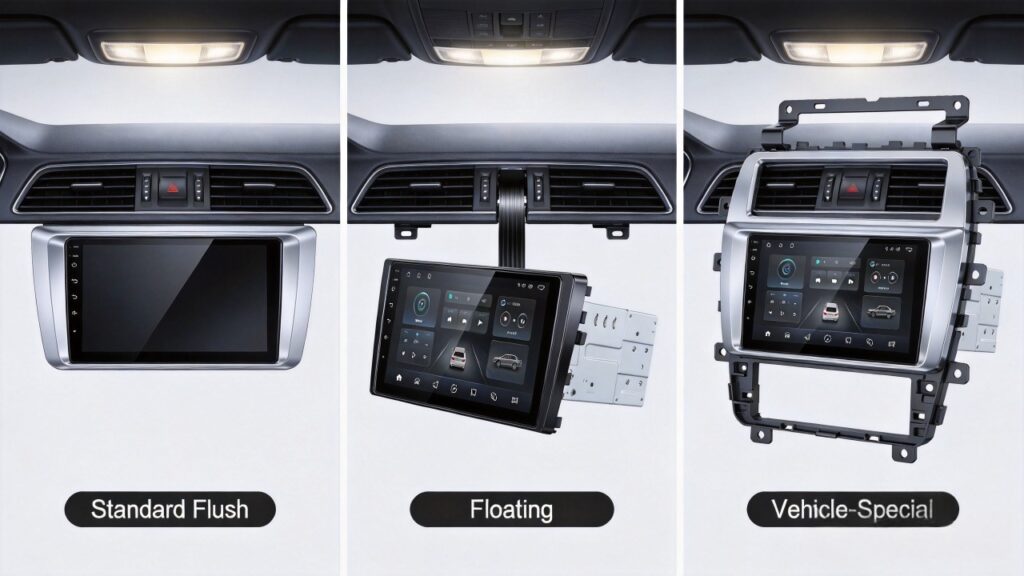
1. Standard Flush-Mount Double DIN
The screen sits within the Double DIN faceplate dimensions (178mm × 100mm). This offers a clean, factory-like appearance and is the easiest to install in vehicles with a standard Double DIN dash opening.
2. Floating Screen Double DIN
The chassis is Double DIN size, but the screen extends outward on a stand, allowing displays of 9 inches or larger while still fitting the standard dash opening. This design is increasingly popular for Android head units because it provides a larger visual experience without requiring dashboard modifications.
3. Vehicle-Specific Double DIN
The chassis is Double DIN compliant, but the unit includes custom trim kits and mounting brackets designed to match a specific vehicle’s dashboard. This eliminates gaps and provides an OEM-grade appearance.
Commercial Consideration for Screen Size Selection
Screen size directly impacts retail pricing. Larger screens command premium retail prices and higher margins for dealers and wholesalers. For cross-border wholesale buyers, 9-inch and 10.1-inch Double DIN Android head units are the most popular choices in mature markets.
Double DIN & Android Head Units: Compatibility & Business Value
Double DIN has become the de facto standard for Android head units in the aftermarket because of the physical space requirements of modern infotainment hardware.
Why Double DIN is the Preferred Form Factor
An Android head unit needs space for:
- A processor board and memory modules
- A screen with touch controller
- CAN Bus decoder for vehicle integration
- Wiring harness connectors
- GPS and Wi-Fi/Bluetooth modules
- Heat dissipation components
A Single DIN chassis simply does not have enough internal volume to accommodate all these components while maintaining reliable thermal performance. This is why approximately 80% of aftermarket Android head units sold in mature markets are Double DIN form factors.
Commercial Value for B2B Buyers
From a business perspective, Double DIN Android head units offer several advantages:
- Higher retail prices: Larger screens justify premium pricing compared to basic Single DIN units
- Broader market appeal: Double DIN is the expected specification for modern vehicle upgrades; customers generally see it as the “standard”
- Stronger feature differentiation: More space allows for more hardware features that can differentiate your product line
- Lower installation friction: Standardized size reduces the need for extensive custom fitment work
How to Choose Between Double DIN & Single DIN for Your B2B Business
Your target market and customer profile should drive the DIN size decision. Here is a scenario-based guide for different business models:
Scenario 1: 4S Dealership Retail Upgrades
Recommendation: Double DIN — Most customers expect a large touchscreen experience. Single DIN is considered outdated for vehicle upgrades in this channel. Double DIN Android head units with 9-inch or 10.1-inch screens generate the highest customer satisfaction and profit margins.
Scenario 2: Cross-Border Wholesale — Mature Markets (EU, North America)
Recommendation: Double DIN — Dominant product category. Demand for Single DIN is niche (primarily for very old vehicles). Prioritize Double DIN with 9-inch and 10.1-inch screen options.
Scenario 3: Cross-Border Wholesale — Emerging Markets (Southeast Asia, Middle East, South America)
Recommendation: Double DIN with Single DIN as a supplement — Double DIN is the growth segment, but Single DIN still has demand for entry-level replacements and older vehicle fleets. A balanced inventory covering both sizes can maximize market coverage.
Scenario 4: Fleet and Commercial Operators
Recommendation: Double DIN for multimedia-equipped vehicles; Single DIN for basic fleets — If the fleet requires navigation and smartphone projection, Double DIN is the better choice. For basic audio-only requirements, Single DIN provides a cost-effective option.
Scenario 5: Older Vehicle Models (pre-2000)
Recommendation: Verify compatibility — Many pre-2000 vehicles have Single DIN dash openings. Installing a Double DIN unit may require dashboard modification or an adapter kit, which adds cost and installation complexity. For a complete framework on matching head unit specs to your business scenario — including 4S dealerships, cross-border wholesale, fleet operators, and OEM projects — read our guide: How to Choose an Android Head Unit for Your Vehicle.
Common DIN Size Sourcing Risks & Installation Red Flags
For B2B buyers, the most common after-sales issues related to DIN sizing are preventable with proper verification. Here are the red flags to watch for:
Red Flag 1: “Double DIN” Labeling Without Standard Dimensions
Some suppliers advertise “Double DIN” but deviate from the ISO 7736 standard dimensions. Always verify physical dimensions (178mm × 100mm) before bulk ordering. A unit that is even a few millimeters off will not fit standard dash openings.
Red Flag 2: Depth Clearance Issues
The ISO 7736 standard does not specify depth. Some Double DIN units are deeper than others and may not fit vehicles with shallow dash spaces (common in some Japanese and American models). Request depth specifications and verify against target vehicle models.
Red Flag 3: Vehicle-Specific Fitment Requirements
Even with a compliant Double DIN chassis, many vehicles require specific mounting brackets or trim kits. Some manufacturers include these; others do not. Verify before ordering to avoid shipments that cannot be installed without additional parts.
Red Flag 4: Dashboard Modification Assumptions
Some vehicles originally equipped with Single DIN require dashboard cutting to fit Double DIN. This is a significant installation barrier that can cause customer dissatisfaction. Always confirm the original DIN size of target vehicle models.
Sourcing Best Practices
- Request sample units: Test fit in representative vehicle models before placing bulk orders
- Ask for vehicle fitment lists: Reputable suppliers can provide compatibility lists
- Verify depth clearance: Particularly for vehicles with tight dashboard spaces
FAQ
Q1: What is the exact standard size of a Double DIN car stereo according to international specifications?
ISO 7736 defines the Double DIN standard as 178mm width × 100mm height (approximately 7 inches × 4 inches). The depth is not standardized, which is why depth clearance must be verified separately for each vehicle model.
Q2: Can a Double DIN head unit be installed in a vehicle originally equipped with a Single DIN factory stereo?
Sometimes, but not always. Installation requires either a dash conversion kit or physical modification of the dashboard opening. Some vehicles have a Double DIN-sized opening behind a Single DIN bezel; others require cutting. Always verify compatibility before ordering.
Q3: What is the most common screen size for Double DIN Android head units in cross-border bulk wholesale?
9-inch and 10.1-inch floating screen configurations are the most popular in mature markets. 7-inch flush-mount units remain common for applications where a cleaner, more factory-like appearance is desired.
Q4: How to verify if a car stereo’s DIN size matches the target vehicle’s central control opening before bulk ordering?
Request the supplier’s dimensional drawings or measure a sample unit. Compare these dimensions against the vehicle’s dashboard opening specifications. Also ask the supplier for their vehicle compatibility list and check depth clearance specifically.
Q5: Do Double DIN and Single DIN car stereos have different wiring and power supply requirements?
The DIN standard only covers physical dimensions, not electrical specifications. Both Single DIN and Double DIN units typically use the ISO 10487 standard for power and speaker connections. However, Double DIN Android head units may require additional wiring for GPS antennas, CAN Bus connections, and other peripherals.