A head unit’s spec sheet often name-drops a premium DAC chip. It does so as though that alone settles the audio quality question. It does not. Two units built around the identical DAC part number can sound noticeably different once installed. The chip is only one link in a longer chain. For dealers and wholesalers sourcing audio-focused head units, understanding what a DAC actually does — and what it does not — prevents overpaying for a spec that a weak surrounding circuit design ends up undermining anyway. EQ and DAC quality work together in the audio chain. See our car stereo equalizer guide for detailed guidance.
This guide covers car stereo audio DAC. It covers what a DAC actually does. It covers how it fits into the audio chain. It also covers what to check before committing to a supplier.
Car Stereo Audio DAC – Core Definition
What Is a DAC?
A DAC (Digital-to-Analog Converter) is the hardware component that converts digital audio data into analog audio signal. It handles audio from streaming, USB, Bluetooth, or stored files. The analog signal gets amplified and played through speakers. Its core function is straightforward in concept. It takes digital audio represented as 0s and 1s. It turns it into a continuous analog voltage waveform. Speakers can actually reproduce this as sound.
Why DAC Quality Matters
DAC quality matters because a low-grade converter introduces noise, distortion, and generally poor sound quality right at the source. This happens before amplification even happens. Problems downstream components cannot fully undo.
The B2B Risk
This creates a real B2B risk worth being aware of. Poor DAC-related audio quality generates customer complaints and returns. Marketing claims about a specific DAC chip do not always translate into real-world performance. Actual DAC output quality depends heavily on the circuit design surrounding the chip. It is not the chip’s datasheet numbers alone. Buyers who treat “DAC chip model” as a complete quality indicator are working from an incomplete picture.
Digital-to-Analog Conversion Process for Car-Stereo Audio
The Conversion Workflow
Understanding the conversion workflow at a high level helps buyers see exactly where DAC quality enters the picture. It also shows where it does not.
Step 1: Digital Audio Input
The head unit receives digital audio data from a source. This could be USB, Bluetooth, a streaming app, or a storage device.
Step 2: Digital Audio Processing (Optional)
A DSP (digital signal processor) may apply equalization, crossover settings, or time alignment to the digital signal before it reaches the DAC.
Step 3: DAC Conversion
The DAC chip converts that digital audio data into an analog audio signal.
Step 4: Analog Output
The resulting analog signal passes to an amplifier. This could be the head unit’s internal amplifier or an external one. From there it goes to the speakers.
The Full Path
The full path runs: digital audio source → optional DSP → DAC → amplifier → speakers. The core concept worth holding onto is that the DAC serves as the bridge between the digital and analog worlds. Everything before it is digital data manipulation. Everything after it is analog signal handling. Whatever quality the DAC establishes at that conversion point becomes the ceiling for everything downstream. This is exactly why its role, while narrow, carries real weight.
DAC’s Position and Role Within the Full Car-Audio Signal-Processing Chain
A Precise Role
It helps to be precise about what a DAC actually does. The term sometimes gets used loosely to describe an entire audio subsystem. It refers to one specific component.
The Full Signal Chain
The full signal chain runs: digital source → DSP → DAC → analog processing → amplifier → speakers.
What the DAC Does
Within that chain, the DAC’s job is limited to two things. Converting digital audio into analog audio. In doing so, establishing the initial quality of that analog signal.
What the DAC Does Not Do
What it does not do is just as important to understand. It does not process audio — equalization, crossover filtering, and time alignment are DSP functions. They happen before the DAC receives the signal. It does not amplify anything — that is the amplifier’s job, happening after the DAC’s output. It does not work in the reverse direction either. Converting analog signals back to digital is a separate component, an ADC, entirely.
Interaction with Other Components
In terms of interaction, the DAC receives already-processed digital audio from the DSP. It sends its analog output onward — either to an internal amplifier or out through RCA pre-outs to an external one. Because everything downstream builds on what the DAC produces, its output quality effectively sets the foundation the rest of the signal chain has to work with.
DAC-Related Specifications and Their Relationship to Automotive Audio Quality
Key Published Specs
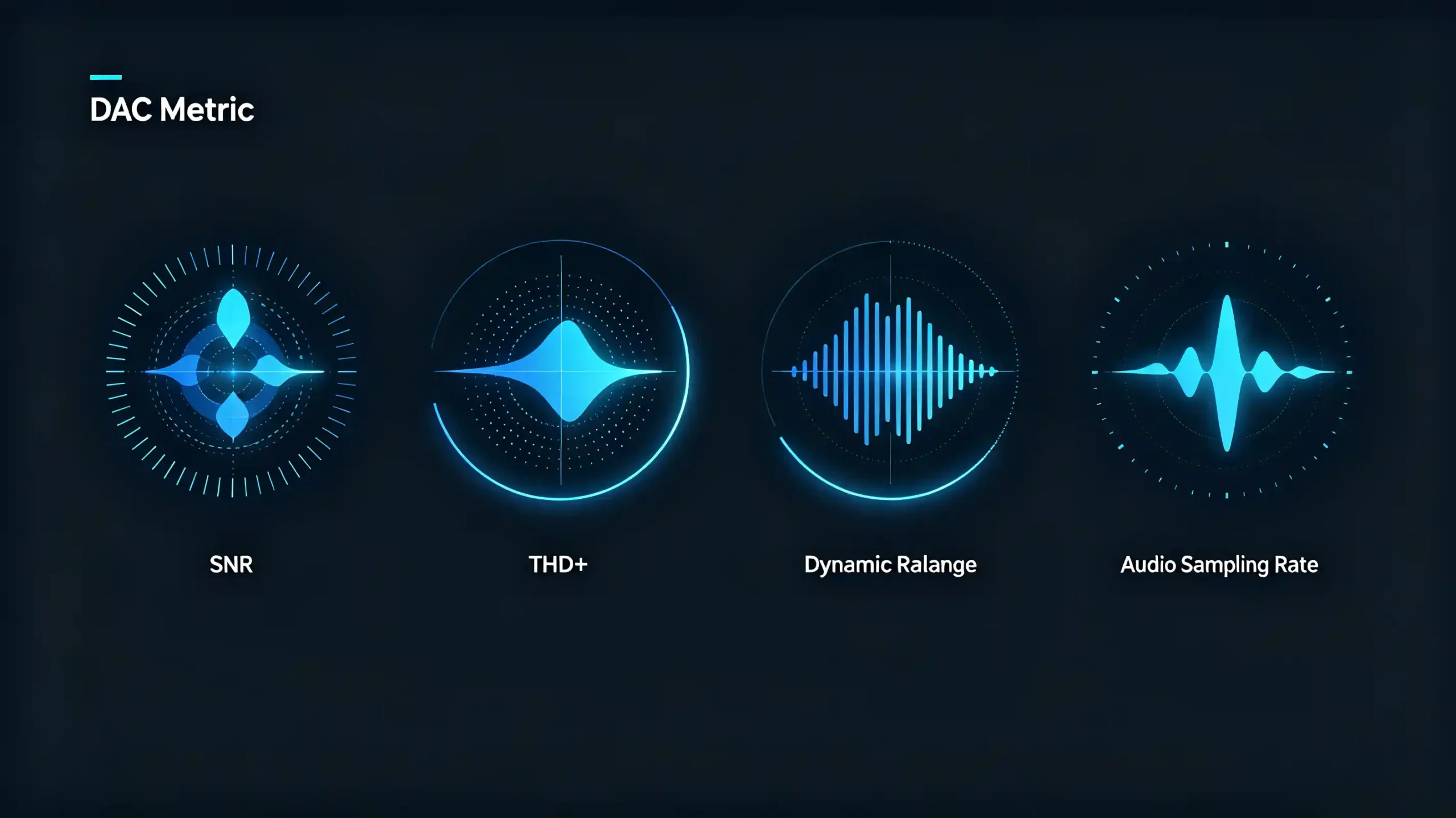
A handful of published specs describe DAC performance. Knowing what they measure — and their real-world limits — helps buyers read a datasheet more critically.
Signal-to-Noise Ratio (SNR)
SNR measures how much louder the actual signal is compared to background noise. Higher figures are better. Above 100dB is generally considered a strong result.
Total Harmonic Distortion plus Noise (THD+N)
THD+N measures unwanted distortion added to the signal. Lower is better. Figures under 0.01% are considered good.
Dynamic Range
Dynamic range describes the gap between the quietest and loudest sounds the DAC can reproduce accurately. A wider range is preferable.
Sampling Rate and Bit Depth
Sampling rate support, typically ranging from 44.1kHz up to 192kHz, determines compatibility with higher-resolution audio formats. Bit depth support — 16-bit, 24-bit, or 32-bit — affects the resolution of the amplitude data itself.
The Important Caveat
The important caveat is this: a high-spec DAC chip on paper does not guarantee good real-world sound. Datasheet figures are measured under ideal, controlled lab conditions. A production head unit rarely replicates these exactly. Actual performance depends just as much on PCB layout, power supply cleanliness, and the analog output stage surrounding the chip. Buyers should treat these numbers as a useful reference point rather than a guaranteed outcome.
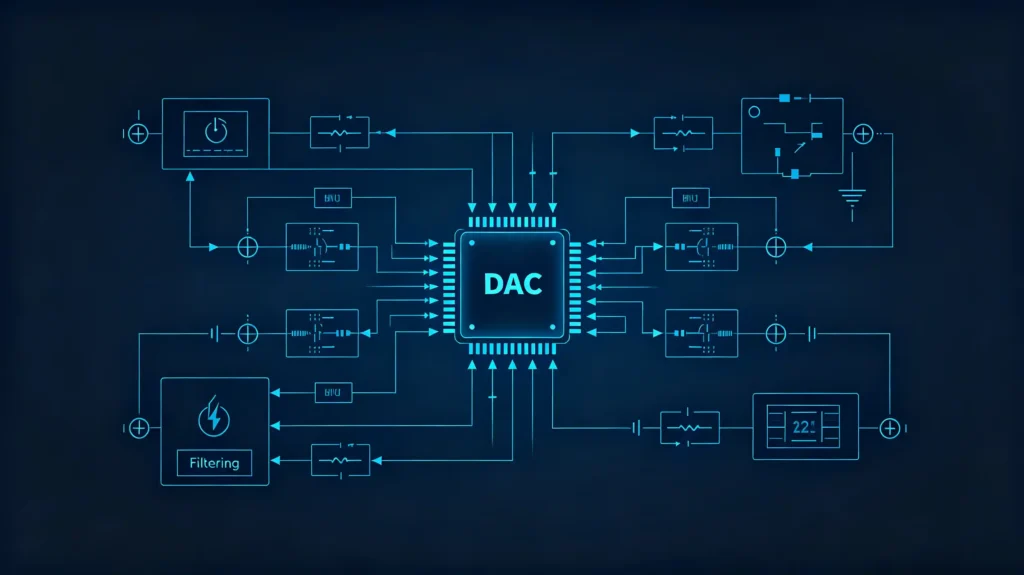
DAC Interplay With Other Car-Stereo Audio Hardware Components
Not Operating in Isolation
The DAC does not operate in isolation. Its output becomes the input for several other components. Understanding those handoffs clarifies where responsibility for final sound quality actually sits.
Relationship with the DSP
With the DSP, the relationship runs one direction. The DSP processes digital audio — equalization, crossover, time alignment — before that signal ever reaches the DAC. The DAC then converts the already-processed digital stream into analog form.
Relationship with the Amplifier
With the amplifier, the DAC’s analog output becomes the amplifier’s input. The amplifier then boosts it to speaker-level power.
Relationship with RCA Pre-Outs
RCA pre-outs draw from this same source. The DAC’s analog output is effectively what gets carried out to an external amplifier through those RCA connections.
Relationship with Internal Amplifier
Where a head unit relies on its own internal amplifier rather than external ones, that internal amplifier is likewise just taking the DAC’s analog output as its starting point.
The Commercial Takeaway
The commercial takeaway from all of this: DAC quality does not stay contained to one part of the system. It sets a ceiling that every downstream component inherits and works from. Whether DSP-adjacent or amplifier-side.
Additional Factors That Shape Final Car-Stereo Audio Quality Beyond the DAC Chip
More Than the DAC
The DAC chip gets a disproportionate share of attention in marketing materials. Several other factors influence final sound quality just as much, if not more.
Analog Output Stage
The analog output stage — op-amps and filtering circuitry positioned right after the DAC — shapes the signal before it goes anywhere else.
Power Supply Design
Power supply design matters enormously. Clean and stable power reduces noise that would otherwise bleed into the analog output.
PCB Layout
PCB layout, particularly grounding and signal routing, determines how much interference the audio path picks up along the way.
Component Quality
Component quality — the capacitors, resistors, and connectors used throughout — affects overall signal integrity. This rarely shows up on a DAC-specific datasheet.
Firmware and Software
Firmware and software matter too. DSP algorithms, volume control implementation, and audio routing logic all shape what the listener actually hears.
Downstream Components
Beyond the head unit entirely, amplifier quality and, ultimately, speaker quality determine how well everything upstream translates into the sound a driver experiences.
The Bottom Line
None of this diminishes the DAC’s role. It just places it correctly within a longer chain, where it is a necessary but far from sufficient condition for good final audio quality.
B2B Considerations for Evaluating DAC and Audio-Processing Specifications
Evaluation Framework
Turning this into a practical evaluation framework for RFQs and sample assessment.
- DAC chip specification — request SNR, THD+N, dynamic range, and sampling rate figures where available
- Audio output stage — ask about op-amp quality and analog circuitry design around the DAC
- DSP capabilities — verify support for equalization, crossover, and time alignment functions
- RCA output quality — confirm RCA pre-outs are sourced directly from the DAC’s analog output
- Audio performance testing — listen for noise, distortion, and clarity on actual sample units, not just datasheet review
- Documentation — request full DAC and surrounding audio circuit details, not just a chip model number
- Sample testing — compare sample audio output directly against a known reference product before committing to volume
FAQ
Does a high-end DAC chip guarantee excellent real-world audio performance on a car-stereo head unit?
No. The DAC chip sets a ceiling for potential audio quality. But the surrounding circuit design — power supply cleanliness, PCB layout and grounding, and the analog output stage — determines how much of that potential actually gets realized. A premium DAC paired with a poorly designed power supply can sound worse than a mid-tier DAC in a well-engineered circuit. Datasheet specifications are a useful starting point. But they are measured under lab conditions that a production unit does not always replicate.
What is the functional difference between an audio DAC and an audio DSP inside an Android head unit?
A DSP processes digital audio while it is still in digital form. It applies equalization, crossover filtering, and time alignment. It does this before handing that processed signal off to the DAC. The DAC’s job is narrower. Converting that digital signal into an analog waveform. It does not do any of the tonal shaping or processing itself. In short, the DSP shapes the sound. The DAC converts it. Confusing the two roles can lead buyers to expect processing features from a component that is not designed to provide them.
Why can two head units using the identical DAC chip deliver different audio noise performance?
The DAC chip itself is only one variable. Actual output quality depends heavily on the surrounding circuit. Power supply stability. PCB grounding and trace routing. The quality of components in the analog output stage. A poorly designed power supply can introduce noise into an otherwise capable DAC’s output. Sloppy PCB layout can pick up interference the chip’s own specifications never accounted for. This is exactly why sample testing matters more than comparing chip model numbers between two suppliers.
Which DAC-spec parameters are most meaningful for B2B automotive-infotainment project assessment?
SNR and THD+N are generally the most directly useful figures. They describe noise floor and distortion — the two issues most likely to translate into audible sound quality problems. Sampling rate and bit depth matter primarily if a project specifically targets high-resolution audio playback. For standard use cases, they are less critical than SNR and THD+N. That said, all of these figures should be treated as a starting point for comparison rather than a final answer. Real-world circuit design ultimately determines how those numbers translate into actual sound.
Conclusion
DAC quality is real. But it is one link in a chain that includes power supply design, PCB layout, firmware, and everything downstream through the amplifier and speakers.