Why Equalizer Capability Matters
An equalizer sounds like a minor feature on a spec sheet. A few sliders in a settings menu. That is until a customer complains that music sounds flat. Or a batch of units ships with an EQ that resets itself every time the source changes. For dealers and wholesalers sourcing Android head units, understanding what EQ actually does, and where its capabilities genuinely differ between products, turns a vague “has EQ” checkbox into something worth actually comparing.
This guide covers car stereo equalizer. It covers what EQ actually does. It covers how it differs between products. It also covers what to check before committing to a supplier. For a full view of all hardware decisions, see our car stereo hardware components overview.
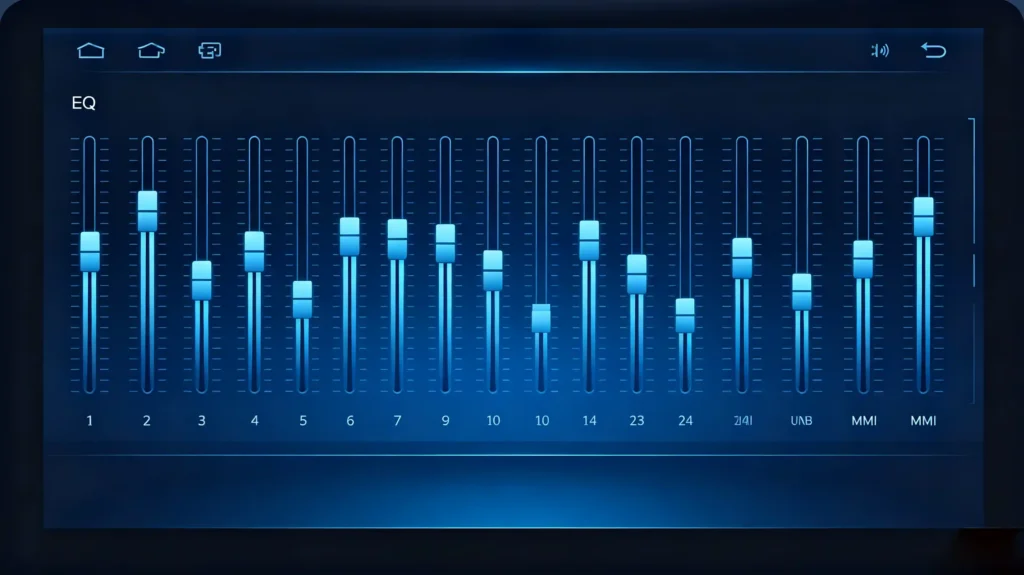
Car Stereo Equalizer – Core Definition
What Is an Equalizer?
An equalizer, or EQ, is an audio processing tool. It adjusts the volume, or gain, of specific frequency bands. This shapes the overall sound output. Its core role is straightforward. It lets a listener tailor audio to personal preference. It can also compensate for a vehicle’s particular acoustics — cabin reflections, speaker placement, road noise — that shift how music actually sounds compared to a controlled listening environment.
Value for End Users
For end users, EQ delivers value in three overlapping ways. It customizes sound by adjusting bass, midrange, and treble balance. It compensates for less-than-ideal vehicle acoustics like poor speaker placement or a reflective cabin. It generally improves the listening experience by letting music sound closer to what the listener actually prefers.
Commercial Weight for B2B Buyers
For B2B buyers, EQ capability carries real commercial weight. A head unit limited to a basic 3-band EQ leaves little room for genuine fine-tuning. This shows up as customer dissatisfaction once buyers compare it to competing products with more granular control. A buggy EQ implementation — settings that silently reset or simply do not apply — generates support tickets and, in worse cases, returns. EQ capability is not a cosmetic feature. It is a real differentiator in how competitive a finished product feels against otherwise similar alternatives.
Audio Frequency Bands and Basic EQ Control Mechanics
The Frequency Spectrum
Understanding what EQ actually adjusts starts with the frequency spectrum itself. It breaks into ranges that correspond to different elements of a typical recording.
Sub-Bass
Sub-bass covers roughly 20–60 Hz. Deep bass and rumble, felt as much as heard.
Bass
Bass sits around 60–250 Hz. Kick drum and bass guitar live here.
Midrange
Midrange spans 250 Hz to 2 kHz. Vocals, guitars, and piano live here. It is arguably the most perceptually important band for clarity.
Treble
Treble runs 2–6 kHz. Cymbals and vocal sibilance are in this range.
High Treble
High treble extends from 6–20 kHz. It adds the sense of “air” and sparkle to a recording.
EQ Controls
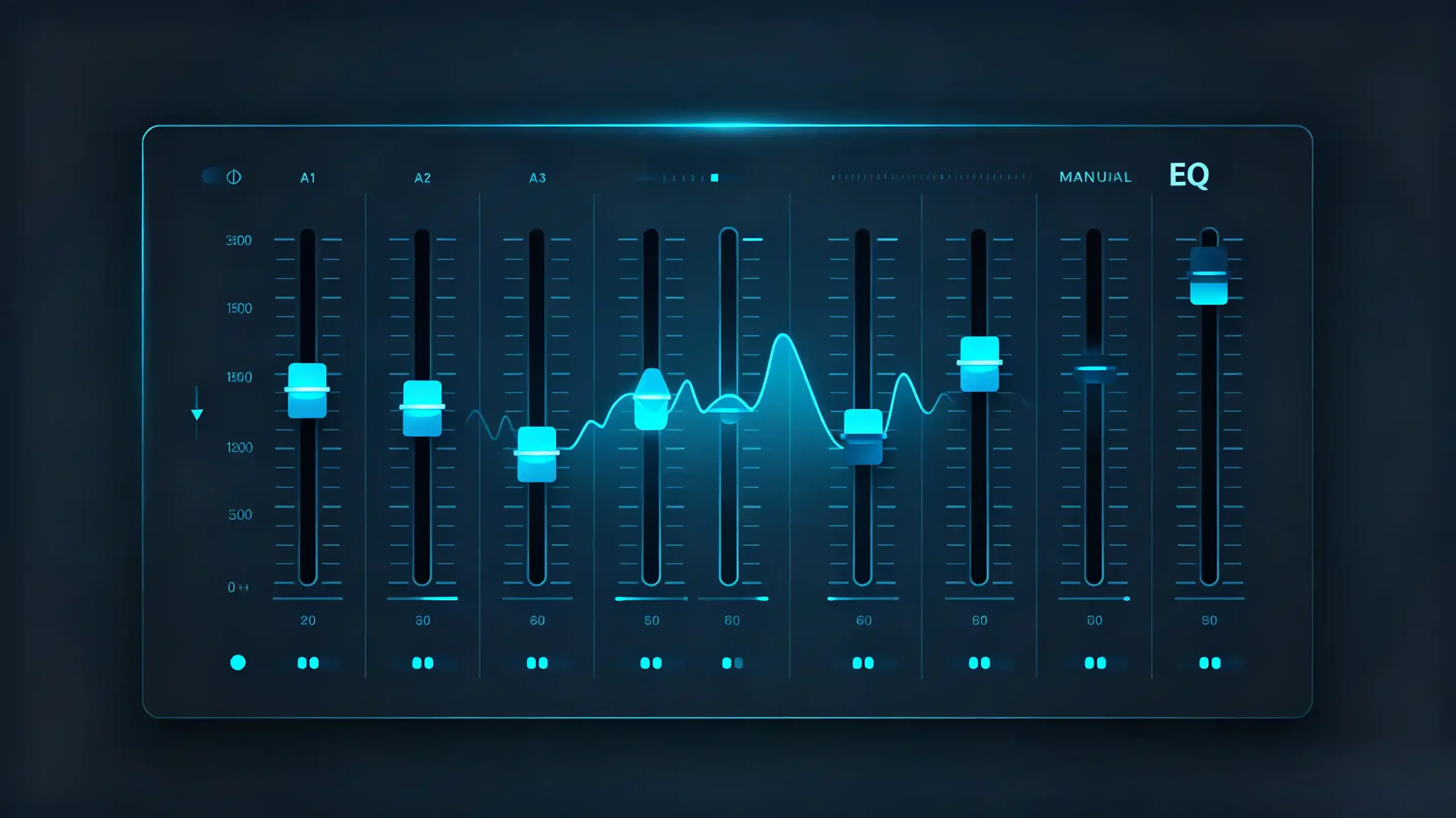
EQ controls work through gain adjustment — boosting or cutting the level within a given band. Band count determines how finely that adjustment can be targeted. This ranges from basic 3-band systems up through 5-band, 7-band, 10-band, and even 31-band graphic EQ implementations.
Practical Effects
The practical effect follows directly from which band gets adjusted. Boosting bass produces a fuller, punchier sound. Cutting it tightens things up and reduces boominess. Boosting treble brightens and clarifies. Cutting it warms and softens the overall tone. More bands simply mean more precise control over where exactly that shaping happens across the spectrum.
EQ Implementations on Conventional and Android Car Stereo Head Units
Not All EQ Is the Same
EQ is not implemented the same way across every product. The gap between traditional and Android-based systems is worth understanding before comparing spec sheets.
| Aspect | Traditional Car Stereo EQ | Android Head Unit EQ |
|---|---|---|
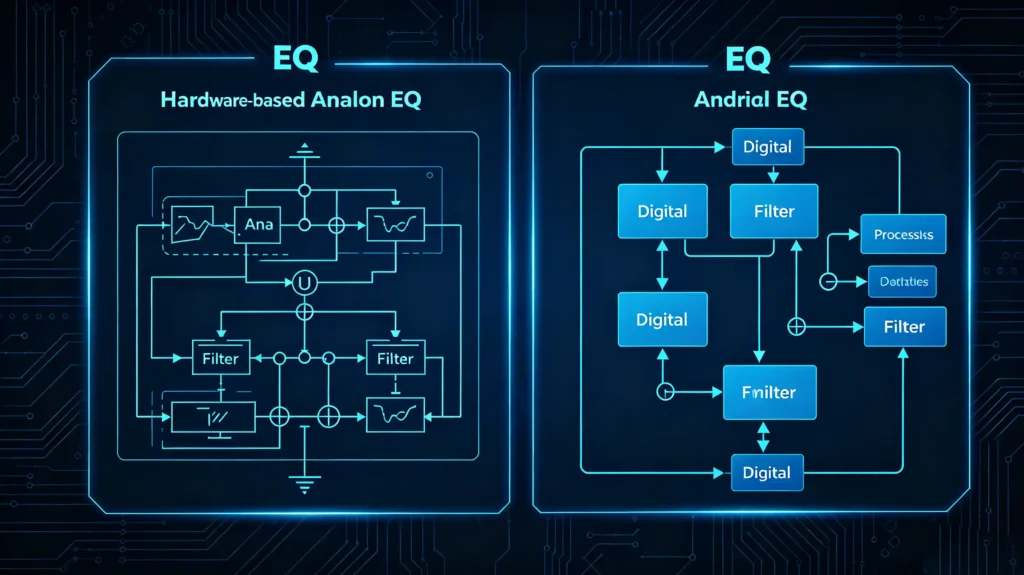
| Control method | Hardware-based, built into the audio processor | Software-based, within the OS or an audio app |
| Typical band count | Often 3-band or 5-band | Can extend to 5-band, 7-band, or 10-band |
| Flexibility | Limited; applies uniformly to all sources | Can support per-source settings (radio, USB, Bluetooth) |
| Dependency | Self-contained within dedicated hardware | Tied to Android’s audio routing framework |
| Known risk | Minimal — simple, stable | Possible bugs, settings resets, or app-switching inconsistencies |
Traditional EQ
Traditional EQ tends to be simple and predictable precisely because it is hardware-controlled. A fixed number of bands, basic bass/mid/treble sliders, and behavior that does not change across firmware updates.
Android-Based EQ
Android-based EQ trades some of that predictability for flexibility. More bands, potentially different settings per audio source, but also more exposure to the kind of software bugs that come with any OS-dependent feature.
Buyer Takeaway
Buyers evaluating Android head units for EQ capability should treat “software-based” as a trade-off rather than a strict upgrade. More capable in theory, but worth verifying in practice.
Common Preset and Manual Car-Audio Equalizer Settings
Two Complementary Paths
Most head units offer EQ control through two complementary paths. Factory presets for quick adjustment. Manual controls for anyone who wants to fine-tune further.
Common Factory Presets
Common factory presets include Rock (boosted bass and treble for punch and energy). Pop (balanced midrange with a slight treble lift). Classical (a flatter, more natural balance suited to acoustic recordings). Jazz (a warmer tone with emphasized midrange). Vocal (midrange emphasis specifically for speech and vocal clarity). Flat (no adjustment at all, serving as a neutral reference point).
Manual EQ
Manual EQ, by contrast, lets a user adjust individual frequency bands directly. This supports genuine personal fine-tuning. It can compensate for a specific vehicle’s acoustic quirks or speaker limitations in ways a generic preset cannot.
Different Scenarios
Different scenarios call for different starting points. Rock or pop listening generally benefits from boosted bass and treble. Audiobooks and podcasts benefit from emphasized midrange for speech clarity. A vehicle with awkward speaker placement often needs manual adjustment to correct for frequency imbalances. A preset alone will not address these.
What to Look For
The combination of solid presets and genuine manual control gives a broader range of end users a workable starting point. They do not require deep audio expertise to get reasonable results.
DSP-Powered Equalizer Functions on Modern Head Units
Beyond Basic Gain Adjustment
DSP-driven EQ goes considerably further than basic gain adjustment. It extends into a broader toolkit for shaping how a vehicle’s audio actually sounds as a complete system.
Multi-Band EQ
Multi-band EQ scales up to 7-band, 10-band, or even 31-band control for far more precise frequency shaping than basic systems allow.
Time Alignment
Time alignment adjusts the timing of output to each individual speaker. It corrects for the fact that speakers sit at different distances from the listener. They would otherwise arrive slightly out of sync.
Crossover Control
Crossover control routes the correct frequency ranges to the right speaker. Bass to a subwoofer. Midrange to door speakers. It does not send a full-range signal to hardware that is not built to reproduce it well.
Phase Correction
Phase correction addresses phase relationship issues between speakers. These can otherwise cause frequency cancellation and a muddled soundstage.
Parametric EQ
Parametric EQ goes a step further than basic graphic EQ. It allows adjustment of frequency, gain, and Q-factor (bandwidth) simultaneously. This enables genuinely surgical tone shaping.
The Distinction
The distinction is worth being direct about. Basic EQ is a simple frequency-adjustment tool. DSP-EQ is a full sound-processing toolkit addressing timing, routing, and phase alongside tone. This generally positions DSP-EQ as a premium capability rather than a standard inclusion. Buyers should confirm what is actually present rather than assuming “DSP” on a spec sheet implies the full feature set described here. For more on DSP, see our DSP amplifier in car stereo guide.
How Equalizer Performance Influences Overall Car-Stereo Audio Quality
What EQ Can and Cannot Fix
EQ is a genuinely useful tool. But it is worth being clear-eyed about the boundary of what it can actually fix.
What EQ Can Do
What EQ can do: adjust frequency balance to match personal preference. Compensate reasonably well for vehicle acoustics like cabin reflections or awkward speaker placement. Generally make music sound more pleasing within the limits of the existing hardware.
What EQ Cannot Do
What EQ cannot do is just as important. It cannot fix a poor-quality DAC’s noise or distortion. It cannot compensate for genuinely low-grade speakers. It cannot resolve amplifier distortion or clipping. It cannot add detail to a recording that simply was not captured in the original source material. For more on DAC quality, see our car stereo audio DAC guide.
The Useful Way to Think About It
The useful way to think about this: EQ is a tuning tool. It is not a hardware upgrade. Good EQ applied to weak hardware produces a modest improvement that is still fundamentally limited by that hardware’s ceiling. Poor EQ applied to strong hardware wastes potential that was already there.
For B2B Buyers
For B2B buyers, this means EQ capability should be evaluated as one part of a full audio system assessment. It should not be treated as a standalone feature that compensates for weaknesses elsewhere.
B2B Specification Considerations for Evaluating Head-Unit EQ and DSP-EQ
Evaluation Framework
Turning this into a practical evaluation framework for RFQs and sample testing.
- EQ band count — verify the actual number of bands (3, 5, 7, 10, or 31)
- Preset profiles — confirm which presets are included (rock, pop, classical, and similar)
- Manual control — verify users can adjust individual bands and gain directly
- DSP-EQ features — confirm time alignment, crossover, and parametric EQ support if the project requires them
- Per-source EQ — check whether EQ settings can be set independently across radio, USB, and Bluetooth sources. For more on audio sources, see our smartphone integration in vehicles guide.
- EQ persistence — verify settings survive a system reboot and switching between audio sources
- Sample testing — test preset switching, manual adjustment, and any DSP functions directly on sample units
FAQ
What practical functional difference exists between basic multi-band EQ and full DSP equalizer on Android head units?
Basic multi-band EQ adjusts gain across a set number of frequency bands and stops there. A full DSP equalizer extends well beyond that. It adds time alignment to correct speaker timing differences. It adds crossover control to route frequencies to the correct speakers. It often adds parametric EQ for more precise tone shaping. Basic EQ shapes tone. DSP-EQ shapes tone, timing, and speaker routing together as a complete system.
Can equalizer or DSP-EQ compensate for poor-quality DAC or low-grade vehicle speakers?
No. EQ works by adjusting the balance of frequencies already present in a signal. It cannot remove noise or distortion introduced by a weak DAC. It cannot add clarity or detail that low-grade speakers simply are not capable of reproducing. Applying aggressive EQ to compensate for genuinely poor hardware often makes problems more audible rather than less. Boosting a frequency band also boosts whatever distortion exists within it.
Why may some Android head unit EQ settings reset after app switching or a system reboot?
This is typically a software implementation issue. It is not a hardware limitation. Some Android audio frameworks do not properly persist EQ settings across every audio session or app context. This is particularly true when different apps manage their own audio routing independently. It is a known category of bug in software-based EQ systems. B2B buyers should specifically test settings persistence across reboots and source switching during sample evaluation. Do not assume stability from a feature list alone.
What should B2B buyers watch out for when a head unit datasheet markets “built-in DSP” without listing a concrete EQ band count?
“Built-in DSP” on its own does not specify what is actually included. It could mean anything from a basic multi-band EQ to a full suite with time alignment and crossover control. Buyers should push for specific details. Exact band count. Whether time alignment and crossover are genuinely supported. Whether parametric EQ is available. Do not accept the general term as sufficient. Vague DSP marketing language is a common area where sourcing conversations benefit from asking direct follow-up questions.
Conclusion
EQ specifications on paper only tell part of the story. How bands actually behave. Whether settings persist. Whether DSP features are genuinely present. All of these need to be confirmed on real hardware.