Two head units can both list “RCA output” on the same spec sheet. They can produce noticeably different results once connected to an external amplifier. One delivers a clean, quiet signal. The other forces the amplifier’s gain up until hiss becomes audible. For dealers and wholesalers building or specifying audio-upgrade projects, understanding what RCA output actually measures is what separates a smooth amplifier integration from a support call.
This guide covers car stereo RCA output and preamp output. It covers signal types, voltage, channel configurations, and what to check before committing to a supplier. For a full view of all hardware decisions, see our car stereo hardware components overview.

Car Stereo RCA Output and Preamp Output – Core Definition
What Is RCA Output?
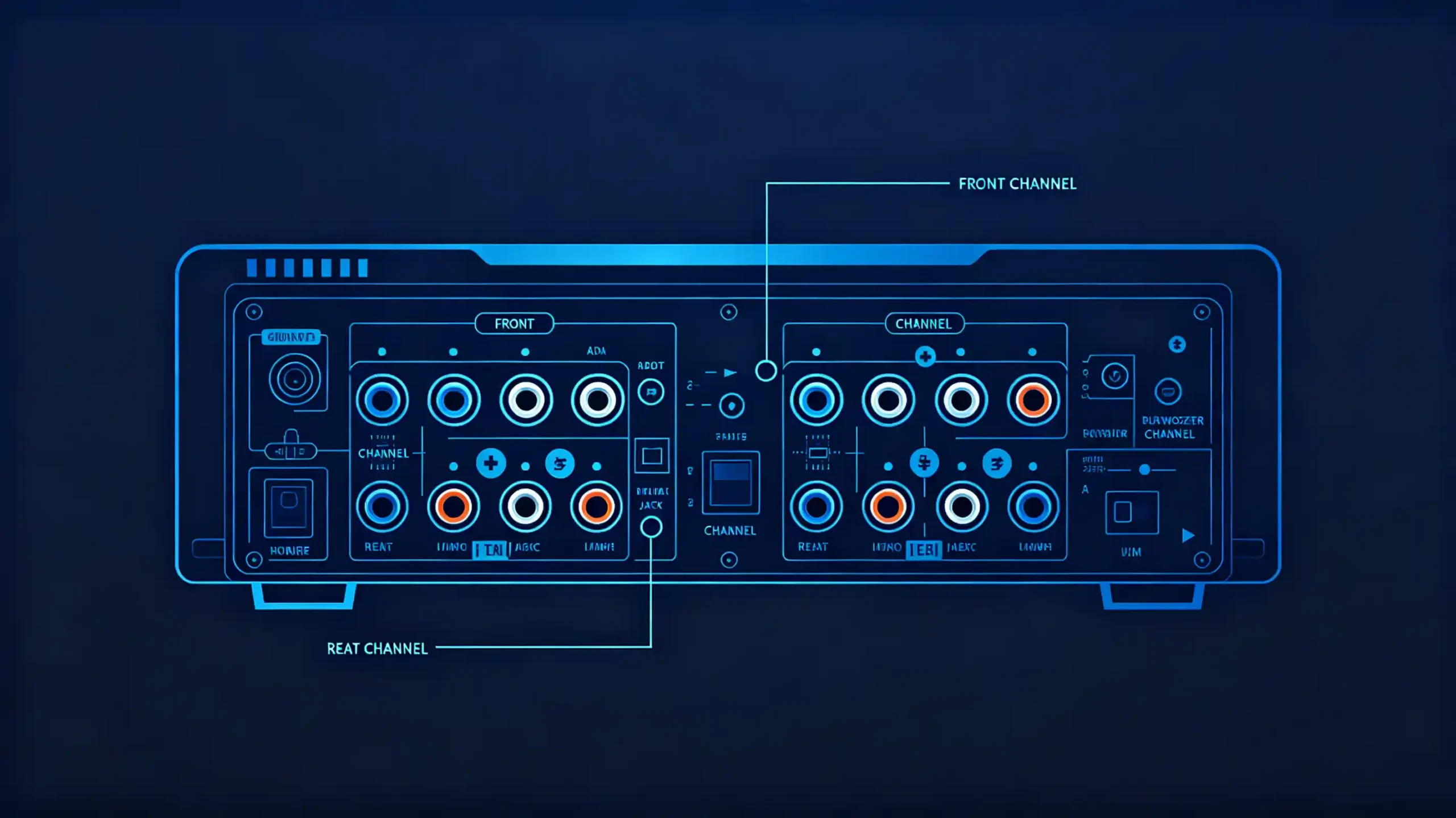
RCA output, also called preamp output, is a low-level analog audio signal from the head unit. It is designed specifically to feed an external amplifier. It delivers a clean, unamplified signal. It bypasses the head unit’s internal amplifier entirely. This generally produces better sound quality than routing through built-in amplification.
Multi-Amplifier Setups
This same output also enables multi-amplifier setups. Separate amplifiers for front speakers, rear speakers, and a subwoofer. All fed from the same head unit.
The B2B Risk
The B2B risk here is straightforward but easy to underestimate. Not all RCA outputs are equal. Voltage and signal quality vary meaningfully across manufacturers and price tiers. This happens even when the connector itself looks identical. Mismatched or low-quality RCA output leads to audible noise, distortion, or generally weak amplifier performance. A head unit missing a dedicated subwoofer output limits what audio configurations a buyer can actually offer downstream. For a complete guide on amplifier integration, see our car stereo amplifier integration guide.
RCA Signal Types and Available Channel Configurations
Line-Level Analog Signal
RCA outputs carry a line-level analog signal. Low voltage, typically in the 1V to 5V range. This is distinct from the higher-power speaker-level output a head unit’s internal amplifier produces directly.
Channel Configurations
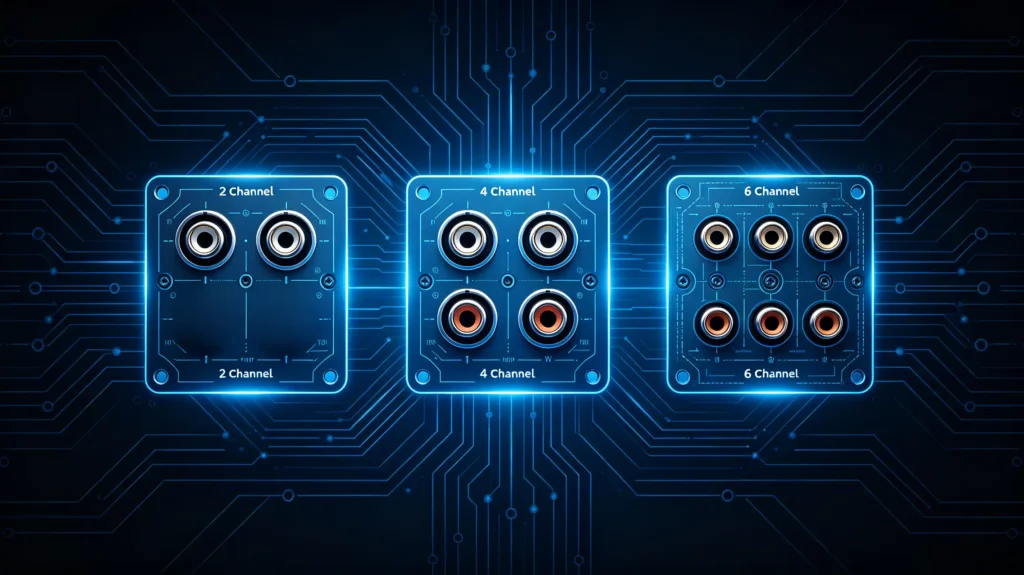
Channel configurations follow a fairly predictable pattern across the aftermarket. A 2-channel setup covers front left and right only. It provides basic stereo output suited to a simple 2-channel amplifier. A 4-channel setup adds front and rear left/right. This matches a 4-channel amplifier for full-range sound across the cabin. A dedicated subwoofer channel, typically mono, feeds a separate subwoofer amplifier. Less commonly, some premium systems include an auxiliary or center channel for more elaborate audio setups.
What to Expect by Tier
In practice, entry-level head units tend to ship with 2 RCA outputs covering the front channels only. Mid-range units commonly include 4 outputs for front and rear. Premium units add a dedicated subwoofer output on top, bringing the total to 6. Channel count directly determines how much amplifier flexibility a buyer has downstream. A unit with only 2 RCA outputs simply cannot support a separate subwoofer amplifier. This holds regardless of how good its sound quality otherwise is.
How Head-Unit RCA Output Connects to an External Amplifier
The Signal Path
At a high level, the signal path from head unit to speakers runs through four steps once RCA outputs are involved.
Step 1: RCA Cable Connection
RCA cables run from the head unit’s RCA outputs to the corresponding RCA inputs on the external amplifier.
Step 2: Signal Transmission
The head unit sends a low-level audio signal, typically in the 1V to 5V range, through those cables.
Step 3: Amplification
The amplifier receives that low-level signal and boosts it up to speaker-level power.
Step 4: Speaker Output
The amplifier sends its amplified output on to the vehicle’s speakers.
The Complete Path
The complete path runs: head unit RCA output → RCA cables → amplifier RCA input → amplifier output → speakers. This approach carries real advantages over relying on the head unit’s built-in amplifier and speaker-level outputs. A cleaner signal. Lower noise and distortion. Considerably more flexibility to configure a multi-amplifier system exactly the way a project calls for.
Matching Signal Levels
The workflow itself is conceptually simple. But getting good results depends on matching signal levels correctly between the head unit and amplifier. This is where the next section becomes relevant.
RCA Output Voltage and Practical Signal-Quality Considerations
The Most Important Spec
Output voltage is the single spec that most directly affects how a finished audio system actually sounds. It deserves more attention than it usually gets on a basic spec comparison.
Typical Range
Typical RCA output falls in the 1V to 5V range. Generally speaking, higher voltage is better. Low output voltage, under roughly 2V, tends to force the amplifier’s gain setting higher to compensate. This in turn raises the noise floor and introduces audible hiss. Output in the 4V to 5V range, by contrast, delivers a cleaner signal with a lower noise floor. This results in correspondingly better overall sound quality once amplified.
Amplifier Gain Setting
This connects directly to amplifier gain setting. A higher output voltage from the head unit allows the amplifier’s gain to sit lower. Lower gain generally means less amplifier-generated noise. A lower output voltage forces gain higher just to reach usable volume. That added gain is exactly where hiss creeps in.
Signal-to-Noise Ratio
Signal-to-noise ratio (SNR) follows the same logic. Higher output voltage generally improves SNR. This means a cleaner signal relative to background noise. Poor-quality RCA cables compound the risk further. They introduce their own signal degradation and noise regardless of how strong the original output voltage was. For more on audio quality, see our DSP amplifier in car stereo guide.
Number and Physical Configuration of RCA Outputs on Head Units
Port Count and Layout
Physical port count and layout vary meaningfully across the aftermarket. Matching this to a target amplifier setup is a core part of the sourcing decision.
2 RCA Outputs
A 2 RCA output configuration (front left/right) is the most basic setup. It supports a simple 2-channel amplifier. It is generally found on entry-level head units.
4 RCA Outputs
A 4 RCA output configuration (front and rear left/right) supports a 4-channel amplifier for full-cabin sound. It is common on mid-range units.
6 RCA Outputs
A 6 RCA output configuration adds a dedicated subwoofer channel on top of front and rear. It supports a 4-channel amplifier plus a separate subwoofer amplifier. This is typically reserved for premium head units.
Dedicated Subwoofer Output
A dedicated subwoofer RCA output, when present, is usually mono. It is labeled “SUB” or “SW” for clarity.
Color Coding and Grouping
Physically, RCA ports follow a standard color-coding convention. White for left. Red for right. They are generally grouped by channel (front, rear, subwoofer). This makes correct wiring easier during installation.
Flexibility
More RCA outputs simply means more downstream flexibility. A buyer building premium multi-amplifier packages needs that 6-output configuration. A basic front-only upgrade has no real use for it. For more on audio system planning, see our best car stereo processor guide.
Common RCA-Output-Related Pitfalls in B2B Audio-Integration Projects
Recurring Issues
A handful of recurring issues account for most of the RCA-related complaints in bulk audio-integration projects.
Low Output Voltage
Low output voltage — under roughly 2V — forces amplifier gain up. This introduces audible noise into the finished system.
Missing Subwoofer Output
Missing subwoofer RCA output limits what bass configurations a buyer can offer. This is true regardless of how strong the front and rear channels perform.
Marketing Ambiguity
Marketing ambiguity is a subtler problem. A listing advertises “RCA output” without specifying voltage or channel count. Buyers only discover the limitation once units are already in hand.
Signal Noise
Signal noise can also originate from poor-quality RCA cables or ground loops in the installation. This is independent of the head unit’s own output quality.
Insufficient Channel Count
Insufficient channel count shows up when a head unit simply does not have enough RCA outputs for the amplifier configuration a project calls for.
Inconsistent Voltage
Inconsistent voltage across channels — one channel measurably weaker than another — produces an uneven, poorly balanced final sound stage. This happens even when the average spec looks acceptable.
The Common Thread
Every one of these issues is checkable before a bulk order ships. Provided the buyer asks for actual specifications rather than accepting “RCA output: yes” as sufficient information.
B2B Specification Considerations for Evaluating Head-Unit RCA Output
Evaluation Checklist
Turning this into an actionable evaluation checklist for RFQs and sample testing.
- Output voltage — verify the rated RCA output voltage; 2V or higher is a reasonable baseline, with 4V+ generally indicating premium performance
- Channel count — confirm the number of RCA outputs (front, rear, subwoofer) matches the target amplifier setup
- Subwoofer output — verify a dedicated subwoofer RCA channel is present if the project requires one
- Signal-to-noise ratio — request the SNR specification where available; higher figures indicate cleaner output
- Physical configuration — confirm port location and color-coding match standard conventions
- Documentation — request full RCA output specifications rather than a simple yes/no feature listing
- Sample testing — measure actual output voltage and listen for noise on sample units before committing to volume
FAQ
What is the key practical difference between speaker-level output and RCA preamp output on a car-stereo head unit?
Speaker-level output is already amplified by the head unit’s internal amplifier. It is meant to connect directly to speakers. RCA preamp output is a low-level, unamplified signal. It is specifically meant to feed an external amplifier, which then does the actual amplification work. Using RCA output generally produces cleaner sound with less noise. The signal bypasses the head unit’s built-in amplifier stage entirely. It also enables more flexible multi-amplifier configurations that speaker-level output alone cannot support.
Why do some head units advertise “RCA output” but lack a dedicated subwoofer RCA channel?
This usually comes down to product tier and cost positioning. Entry-level and mid-range units are often built with only front, or front and rear, RCA outputs. This keeps manufacturing cost down. A dedicated subwoofer channel is typically reserved for higher-tier or premium product lines. The listing “RCA output” on its own does not specify channel count. Buyers need to confirm the actual configuration rather than assuming subwoofer support is included by default.
How does rated RCA output voltage affect amplifier gain setting and risk of audio noise in vehicle deployments?
Higher output voltage lets the connected amplifier run at a lower gain setting to reach the same volume level. Lower gain generally means less amplifier-generated noise or hiss. Lower output voltage forces the amplifier’s gain higher just to compensate. This pushes more noise into the signal path along with it. Two head units with an identical amplifier can produce noticeably different noise levels. The difference often traces back to output voltage rather than the amplifier itself.
Can I add extra RCA output channels if stock head-unit hardware does not provide them?
Generally, no. RCA outputs are tied to the head unit’s internal audio processing hardware. A unit built with only 2 or 4 outputs cannot simply have additional channels added after manufacturing. Some external accessory devices, like a line output converter, can derive an RCA-level signal from speaker-level output as a workaround. But this adds an extra component. It generally does not match the signal quality of a head unit with native RCA channels built in from the start.
What practical sample-test procedures can wholesalers run to validate real-world RCA-output performance pre-mass-order?
A straightforward test involves measuring actual output voltage across each RCA channel with a multimeter or audio test equipment. Confirm the figures are consistent across channels rather than uneven. Beyond voltage, connect a sample unit to a representative amplifier and listen for hiss or noise at both low and high volume settings. This reveals real-world signal quality that a datasheet number alone will not fully capture. Hands-on sample testing, done before committing to volume, is the most reliable way to confirm RCA output actually performs as advertised.
Conclusion
RCA output quality is easy to overlook on a spec sheet. It is hard to ignore once a finished system sounds noisy or underpowered.