Most bad sourcing decisions don’t announce themselves at the sample stage. They show up three months later. That is when you find a container full of units that don’t match what the sample promised.
Picking the right supplier is not about the cheapest quote. It is about knowing which questions separate dependable manufacturers from risky ones.
This guide walks through how to match supplier type to your business model. It covers what qualifications and production capacity actually matter, how to judge technical strength, what a real QC system looks like, and the red flags that tend to show up after it’s too late to do much about them. Before evaluating suppliers, it helps to understand the core concepts of what a car navigation system is and how it’s built — see our pillar guide for a foundational overview.
Clarify Your Business Needs First: What Type of Supplier Do You Need?
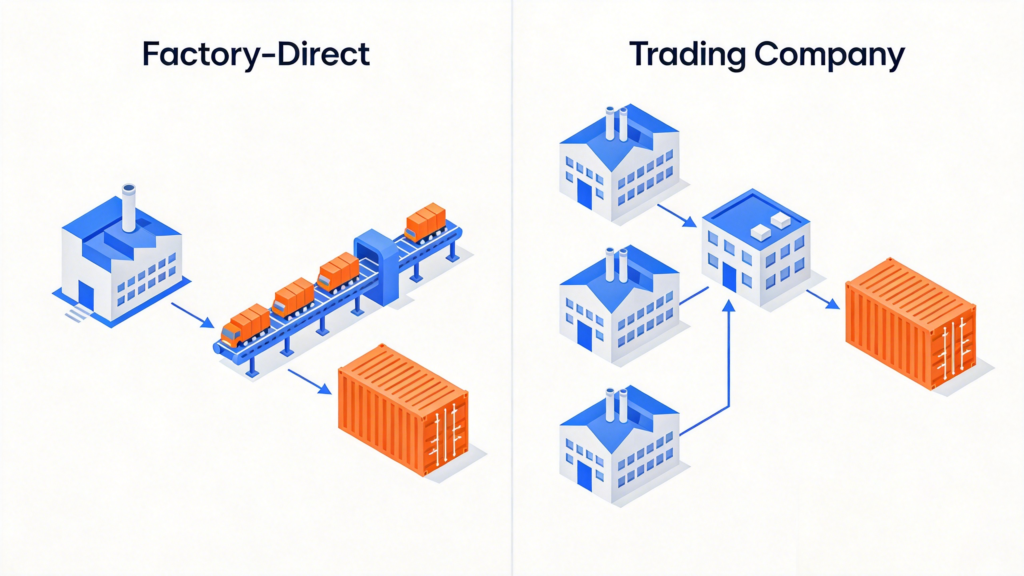
Before comparing quotes, it helps to know which category of supplier you need. “Car navigation system supplier” covers several very different business models.
Factory-direct manufacturers produce their own branded products. They also offer OEM/ODM services directly. This is the right category if customization, competitive pricing, and direct quality control matter to you. For a complete guide on comparing Android head unit brands, see our how to compare Android head unit brands guide.
Trading companies work differently. They source from multiple manufacturers. This gives you a wider product mix but less control over consistency. They tend to suit smaller, mixed orders better than large single-product runs.
OEM/ODM specialists sit in a third category. They focus on custom development for automakers and branded clients. This usually means deeper technical collaboration and longer lead times than a standard order.
How does this map to real buyers? 4S dealerships and automakers generally need an OEM/ODM manufacturer with genuine CAN Bus development capability. Wholesalers and importers do better with factory-direct manufacturers. These offer flexible MOQ and stable supply. Small retailers are often fine with trading companies or distributors who keep low MOQs and ready stock.
Before you go further, it’s worth being honest with yourself about your priorities — customization versus standard products, low cost versus premium quality, fast delivery versus tighter design control. Those trade-offs shape everything that follows. Once you’ve identified your supplier type, the next question is usually whether to stock OEM or aftermarket products — see our detailed comparison guide for a side-by-side breakdown: OEM vs Aftermarket Car Navigation.
Core Qualification & Production Capacity Evaluation
Once you know what type of supplier you are looking for, confirm they can actually deliver at your volume.
Start with the basics. Is this a registered manufacturer, or a trading company presenting itself as one? Request business registration documentation. Do not take the answer at face value. A factory visit remains the most reliable way to verify claims. In-person is best. A video call is the second-best option. Verify factory size, production lines actually running, equipment on the floor, and whether the workforce matches the scale described.
Production capacity numbers are worth pinning down precisely. Ask about monthly output, number of production lines, and whether SMT and assembly happen in-house. A manufacturer running 10-plus production lines with 50,000-plus units of monthly capacity can absorb a large order without straining. A smaller operation claiming the same numbers deserves a second look.
On certifications — ISO 9001, IATF 16949, CE, FCC, RoHS — request current documentation directly. Do not assume compliance from a company profile. Requirements vary by destination market. Confirm what applies to where you are actually shipping.
Factory-direct manufacturers skip the middleman. This tends to mean better pricing, more direct quality control, and faster turnaround on customization. If you’re still deciding which product category to stock — OEM, aftermarket, Android, or portable — see our full breakdown of types of car navigation systems.
Technical Strength & Customization Capability Assessment
If your business needs any degree of customization — and most B2B buyers eventually do — a supplier’s technical bench matters as much as its factory floor.
Look at the R&D team itself. How many engineers are there, and what do they cover? Hardware, software, UI, CAN Bus, firmware, OTA — an in-house team spanning all of these signals real customization capability. It signals more than just assembly work.
CAN Bus development is worth asking about directly. Does the supplier develop protocols in-house, or license them from a third party? For a deeper look at CAN bus technology — how it works, why it matters, and what to look for in a decoder — read our guide on What Is CAN BUS.
In-house development adapts faster to new vehicle models. It also tends to produce better compatibility. The team is not waiting on someone else’s roadmap.
Beyond that, check what customization is actually on offer. This includes UI themes, boot animation, front panel logo, packaging, regional radio frequency adaptation, language packages, RAM/ROM configuration, and hardware interface changes.
On the software side, confirm the supplier develops its own Android or Linux systems. Also confirm they support OTA updates. This matters more than it might seem. It determines whether your product line can keep improving after it ships, rather than freezing in place.
Hardware customization rounds this out. Ask about screen resolution options, processor platform choice between Snapdragon and MediaTek, and power module configuration for different countries’ voltage standards.
Supply Chain & Quality Control System Evaluation
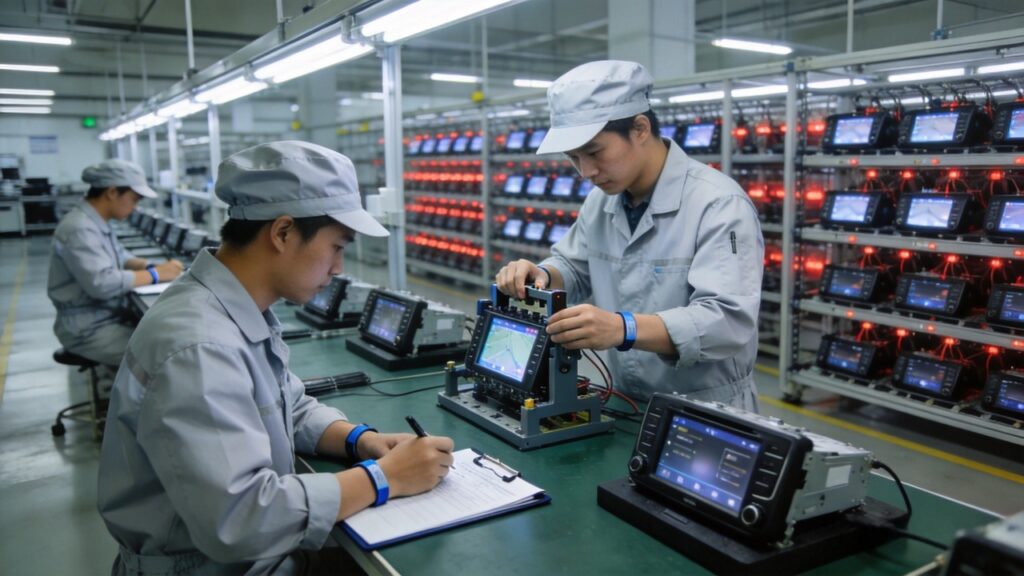
This is where many otherwise-promising suppliers fall apart at scale. The problem is not that the sample was bad. The problem is that the systems behind it were not solid.
Evaluating Component Supply Chain Stability
Ask who the component suppliers actually are. Working with authorized, tier-1 suppliers for the CPU, touch screen, CAN Bus decoder, and wiring harness tends to produce more consistent quality than sourcing from the open spot market. For a detailed breakdown of each hardware component and what to look for, read our guide on car navigation system components.
Supply chain stability matters too. Does the supplier keep raw material reserves to avoid stock-outs? Do they have durable relationships with their own suppliers?
Understanding the Full QC Process
On QC, ask for documented process, not verbal assurance. Look for incoming material inspection (IQC), in-process patrol inspection (IPQC), full function testing on finished units (FQC), and pre-shipment random sampling (OQC).
Aging and environmental testing catch what a quick function check won’t. This includes a 48-hour continuous power-on burn-in test, high-temperature testing around 60°C, and vibration testing that simulates real road conditions. These steps surface hidden failures before they become your customer’s problem.
One more thing worth asking about: traceability. Can the supplier trace a finished unit back to its production batch and component lots? That is what makes a real investigation possible if a quality issue surfaces later.
Pre-Sales & After-Sales Support Capability Assessment
Support quality is hard to judge from a product catalog. But it often determines whether a supplier relationship actually lasts.
On the pre-sales side, a good supplier offers genuine technical consultation. They match product parameters to your needs. They support sample testing. They verify compatibility for your specific target vehicles. They do not just point you toward a catalog page.
After the sale, look for a dedicated after-sales team with responsive channels — WhatsApp, email, video support. Look for a track record of actually responding quickly, not just promising to.
Technical support is worth probing specifically. Can they do remote debugging? Do they provide proper documentation like installation guides and wiring diagrams? Can they walk through issues over video when text is not enough?
Warranty terms matter too. Get clarity on the standard period, how claims get processed, and the return policy for defective units.
Spare parts supply is the one buyers most often overlook until they need it. Long-term availability of matching parts — touch screens, motherboards, CAN Bus boxes, wiring harnesses, remote controls — is critical. This lets your local installers actually service what they sold, months or years down the line.
Step-by-Step Supplier Selection & Cooperation Process
Turning all of this evaluation into an actual decision works best as a sequence. It should not be a single leap of faith.
Start with initial screening. Shortlist suppliers based on qualification, production capacity, and general market reputation. Request company profiles to compare side by side.
From there, move into detailed evaluation. Assess technical strength, QC systems, customization capabilities, and support services. Verify the claims rather than taking them at face value.
Sample ordering comes next. Order units for testing on real vehicles. Check build quality, feature completeness, CAN Bus compatibility, and general performance.
Once a sample clears that bar, place a small trial order. Test production consistency, delivery reliability, and how responsive after-sales support actually is once money has changed hands.
If that goes well, move into negotiation and formal cooperation. Lock in MOQ, pricing, lead time, payment terms, warranty, and quality standards in a signed agreement. From there, it becomes ongoing partnership management. This includes regular quality reviews, open communication, and periodic conversations about what could improve.
Common Supplier Cooperation Risks & Avoidance Methods
A handful of risks show up again and again. Most are avoidable if you check for them early.
Qualification fraud tops the list. This is a supplier presenting itself as a manufacturer when it is actually a trading company reselling someone else’s stock. Business license verification and a real factory tour usually settle this quickly.
Inconsistent quality is another common trap. First samples look great, but bulk quality quietly drops from there. Clear QC documentation and inspection on delivery catch this before it becomes a pattern.
Fake or inflated specifications are worth verifying. This includes exaggerated RAM/ROM, resolution, or processor claims. Use sample testing and diagnostic tools rather than trusting the listing.
CAN Bus compatibility issues are especially costly at scale. A unit that fails to properly integrate with your target vehicles can undo an entire order’s worth of margin. Testing samples on actual vehicles before bulk production is the only real safeguard.
Poor after-sales support tends to reveal itself early if you are paying attention. Test responsiveness during the sample and trial phases. Do not wait until a full container has shipped.
Unrealistic pricing is often a signal in itself. Prices well below market average usually mean corners are being cut somewhere. It may not be obvious which ones yet.
FAQ
What is the minimum production capacity qualification for a reliable car navigation system manufacturer?
There is no universal number. But a supplier running 10-plus production lines with 50,000-plus units of monthly capacity can generally absorb sizable bulk orders without straining. For smaller orders, consistency matters more than raw capacity. A smaller manufacturer with solid QC can still be reliable, provided their claimed capacity is verified.
How to verify a supplier’s OEM/ODM customization capability before placing bulk orders?
Ask about the R&D team directly. How many engineers are there, and which disciplines do they actually cover? Hardware, software, UI, CAN Bus, firmware? Request examples of past customization work. Confirm whether CAN Bus protocols are developed in-house or licensed. A trial order with your specific customization requirements is the most reliable way to confirm capability before committing to full volume.
What certifications must a qualified car navigation system supplier have for cross-border export?
Requirements vary by destination market. Commonly relevant certifications include CE for Europe, FCC for North America, RoHS for hazardous substance compliance, and ISO 9001 for quality management. Request current documentation directly from any supplier rather than assuming compliance. Confirm which apply to your specific target country before finalizing an order.
What is the standard MOQ for bulk orders from car navigation system suppliers?
MOQ varies significantly depending on customization level and supplier type. Standard, non-customized configurations typically support lower minimums than fully custom UI or hardware builds. Factory-direct manufacturers generally offer more flexibility here than trading companies. Many suppliers accommodate smaller trial orders for new buyers before requiring full bulk commitments.
What are the most common risks in cooperating with a new car navigation supplier?
Qualification fraud, inconsistent bulk quality despite good samples, and CAN Bus compatibility failures with specific target vehicles are the three that cause the most damage. Sample testing on actual vehicles, documented QC verification, and a trial order before full-scale production are the most effective ways to catch these issues while they are still cheap to fix.
Conclusion
Choosing a supplier comes down to matching supplier type to your business model. Then you verify — not assume — the qualifications, technical strength, QC, and support behind any promising quote. Buyers who avoid expensive after-sales problems are usually the ones who tested a sample, ran a trial order, and asked for documentation before signing anything at scale.
Evaluating suppliers for your next car navigation order? Contact our team to discuss your business requirements, or request a sample to see our production capabilities firsthand. Explore our Android Car Navigation Systems product lineup to see available hardware configurations..