Choosing between OEM and aftermarket navigation isn’t just a technical question. It’s a business decision that affects your margins, your installation workflow, and how well your product line matches customer expectations.
This guide breaks down how the two categories differ. It shows where each makes commercial sense, and how to match the right one to your role — whether you’re an automaker, a 4S dealership, or a wholesale importer.
Core Definitions: OEM Navigation System vs Aftermarket Navigation System
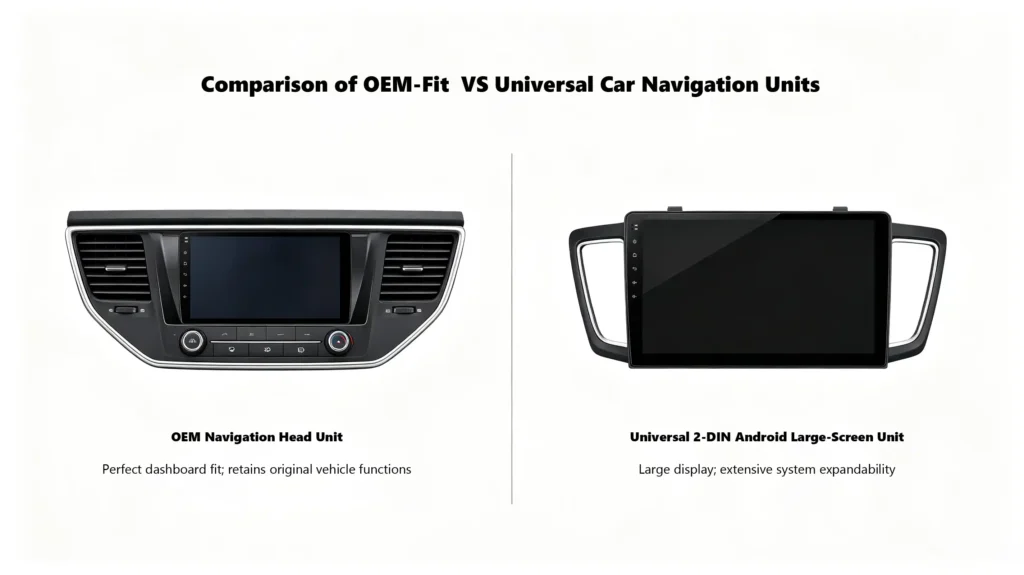
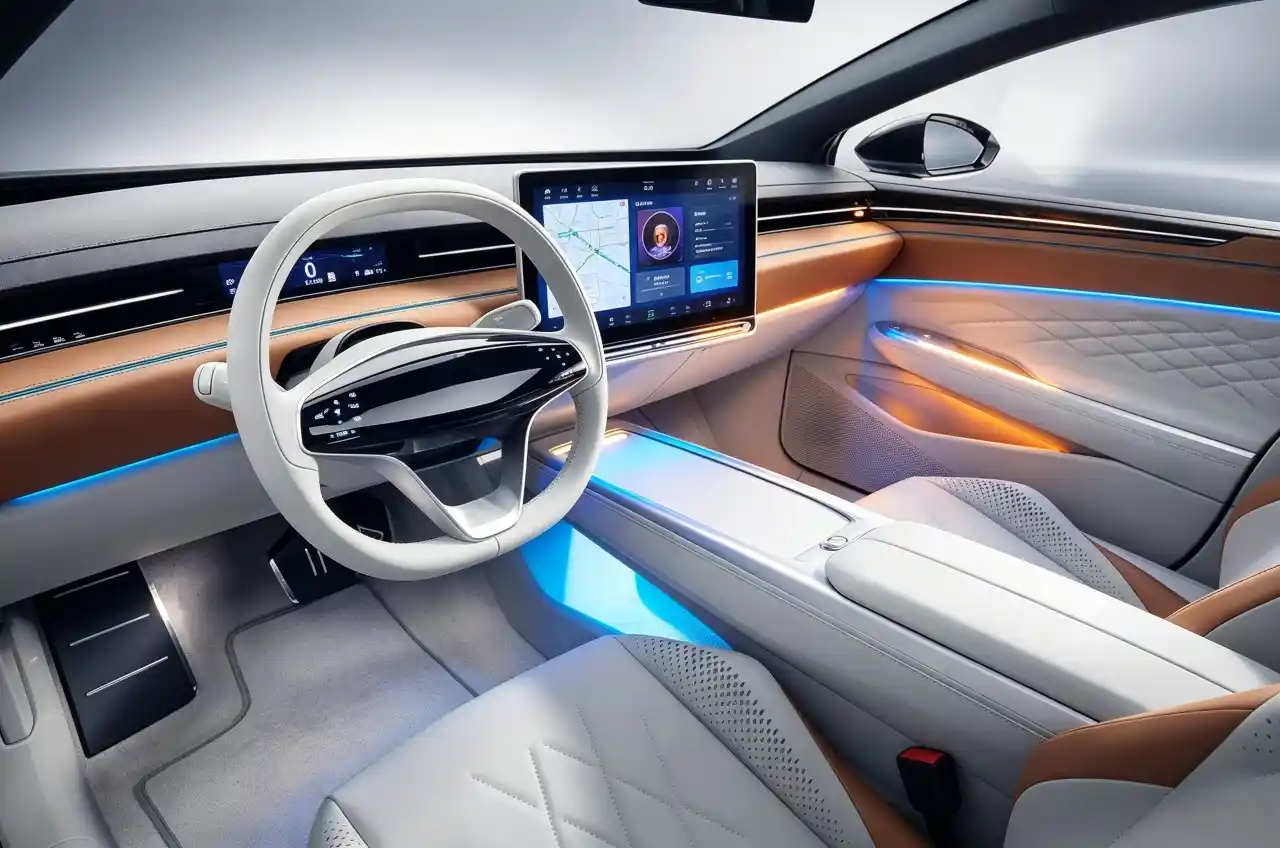
An OEM navigation system is installed at the factory, during vehicle production. It’s built to the exact specifications of one make and model. The CAN bus protocol, dashboard fit, and wiring are engineered around that single vehicle platform from day one. For a full breakdown of navigation system categories, see our guide on types of car navigation systems.
An aftermarket navigation system works differently. It’s installed after the vehicle leaves the factory — at a dealership, an installer shop, or by the end user. Instead of fitting one vehicle, it’s designed to fit many. It relies on universal 2-DIN sizing, or vehicle-specific trim kits that adapt a broader hardware platform to a particular dashboard.
That’s the core distinction to keep in mind. For a foundational overview of what a car navigation system is and how it’s built, see our pillar guide: What Is a Car Navigation System?
OEM is vehicle-first design, built for one model. Aftermarket is product-first design, built to fit a range of models. The sections below unpack what that means for integration, features, and — ultimately — which category fits your sourcing needs.
Key Hardware & Vehicle Integration Differences
Integration depth is where the two categories genuinely diverge, and it’s usually the first thing B2B buyers ask about.
OEM units use CAN bus protocols native to the vehicle platform. Steering wheel controls, the climate display, parking sensors, and other vehicle status data work right out of the box, without adapters. Aftermarket units need a CAN bus decoder instead. For a deeper look at CAN bus technology — how it works, why it matters, and what to look for in a decoder — read our guide on What Is CAN BUS. The decoder’s job is to translate vehicle-specific protocols into signals the head unit can actually read. Decoder quality determines how many original functions survive that translation.
Hardware fit follows the same logic. OEM units use vehicle-specific dashboard trim and mounting, built for one shape. Aftermarket units rely on universal 2-DIN chassis or vehicle-specific mounting kits designed to bridge that gap.
In practice, this means:
- OEM units preserve close to 100% of original vehicle functions, since integration was designed in from the start
- Aftermarket units preserve functions based on decoder coverage — strong decoder development closes most of the gap, weaker development leaves functions unsupported
- Manufacturers with deep CAN bus decoder libraries — Rungrace’s covers 200+ vehicle models — can close much of that integration gap for aftermarket buyers, though it still depends on matching the right decoder to the right vehicle. For a detailed breakdown of each hardware component that goes into these systems — from GPS module to CAN bus decoder — read components of a car navigation system explained.
Feature & Performance Side-by-Side Comparison
Beyond integration, the two categories take genuinely different approaches to software and features.
| Dimension | OEM Navigation | Aftermarket Navigation |
|---|---|---|
| Vehicle integration | Native, built for one platform | Requires CAN bus decoder |
| System software | Closed, vehicle-optimized | Android or Linux, app-flexible |
| Customization | Limited, automaker-controlled | UI, logo, hardware config options |
| Map updates | Typically dealer service visit | OTA firmware and map updates |
| Multimedia support | Basic, vehicle-focused | Broad — video, apps, streaming |
| Phonelink | Varies by automaker | Commonly supported |
| Expansion ports | Limited | USB, HDMI, camera inputs common |
| Typical cost range | Higher | Lower to mid-range |
The pattern here is consistent. OEM systems are closed and optimized for one vehicle’s stability. Aftermarket systems run open platforms — usually Android or Linux — that trade some of that native polish for app flexibility and remote update support.
Pros & Cons of OEM Navigation Systems for B2B Sourcing
OEM navigation makes sense for a specific slice of the market, and it’s worth being clear-eyed about both sides.
Advantages:
- Native integration preserves original vehicle functions without workarounds
- Factory-grade quality and durability testing, matched to the vehicle’s own standards
- Warranty coverage aligns directly with the vehicle manufacturer
- No installation compatibility guesswork
Limitations:
- Higher unit cost, since design and tooling are vehicle-specific
- No post-production customization — the unit is locked to its original vehicle
- Updates typically run through dealer service visits
- Procurement lead times tie directly to automaker production schedules
Automakers, Tier-1 suppliers, and 4S dealerships handling warranty replacements are the primary buyers here. Producing at this level requires deep CAN bus protocol development. It also demands an automotive-grade component supply chain — not every manufacturer can support that depth of integration.
Pros & Cons of Aftermarket Replacement Head Units
Aftermarket is where most wholesale and retail navigation business actually happens, and its trade-offs run in the opposite direction from OEM.
Advantages:
- Lower unit cost across most price tiers
- Flexible customization — UI, logo, boot animation, hardware configuration
- OTA updates for firmware and maps, without a service visit
- Broader feature set: apps, multimedia, accessory expansion
- Flexible MOQ and generally faster supply chains than OEM production
Limitations:
- CAN bus matching varies by vehicle model and by supplier
- Some original vehicle functions may not carry over if decoder coverage is incomplete
- Installation labor is required, unlike a factory-fitted unit
- Quality varies significantly between suppliers, even at similar price points
Electronics wholesalers, importers, 4S dealerships running retail upgrade programs, and general car dealers make up the core buyer base. Aftermarket quality ultimately comes down to two things: how deep a supplier’s CAN bus decoder development goes, and whether their QC process — 48-hour aging tests, high-temperature testing, and similar checks — is documented rather than assumed.
B2B Sourcing Guide: Match Navigation Type to Your Business Scenario
The right category depends less on which is “better” and more on which fits your business model.
- Automakers and Tier-1 suppliers: OEM is the only real option for factory installation, and it requires a supplier with genuine CAN bus development capability and automotive-grade production standards.
- 4S dealerships handling warranty replacements: OEM-spec units are necessary here, since warranty claims and vehicle matching depend on factory-identical parts.
- 4S dealerships running retail upgrades: Aftermarket Android units usually deliver better margin, along with custom UI and accessory bundling that OEM units can’t offer.
- Wholesalers and importers: Aftermarket is the primary market. The priority is supplier CAN bus coverage, documented QC testing, and customization capability.
The practical takeaway: choose OEM when you need a factory-identical replacement. Choose aftermarket when you need a feature-rich upgrade — and confirm your distribution channel can actually support the installation work aftermarket requires. For a complete framework on evaluating suppliers — production capability, quality control, customization support, and delivery reliability — read our guide on how to choose a car navigation system supplier.
FAQ
Do OEM navigation systems support custom function development for automaker mass production projects?
Yes, but customization happens during the design and validation phase, not after production locks in. Automakers working with a manufacturer on OEM projects can specify UI, language, and feature requirements upfront. Changes after tooling is finalized typically require a new development cycle rather than a simple software update.
Will installing aftermarket replacement head units damage the original car’s electronic system?
Not when installed correctly with a properly matched CAN bus decoder. Risk comes from poor decoder compatibility or rushed installation, not from aftermarket units as a category. Confirming decoder compatibility with your specific vehicle model before installation — and using a supplier with documented CAN bus development — significantly reduces this risk.
Which navigation category delivers higher profit margins for automotive electronics wholesalers?
Aftermarket, particularly Android-based units, generally offers stronger margins for wholesalers. Brand customization — UI, logo, packaging — lets distributors position units as differentiated products rather than commodity hardware. Flexible MOQ also makes it easier to test new markets without large upfront capital.
What certification differences exist between OEM and aftermarket navigation for cross-border export?
Aftermarket units typically need to meet destination-market requirements such as CE, FCC, and RoHS, which importers should verify directly with their supplier rather than assume. OEM projects instead follow the certification and validation requirements set by the automaker itself, which vary by vehicle program and target market.
Why do most 4S dealerships prefer aftermarket replacement head units for in-store upgrade services?
Aftermarket units give dealerships more room to offer feature upgrades — larger screens, custom UI — across the multiple vehicle brands a dealership network typically services. OEM units remain reserved mainly for warranty-driven replacements tied to the original vehicle model.
Conclusion
OEM and aftermarket navigation systems solve different problems for different buyers. OEM delivers factory-identical integration at a higher cost and with less flexibility. Aftermarket trades some of that native polish for customization, faster supply chains, and better margins on volume orders.
Understanding which category matches your business model — rather than assuming one is universally better — makes supplier evaluation faster. It also reduces the risk of stocking the wrong product line.
Sourcing OEM or aftermarket navigation systems for your business? Contact our team to discuss CAN bus compatibility for your target vehicles, or explore our current OEM/ODM and Android navigation solutions.