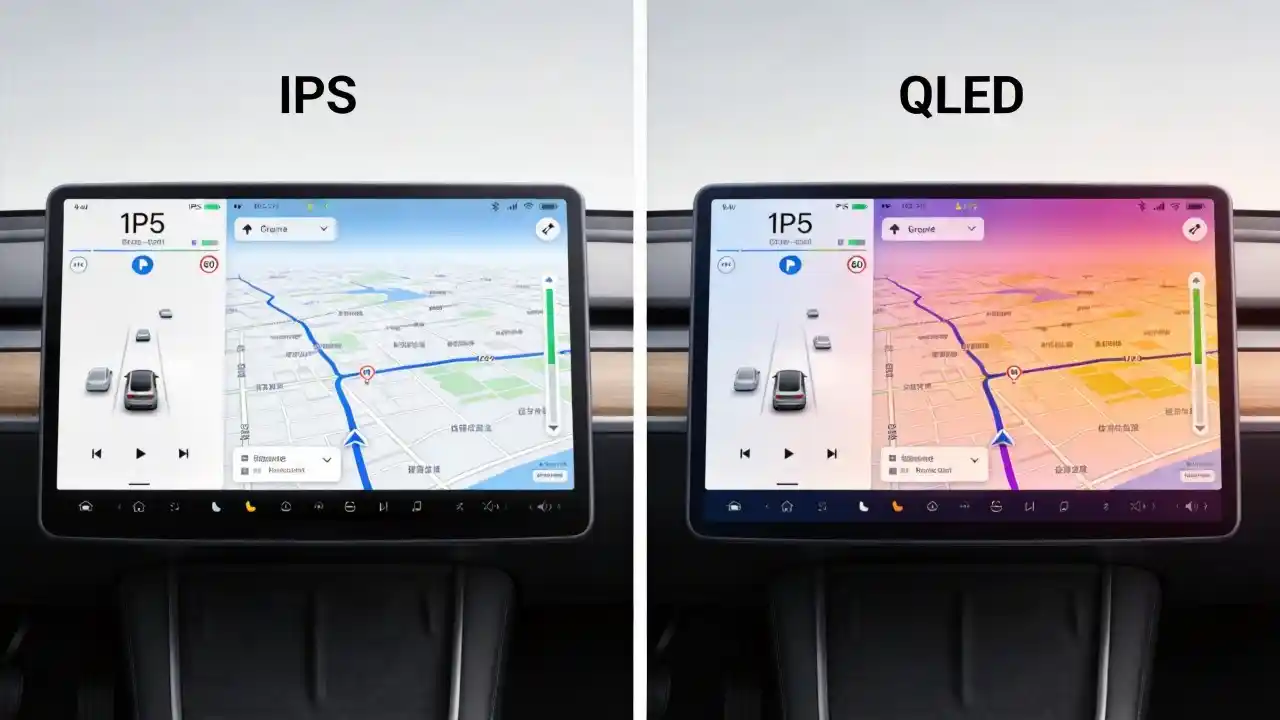
Display quality is the first thing a customer notices, and the first thing they complain about when it’s wrong. Choosing between IPS and QLED panels affects sunlight readability, unit cost, and how your product line gets positioned against competitors.
This guide defines both technologies, compares them across the dimensions that actually matter for bulk sourcing, and walks through which panel fits which business scenario. For a broader overview of car stereo hardware components, see our complete guide.
Core Definitions: IPS vs QLED Car Display Panels
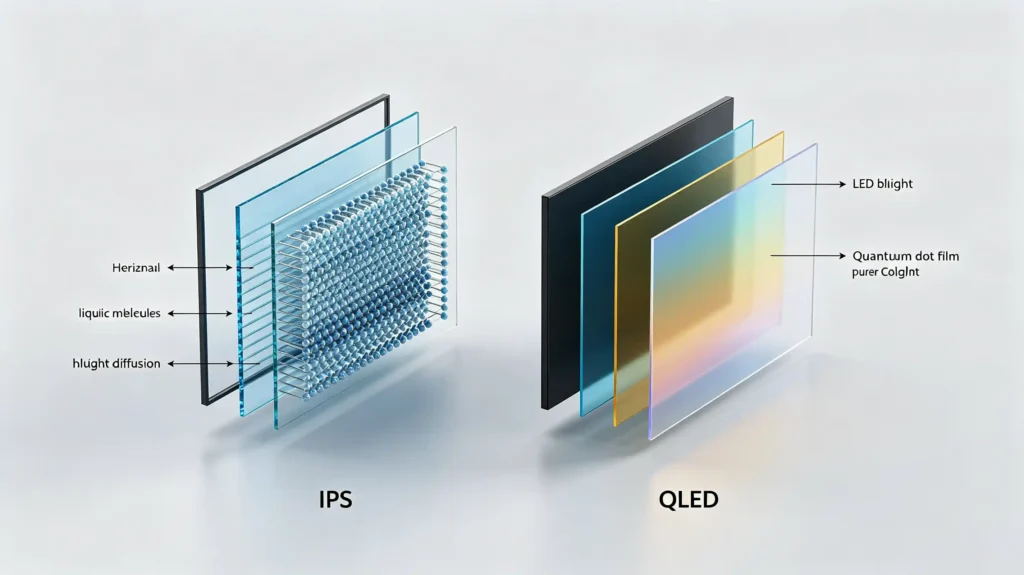
IPS (In-Plane Switching) is a type of LCD panel technology where liquid crystals align parallel to the panel surface. That arrangement produces wide viewing angles, up to 178 degrees, and accurate color reproduction. It’s the most common display technology in aftermarket car stereos today.
QLED (Quantum Dot Light-Emitting Diode) works differently. It adds a quantum dot film as a backlight enhancement layer on top of a standard LED backlight. That layer produces higher brightness, purer colors, and better contrast than a standard LCD panel.
The core technical distinction is worth remembering: IPS describes how liquid crystals are arranged within the panel, while QLED describes a backlight enhancement layer. The two aren’t mutually exclusive — some displays combine both. In practice, automotive aftermarket comparisons usually mean a standard IPS panel versus a QLED-enhanced panel with higher brightness and color performance at a higher cost. Both technologies rely on an LED backlight; the quantum dot film is what separates them.
IPS Display Car Stereo: Core Strengths & Automotive Application Advantages
IPS earns its position as the default choice in car stereos through three consistent strengths.
- Wide viewing angles — color and contrast stay consistent even from extreme angles, which matters in a car where the driver and passenger view the screen from different positions.
- Accurate color reproduction — true-to-life colors that don’t shift or wash out depending on viewing angle, which supports navigation readability and media playback quality.
- Reasonable cost — a mature manufacturing process makes IPS cost-effective at bulk production volumes, which is why it remains the most commonly used display in car stereo wholesale.
IPS panels are also widely available with automotive-grade temperature resistance and integrated capacitive touch, backed by a well-established supply chain. IPS remains the most common display technology across standard product lines, and its mature manufacturing process supports consistent quality for bulk wholesale orders.
QLED Display Technology: Core Strengths & Automotive Application Advantages
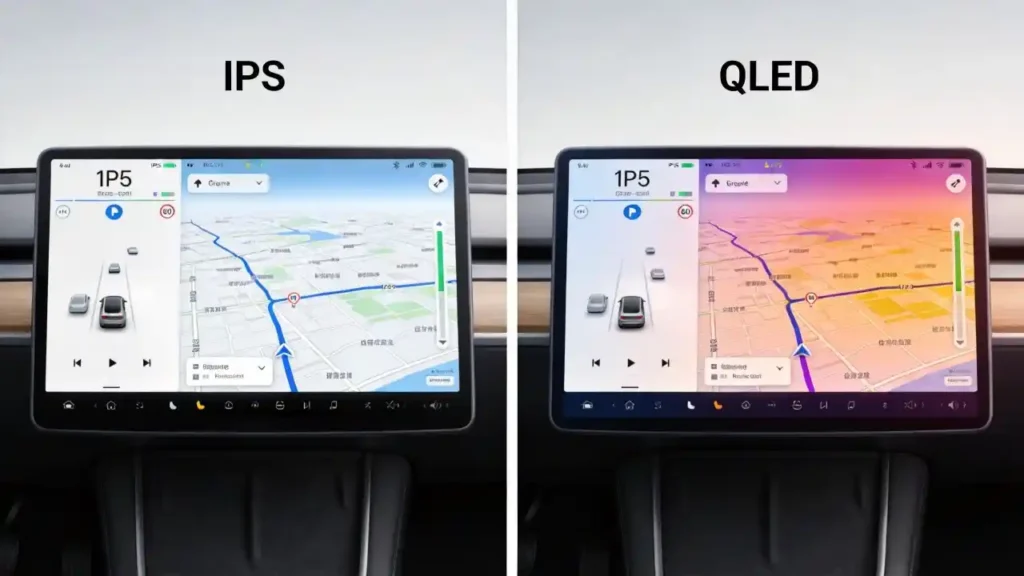
QLED targets a different priority: visual performance that justifies a higher price point.
- Higher brightness — the quantum dot layer boosts brightness significantly, with QLED panels reaching 800 to 1,500 cd/m² peak brightness, critical for outdoor visibility in direct sunlight.
- Purer, wider color gamut — quantum dots produce more saturated, accurate colors, which enhances media viewing and makes navigation maps easier to read in bright conditions.
- Better contrast — deeper blacks and brighter whites improve overall visual experience compared to standard IPS panels.
The automotive-specific advantage is straightforward: enhanced sunlight readability, with less reflection-related eye strain for drivers spending long hours behind the wheel. QLED works well as a premium upsell option specifically, since enhanced brightness and color performance give dealerships a genuine reason to charge more.
IPS vs QLED: Full Side-by-Side Benchmark Comparison
| Dimension | IPS Display | QLED Display |
|---|---|---|
| Brightness | Typically 400–600 nits | 800–1,500 cd/m² peak |
| Color gamut | Solid, accurate | Wider, more saturated |
| Contrast ratio | Standard LCD-level | Improved, deeper blacks |
| Viewing angle | Excellent, up to 178° | Excellent, comparable to IPS |
| Outdoor visibility | Good | Superior in direct sunlight |
| Power consumption | Lower | Somewhat higher |
| Operating temperature | Automotive-grade options available | Automotive-grade options available |
| Touchscreen compatibility | Capacitive touch standard | Capacitive touch standard |
| Typical cost premium | Baseline | 15–30% higher than IPS |
| Best use case | Standard wholesale, cost-sensitive markets | Premium upgrades, high-glare environments |
For more details on touch interface options, explore our guide on automotive touchscreen technology.
The brightness gap is the real differentiator — QLED significantly outperforms IPS where direct sunlight is a daily reality. Both technologies are available in automotive-grade configurations, and QLED’s quantum dot films have shown solid long-term stability across automotive temperature ranges. Resolution, whether HD or FHD, is available on both panel types. Resolution is one factor in display quality. See our car stereo display resolution guide for detailed guidance
How to Choose Between IPS and QLED for Your B2B Business
- 4S dealership standard upgrades: IPS is the go-to recommendation. Excellent viewing angles and color at a competitive cost satisfy most customer expectations, with better margins than budget panels.
- 4S dealership premium upgrades: QLED is a strong upsell. Customers in premium segments notice and pay for superior brightness and color, turning the display into a genuine product differentiator.
- Cross-border wholesale, emerging markets: IPS is the practical choice. Cost-sensitive buyers prioritize price over peak brightness, and IPS remains the established standard in markets like Southeast Asia and the Middle East.
- Cross-border wholesale, mature markets: QLED is gaining ground as buyers in the EU and North America increasingly understand the value of outdoor visibility — worth considering for premium product lines.
- Fleet and commercial operators: IPS covers basic navigation and media needs. QLED only makes sense where vehicles spend significant time in high-glare conditions, such as trucks and buses.
- OEM/ODM automaker projects: QLED for premium vehicle segments, IPS where cost control is the priority.
Common Display-Related Sourcing Risks & Red Flags
- Misleading “QLED” claims — some suppliers advertise QLED while shipping a basic IPS panel with slightly improved backlighting. Verify actual brightness, color gamut, and quantum dot film presence through direct testing, not the listing description.
- Inferior touch integration — poor capacitive touch sensor bonding causes ghost touches or unresponsive zones. Test touch performance across the entire screen during sample evaluation, not just the center.
- Low brightness in direct sunlight — insufficient brightness causes legibility problems outdoors. Verify specs and test under direct light: 400–600 nits minimum for IPS, 800+ nits for QLED.
- Temperature-related failures — non-automotive-grade panels fail in high heat. Confirm automotive-grade certification and ask about high-temperature QC testing at 60°C.
- Inconsistent viewing angles — some panels shift color when viewed from the passenger side. Check this directly during physical inspection, not from a spec sheet.
Always order samples and test under real-world conditions — direct sunlight, vehicle interior heat, wide-angle viewing — before committing to bulk production. A 48-hour aging test combined with 60°C high-temperature testing catches most panel defects before they reach the field.
FAQ
What is the outdoor visibility difference between IPS and QLED car displays in direct sunlight?
QLED displays are significantly easier to read in direct sunlight, thanks to higher peak brightness (800–1,500 cd/m² versus 400–600 nits for typical IPS panels). IPS remains usable outdoors but can wash out more in intense light. For vehicles spending extended time in bright, high-glare conditions, this gap is the main reason buyers choose QLED despite the added cost.
Which display technology is more suitable for high-temperature and high-vibration automotive environments?
Both technologies are available in automotive-grade configurations rated for typical in-vehicle temperature and vibration conditions, so the display technology itself isn’t the deciding factor. What matters more is whether a specific panel has passed proper QC — high-temperature testing at 60°C and vibration testing — regardless of whether it’s IPS or QLED.
How much higher is the procurement cost of QLED car displays compared to IPS panels?
QLED typically costs 15 to 30 percent more than IPS, depending on specific brightness and color gamut specifications, plus order volume. For buyers evaluating margin, this premium usually gets recovered through higher retail pricing on premium product lines. QLED’s visual advantages are noticeable enough that customers accept paying more for them.
What is the visual experience difference between FHD and HD resolution on IPS/QLED panels?
FHD delivers sharper text and finer map detail than HD, which is noticeable on larger screens or when displaying detailed navigation graphics. That said, resolution and display technology are separate factors. An FHD IPS panel and an HD QLED panel each have distinct strengths, so buyers should evaluate resolution and panel technology as independent specs, rather than assuming higher resolution always means better overall visual quality.
What automotive-grade certifications must qualified car display panels pass?
Look for confirmation of operating temperature range testing, vibration resistance testing, and general electronics compliance such as CE, FCC, and RoHS where relevant to your export market. Request documented high-temperature test results (60°C is a reasonable benchmark) directly from suppliers rather than assuming compliance based on a product description alone.
Conclusion
IPS and QLED solve different problems for different buyers, just as Qualcomm vs MediaTek for car stereos represents different processor priorities. IPS delivers reliable, cost-effective performance that satisfies most standard sourcing needs. QLED justifies a premium price where outdoor visibility and visual impact genuinely matter to the end customer. Matching the panel technology to your specific market — and verifying real specifications rather than trusting labels — is what protects both your margins and your after-sales reputation.
Sourcing Android car stereos with the right display technology for your market? Contact our team to discuss IPS or QLED configurations, or explore our current Android head unit product lineup.