A car stereo spec sheet usually reads like a checklist — processor, screen, RAM, done. What it doesn’t show is how those pieces actually work together, and that gap is exactly where bulk orders run into trouble. A unit can look complete on paper and still fail in the field because one module wasn’t built to talk to the others properly.
This guide walks through the actual hardware architecture behind a commercial-grade car stereo — the core components, how they’re built as modules, the standard setup process for bulk projects, what determines real-world performance, and how to evaluate all of it before placing a bulk order.
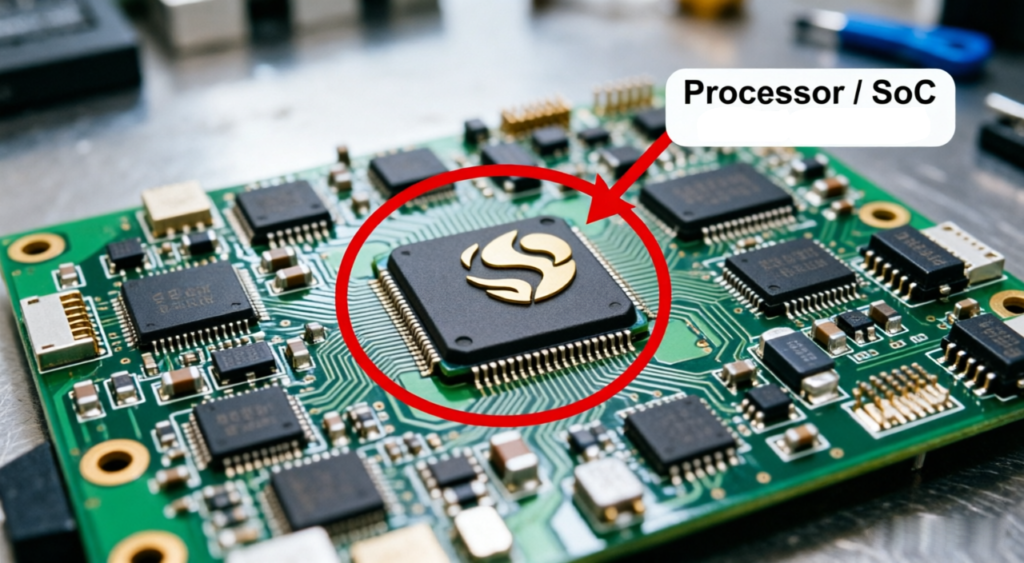
What Is the Core Architecture of a Car Stereo Hardware System?
Car stereo hardware architecture is the complete physical system that powers the unit — processing, display, audio, communication, and power management working as one system, not five separate parts bolted together. Power supply is a key hardware consideration. Read our car stereo power supply guide for a complete breakdown.
- Processing module — SoC, RAM/ROM — the computing brain running everything else.
- Display module — screen panel, touch sensor, backlight — the visual interface.
- Audio module — DSP chip, amplifier, audio outputs — sound processing and output.
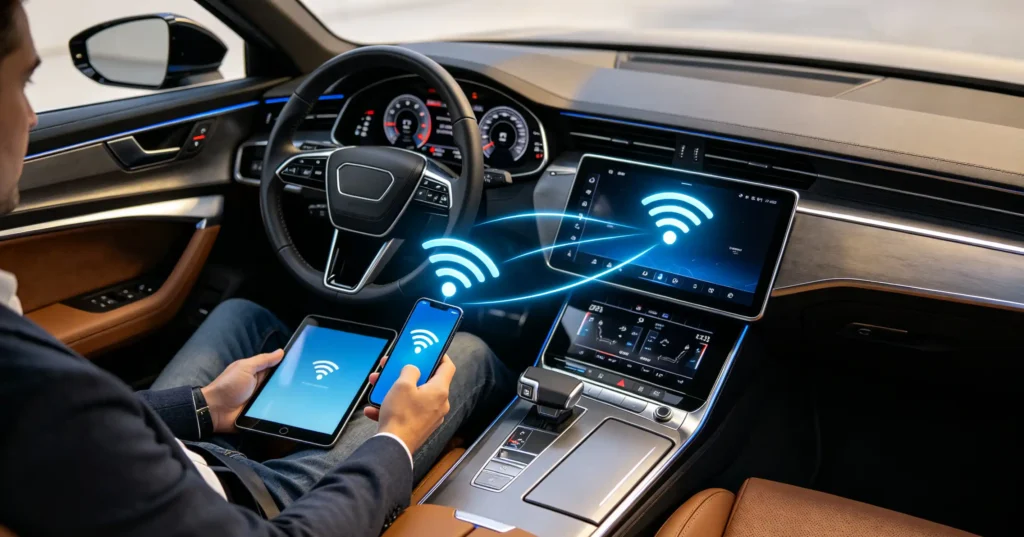
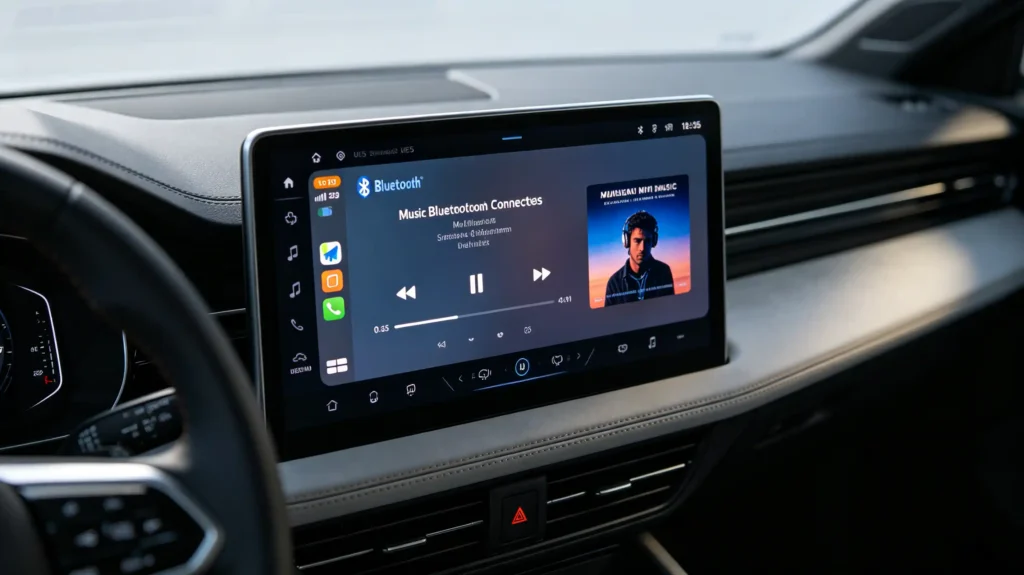
- Communication module — CAN Bus, Bluetooth, Wi-Fi, 4G/5G — vehicle and device connectivity.
- Power module — voltage regulation, power filtering — stable electricity supply.
The processor coordinates all of this through data buses, the power module keeps voltage stable across the whole system, and the audio, display, and communication modules each process and output their piece of the signal. For B2B buyers, understanding this architecture isn’t academic — it’s what lets you actually evaluate a supplier’s capability and spot the weak point that’s going to become next quarter’s after-sales ticket, rather than discovering it after a container’s already shipped.
Core Car Stereo Hardware Components: Full Breakdown & Functions
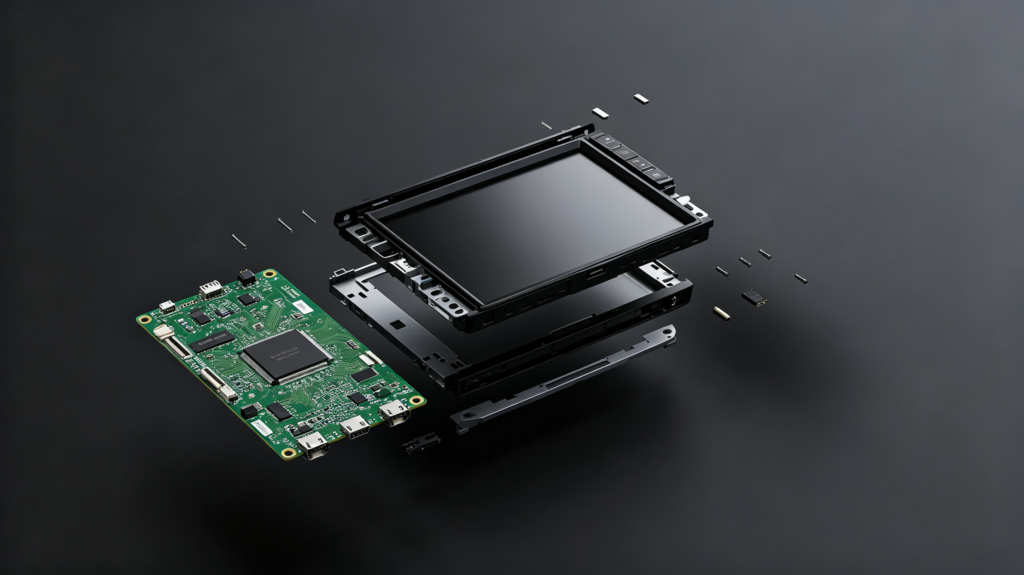
Six components make up a genuinely complete car stereo system, and each one carries its own technical standard worth checking before a bulk order.
The processor (SoC) manages every computing task — OS, navigation, media, multitasking — and AEC-Q100 certification is the marker of automotive-grade reliability worth asking about directly. For a detailed comparison of leading platforms, see Qualcomm vs MediaTek for car stereos.
Memory (RAM/ROM) splits into two jobs: RAM handles running apps and multitasking, with 4GB or more recommended for smooth operation, while ROM stores the OS, maps, and user data, where 64GB or more avoids the storage complaints that plague budget units. The display panel covers resolution (HD or FHD), brightness (400 to 600-plus cd/m²), and panel technology (IPS or QLED), with capacitive touch as the standard for anything commercial-grade. Compare IPS vs QLED display technology to choose the right panel.
Audio hardware runs through a DSP chip for real-time processing, an amplifier IC for power output, and audio outputs — RCA for standard analog, optical for premium digital setups. Learn more about DSP audio processing in car stereos. Communication modules cover the CAN Bus decoder for vehicle integration, Bluetooth 5.0 or newer for hands-free and audio, Wi-Fi for OTA updates, and optional 4G/5G. And the power supply — voltage regulation, noise filtering, a proper power management IC — matters more than buyers often expect, since it’s what keeps everything else stable inside a genuinely noisy automotive electrical environment.
Car Stereo Module Design: Modularization & Integration Technology
Modular design means car stereo hardware is built from interchangeable pieces — processor board, display assembly, audio board, power board, communication module — that can be configured and swapped independently rather than treated as one fused unit.
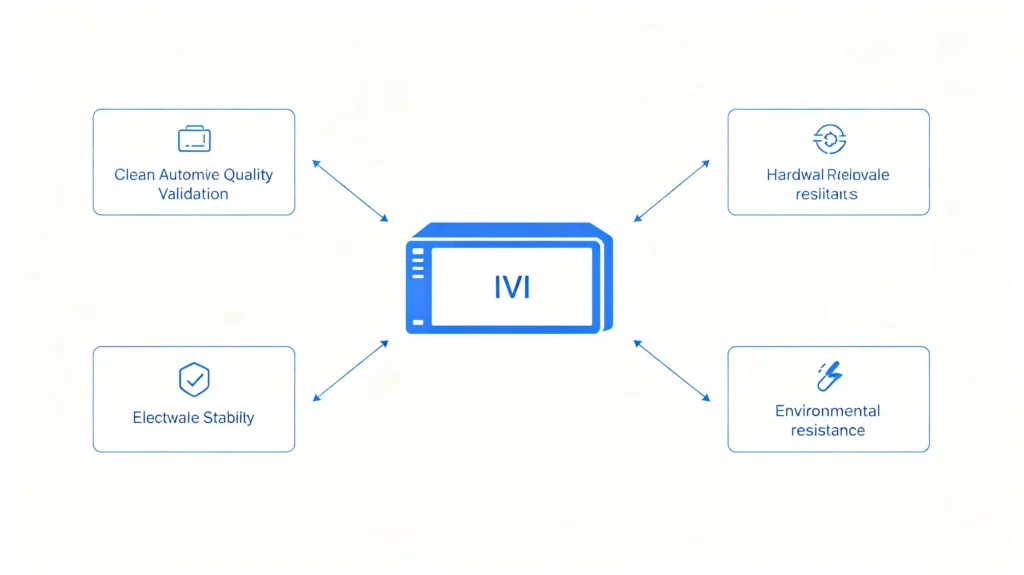
The benefits show up across the whole supply chain: easier customization since modules mix and match, simpler repairs since a single failed module gets replaced rather than the whole unit, faster production scaling, and clearer quality control at each stage of assembly. None of that matters much, though, if the modules can’t actually survive a vehicle’s operating environment — which is where automotive integration gets genuinely demanding. Components need to run reliably up to 60°C or higher, matching the reality of a parked car in summer sun. They need to withstand road vibration without connections loosening over time. And they need proper shielding against electromagnetic interference, since automotive electrical environments are electrically noisy in ways a living room simply isn’t.
Getting this right comes down to a few integration essentials: proper thermal management through heat sinks, secure mounting with vibration-resistant connectors, and EMI shielding through grounding and filtering. Automotive-grade components are tested against all three; consumer-grade components generally aren’t, which is exactly why they don’t hold up in this application regardless of how they perform on a bench test.
Auto Audio Hardware Setup: Standardized Workflow for Bulk Projects
A standardized six-step process is what separates a bulk project that scales cleanly from one that generates a stack of inconsistent units.
It starts with requirements definition — target market, vehicle compatibility (DIN size, CAN Bus requirements), and the actual feature set needed (GPS, Bluetooth, audio quality, display size). From there, component selection locks in the processor platform (Snapdragon or MediaTek), memory configuration, display panel, audio hardware, and communication modules to match both the requirements and the budget. System integration follows: assembling and configuring components with proper thermal management, secure mounting, and correct interconnection between modules.
Software and firmware loading comes next — installing the OS, drivers, and application firmware, then verifying every module is actually recognized and configured correctly, not just powered on. Quality testing is where the real filtering happens: full function tests across IQC, IPQC, and FQC stages, a 48-hour aging test, high-temperature testing at 60°C, and vibration testing. Final verification closes the loop — confirming every feature works correctly, testing sample units in actual target vehicles, and documenting the results for traceability.
Core Factors Determining Car Stereo System Hardware Performance
Six factors determine whether a car stereo actually performs well in daily use, and none of them can be judged in isolation from the others.
Processor performance sets the ceiling for everything else — a faster processor means a smoother UI, quicker navigation, and better multitasking, which is why established automotive-grade platforms like Snapdragon and MediaTek are worth prioritizing over unproven alternatives. Memory configuration works alongside this: 4GB or more of RAM keeps multitasking smooth, while 64GB or more of ROM supports maps and apps without the slow degradation that comes from running low on storage. Display quality — higher resolution and brightness for visual clarity, automotive-grade panels for reliability across temperature extremes — shapes the experience end users notice first.
Audio hardware quality is where premium and budget units genuinely separate: the DSP chip and amplifier together determine sound quality and power output, and this is one of the more visible differentiators in a side-by-side comparison. Component quality and QC tie it together — automotive-grade components hold up in harsh environments long-term, and proper QC processes catch defects before they ever reach a customer. Thermal management rounds this out, since units that run hot throttle, degrade faster, and post higher failure rates over their service life than units with proper heat dissipation designed in from the start.
B2B Sourcing Guide: Hardware-Level Evaluation & Quality Control Standards
Five evaluation dimensions cover what actually matters when sourcing car stereo hardware at scale, rather than trusting a supplier’s own claims.
Component quality means verifying automotive-grade certifications — AEC-Q100 for processors specifically — and confirming components are sourced from authorized suppliers, backed by IQC documentation rather than a verbal assurance. Manufacturing capability comes down to factory size, production line count, and SMT capability, all worth confirming can actually scale to your order volume rather than just your sample order. QC process should be fully documented across IQC (incoming), IPQC (in-process), FQC (function testing), and OQC (pre-shipment), alongside a 48-hour aging test, 60°C high-temperature test, and vibration test.
Certification compliance varies by destination market — CE for Europe, FCC for North America, RoHS for environmental compliance, ISO 9001 for quality management, and IATF 16949 for automotive-specific quality where relevant. Customization support closes the list: hardware configuration options (processor, RAM/ROM, display) and software customization (UI, boot animation) that let you actually differentiate rather than reselling identical hardware. The practical advice across all five: request samples, request QC documentation, verify certifications directly, and test units in your actual target vehicle environments before committing to volume.
Common Hardware Technical Risks & B2B Procurement Avoidance Guide
A handful of technical risks account for most bulk after-sales losses, and each one is checkable before a container ships.
Non-automotive-grade components fail in high-temperature or vibration environments — avoided by verifying automotive-grade certifications and requesting actual test reports rather than a claim. Inadequate thermal management leads to units that overheat, throttle, or fail outright — avoided by verifying thermal design and high-temperature test results directly. Power supply instability causes resets or failures under voltage fluctuation — avoided by verifying power circuit design and voltage stability test results. Incompatible hardware modules — mismatched display, audio, or communication components — cause function loss, avoided by verifying module compatibility before production starts. Inflated specifications, where advertised specs don’t match actual hardware, are avoided by ordering samples and verifying with diagnostic tools. And poor QC processes let units pass a line test but fail in the field — avoided by verifying genuine 48-hour aging and high-temperature testing rather than taking a QC claim at face value.
FAQ
What is the core hardware component that determines the sound quality of a car stereo?
The DSP chip and amplifier together determine sound quality more than any other component — the DSP handles real-time processing like equalization and time alignment, while the amplifier determines power output and clarity. A strong processor and good display don’t compensate for weak audio hardware, so buyers prioritizing sound quality should evaluate this pairing specifically rather than assuming it scales with overall unit price.
How to verify the reliability of car stereo hardware in high-temperature and vibration automotive environments before bulk ordering?
Request documented test results for a 48-hour aging test, high-temperature testing around 60°C, and vibration testing that simulates real road conditions. Sample testing is worth doing directly too — running units through extended operation and checking performance under heat yourself, rather than relying entirely on a supplier’s own test reports without independent verification.
What is the core difference between automotive-grade and consumer-grade car stereo hardware components?
Automotive-grade components are certified and tested for a wider operating temperature range, vibration resistance, and long-term reliability under conditions a vehicle interior actually produces. Consumer-grade components, often adapted from phones or tablets, may perform well initially but carry meaningfully higher risk of failure once exposed to sustained heat, vibration, and electrical noise over time.
What hardware components are most prone to failure in car stereos for commercial vehicle applications?
Display assemblies and communication modules see the most failures in commercial use, given the combination of heavy daily use, temperature extremes, and constant vibration those vehicles experience. Power supply components are a close third, since commercial vehicles often have less stable electrical systems than passenger cars, making voltage stability testing especially worth prioritizing for fleet-oriented orders.
Can car stereo hardware modules be replaced and upgraded individually after the system is installed?
Some modules, like the display assembly, can sometimes be replaced as standalone repairs. Core elements like the processor board are typically fixed at the point of manufacturing rather than field-upgradeable. That’s exactly why getting processor, memory, and platform specifications right during sourcing matters more than assuming they can be improved later.
Conclusion
Car stereo hardware is a system, not a spec list — processing, display, audio, communication, and power all have to work together, and automotive-grade quality at every module is what actually determines whether a bulk order performs reliably in the field. Evaluating suppliers at the component level, verifying documented QC rather than claims, and testing samples in real target vehicles is what keeps hardware risk from becoming an after-sales cost.
Sourcing car stereo hardware with verified automotive-grade quality? Contact our team to discuss component configuration and customization options for your target market, or explore our current car stereo product lineup.