Every modern vehicle runs dozens of electronic control units talking to each other constantly, and CAN Bus is the protocol that makes that conversation possible. Understanding how it actually works is the difference between an aftermarket unit that preserves original vehicle functions and one that doesn’t.
This guide covers what CAN Bus is and how it compares to LIN Bus and MOST Bus. It also covers its relationship to OBD II diagnostics, and what it means for aftermarket integration and sourcing decisions. For a practical guide on one key integration area, see our steering wheel control integration guide.
What Is CAN Bus? Core Definition & Working Principle
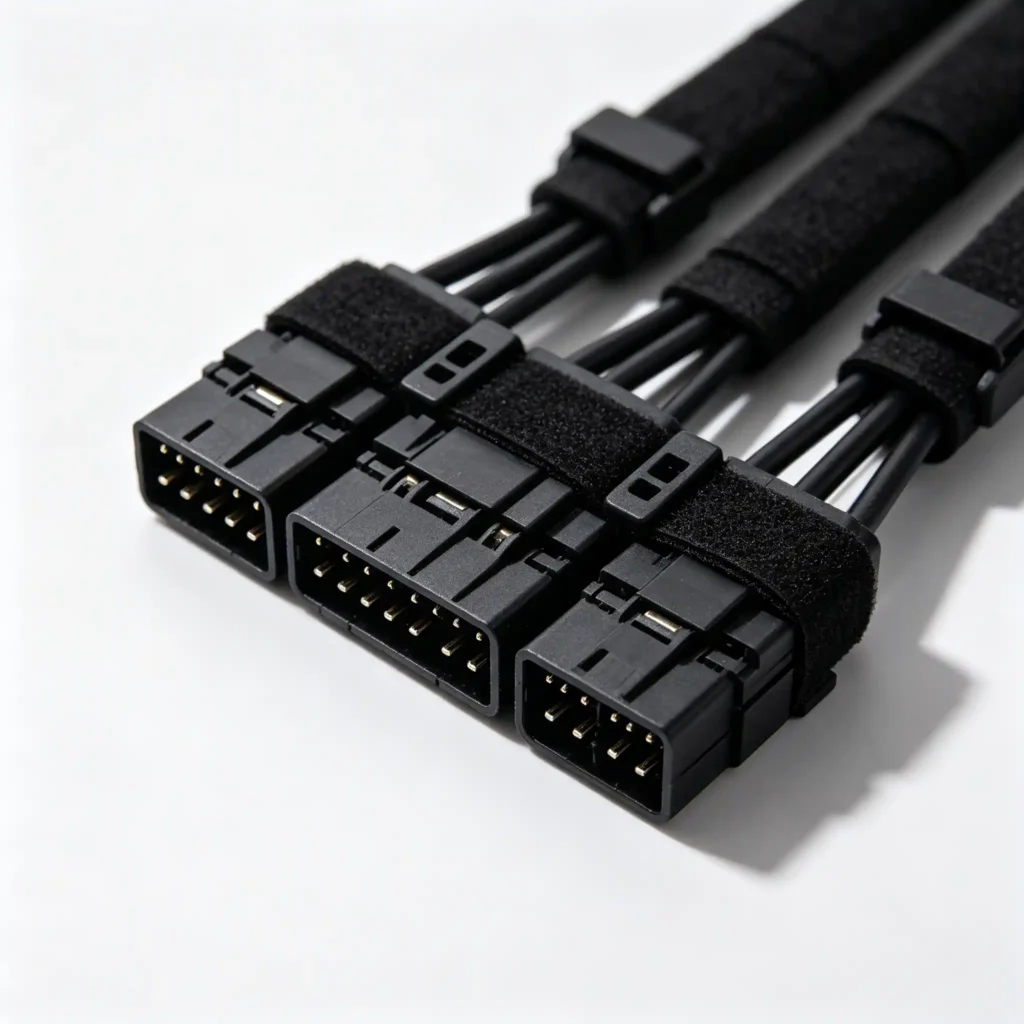
CAN Bus (Controller Area Network) is a robust, multi-master serial communication protocol developed by Bosch in the 1980s for automotive use. It lets microcontrollers and electronic control units (ECUs) communicate directly, without a central host computer managing every message.
A two-wire differential signal — CAN_H and CAN_L — carries data across the network, and every ECU on it can send and receive messages. When multiple ECUs transmit at once, CSMA/CD (Carrier Sense Multiple Access with Collision Detection) resolves the conflict, letting higher-priority messages through first.
CAN Bus exists because vehicles needed a better solution than a heavy, complex wiring harness connecting every component point to point. A single shared network lets dozens of ECUs — engine, transmission, ABS, airbags, steering, climate, infotainment — talk over one line instead of dozens.
Key features include message priority arbitration, built-in error detection, and high noise immunity, which matters given how electrically noisy a vehicle’s environment actually is. The protocol is standardized under ISO 11898 for the physical and data link layers, with SAE J1939 covering heavy-duty vehicles and diagnostics.
CAN Bus vs LIN Bus vs MOST Bus: Key Differences & Applications
Modern vehicles layer several networks, each suited to a different job.
LIN Bus (Local Interconnect Network) is a low-cost, low-speed single-wire network, topping out around 20 kbps, used for non-critical functions: window controls, seat adjustment, mirror controls, interior lighting.
MOST Bus (Media Oriented Systems Transport) is a high-speed multimedia bus reaching up to 150 Mbps, built for infotainment, audio, video, and navigation systems that stream media — though newer vehicles are shifting to Ethernet for this role.
CAN Bus occupies the middle ground: medium-speed, up to 1 Mbps, but highly reliable and noise-immune. It’s the protocol for critical functions — engine control, transmission, braking, steering, and body electronics.
| Dimension | LIN Bus | CAN Bus | MOST Bus |
|---|---|---|---|
| Speed | Up to 20 kbps | Up to 1 Mbps | Up to 150 Mbps |
| Cost | Lowest | Moderate | Highest |
| Wiring | Single-wire | Two-wire differential | Fiber optic or coax |
| Application | Peripheral controls | Critical vehicle functions | Multimedia streaming |
| Reliability | Basic | High noise immunity | High bandwidth focus |
The hierarchy follows this logic: CAN Bus handles safety- and function-critical tasks, LIN Bus handles low-cost peripheral control, and MOST (or increasingly Ethernet) handles high-bandwidth multimedia.
CAN Bus & OBD II: Connection, Compatibility & Diagnostic Functions
OBD II (On-Board Diagnostics II) is the standardized diagnostic system required on every vehicle sold in the US since 1996, providing a standardized 16-pin connector (DLC) for reading diagnostic trouble codes and real-time vehicle data.
CAN Bus is the communication protocol modern vehicles actually use internally. The OBD II connector is simply the standardized access point into that network for diagnostic tools.
ISO 15765-4 is the most common CAN-based diagnostic protocol in use today. SAE J1939 covers heavy-duty vehicles, and SAE J1850 still shows up in older vehicles predating widespread CAN adoption.
Through this connection, diagnostic tools can read sensor data, retrieve fault codes, monitor emissions status, and run component activation tests. For diagnostic tool manufacturers, fleet operators, and 4S dealerships, CAN Bus compatibility is the foundation that makes OBD II diagnostics possible at all.
CAN Bus Integration for Aftermarket Automotive Electronics
Factory-original head units are built directly into the vehicle’s CAN Bus network. Replacing one means the aftermarket unit needs to “speak” the same protocol to retain any original vehicle functions at all.
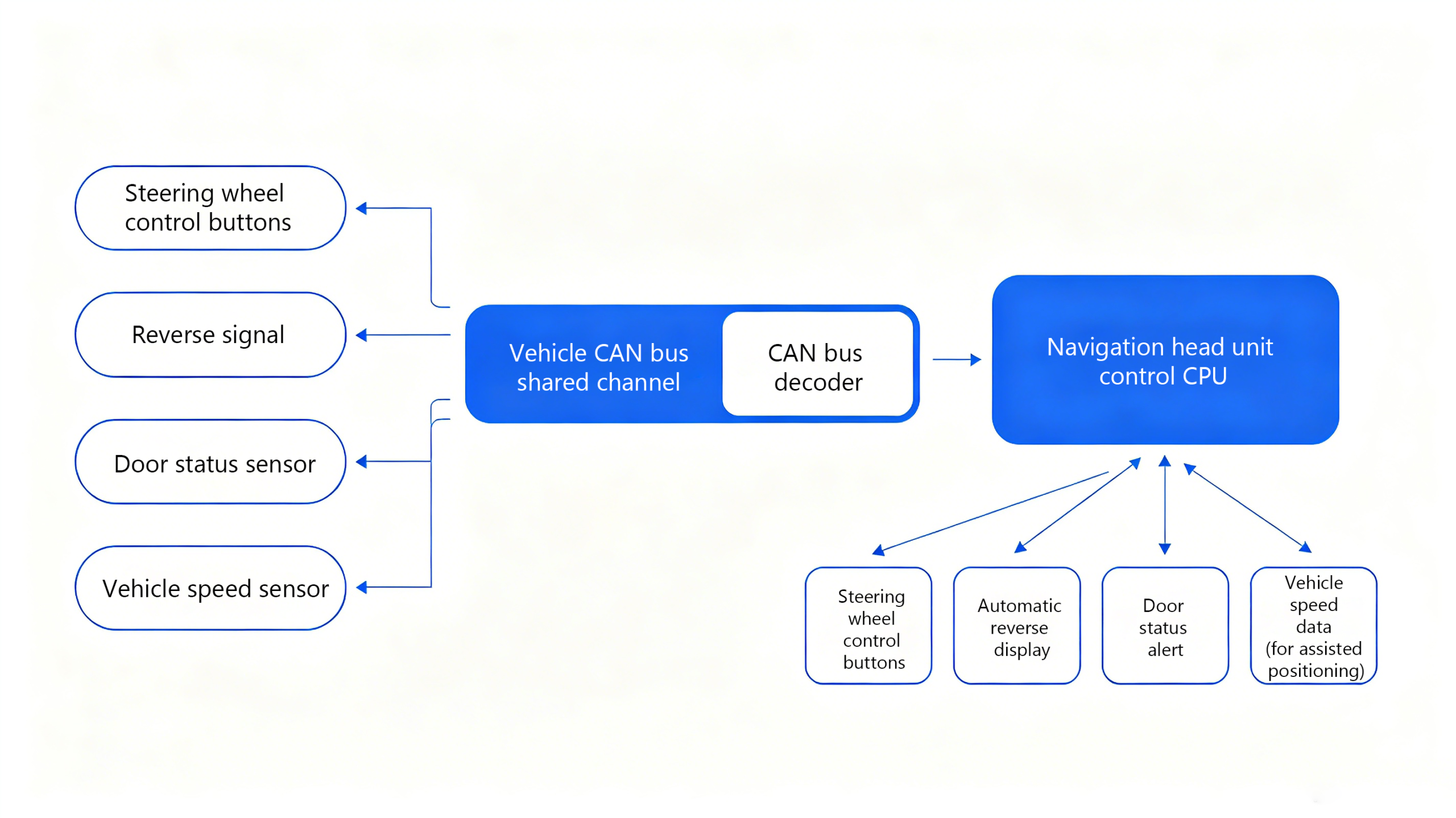
Proper CAN Bus integration is what enables an aftermarket unit to support several original functions. That includes steering wheel controls and a reverse camera trigger when shifting into reverse. It also covers the vehicle speed signal for navigation, door and trunk status, air conditioning status display, and parking sensor audio.
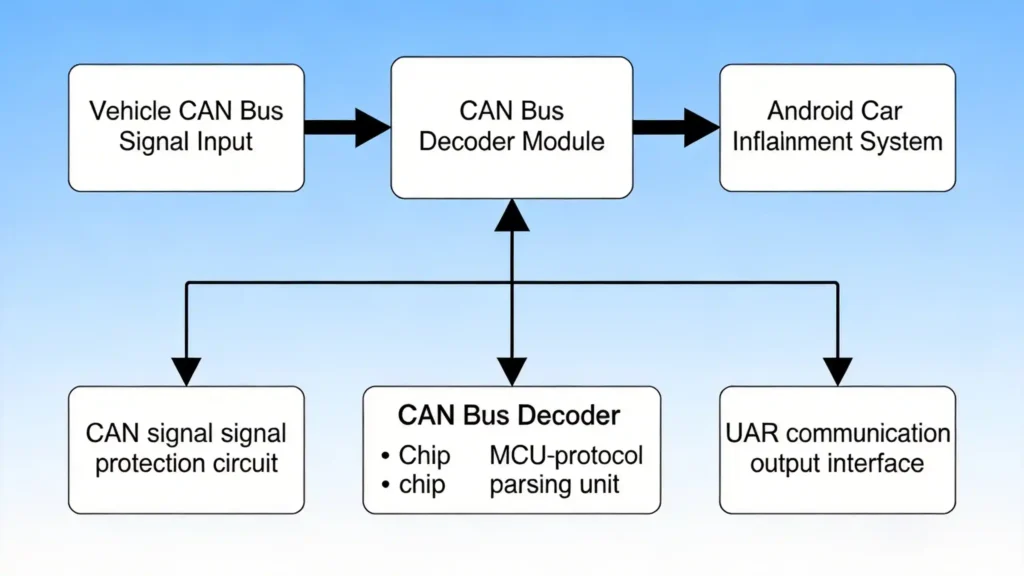
A CAN Bus decoder is what makes this possible. It translates vehicle-specific CAN Bus messages into signals the aftermarket head unit can understand, and decoder quality directly determines how many original functions survive that translation.
Integration depth varies by vehicle brand. European vehicles — BMW, Audi, Mercedes — tend to run complex, vehicle-specific protocols. Japanese vehicles — Toyota, Honda, Nissan — are often more straightforward to adapt, and domestic Chinese vehicles vary widely by manufacturer.
For B2B buyers, CAN Bus compatibility is one of the clearest differentiators between a low-quality and a high-quality aftermarket unit. Manufacturers with self-developed CAN Bus decoders covering 200+ vehicle models can adapt faster to new or less common brands than those relying on third-party protocol libraries.
Steering Wheel Control & CAN Bus: How They Work Together
Steering wheel buttons — volume, track, voice, phone — send button-press signals into the vehicle’s CAN Bus network as specific CAN messages. In the factory setup, the original head unit reads and responds to these directly.
The aftermarket challenge appears once the factory head unit is removed: those same CAN messages need interception and interpretation by whatever replaces it. The CAN Bus decoder handles that job. It reads the steering wheel CAN messages and translates them into signals the aftermarket unit understands — volume up becomes a +1 signal to the amplifier, for example.
Older vehicles sometimes use resistive ladder steering wheel controls, a simpler analog approach, while most modern vehicles use digital CAN Bus-based controls instead.
Not every decoder supports every function equally. Some only handle basic volume and track control, while premium decoders extend to phone answer/end, voice command activation, and custom button mapping.
Verifying exactly which steering wheel functions a decoder supports is worth doing before a bulk order, rather than assuming full coverage. Mismatched or incomplete protocol support is one of the more common sources of after-sales complaints in this category.
B2B Sourcing Guide: CAN Bus-Related Product Evaluation
A handful of factors separate a dependable CAN Bus product supplier from a risky one.
- Vehicle model coverage — how many brands and models does the decoder support? Verify against your specific target lineup.
- Protocol development capability — in-house development adapts faster to new vehicle models than third-party solutions.
- Function retention completeness — confirm which original functions are preserved: steering wheel controls, reverse camera trigger, climate display, door status, speed signal.
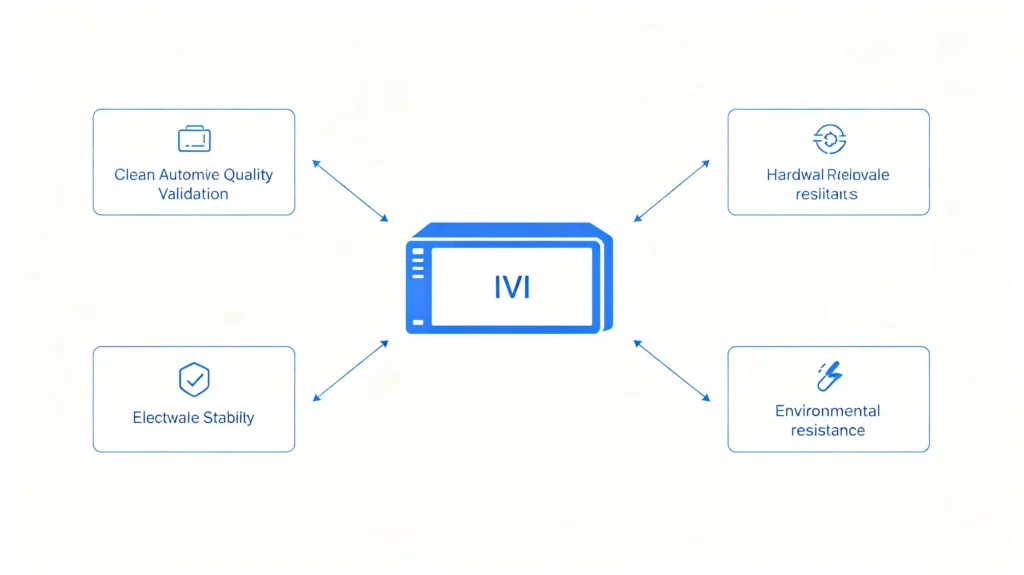
- QC and testing — verify the supplier runs CAN Bus protocol validation and 48-hour aging tests before shipment.
- Customization capability — can the supplier develop new protocols for less common vehicle models on request?
Request a vehicle compatibility list and test samples on actual vehicles before committing to a bulk order. This single step catches most of the mismatches that otherwise surface only after shipment.
CAN Bus Content Hub: Guides & Solutions
This section maps the broader CAN Bus content library for readers who want to go deeper into a specific topic:
- Technical guides: “CAN Bus Explained” (this page), “CAN Bus Troubleshooting Guide for Aftermarket Electronics”
- Compatibility: “CAN Bus Protocol Compatibility by Vehicle Brand,” “CAN Bus for OEM vs Aftermarket Automotive Electronics”
- Sourcing: “How to Choose a CAN Bus Decoder for Bulk Orders,” “CAN Bus Integration for Aftermarket Electronics”
- Product pages: CAN Bus Decoder Modules, Aftermarket Car Stereos with CAN Bus Integration, Custom CAN Bus Integration Solutions
FAQ
What is the essential difference between CAN Bus and OBD II?
CAN Bus is the underlying protocol vehicles use to let ECUs talk to each other. OBD II is the standardized diagnostic system and connector that gives external tools access to that same network. CAN Bus is the language; OBD II is the access point for reading it.
Why do aftermarket car stereos and navigation systems need a CAN Bus decoder?
Because factory head units are built directly into the vehicle’s CAN Bus network, removing one breaks that connection. A CAN Bus decoder translates the vehicle’s native protocol into signals an aftermarket unit can interpret. That’s what allows steering wheel controls, the reverse camera trigger, and other original functions to keep working after installation.
What factors affect CAN Bus compatibility across different vehicle brands and models?
Protocol complexity varies significantly by manufacturer — European brands like BMW and Mercedes often run more intricate, vehicle-specific protocols than Japanese brands like Toyota or Honda. A decoder built and tested for one brand’s protocol won’t necessarily work on another without dedicated development. That’s why broad, verified vehicle coverage matters more than a generic compatibility claim.
How can I verify if a CAN Bus decoder is compatible with the target vehicle model before bulk ordering?
Request the supplier’s actual vehicle compatibility list and confirm your specific models and years are on it, not just the general brand. Then test samples directly on real vehicles from your target lineup before committing to volume. Function retention can vary even across different trims and model years of the same vehicle.
Do different vehicle brands use completely different CAN Bus communication protocols?
Not completely — all comply with the same underlying standard (ISO 11898) — but manufacturers implement their own message formats and data structures on top of it. That’s why a decoder needs brand- and often model-specific development rather than one universal solution.
Conclusion
CAN Bus is the communication backbone that makes modern vehicle electronics — and the aftermarket products built to integrate with them — actually work together. Understanding how it compares to LIN and MOST Bus, how it connects to OBD II diagnostics, and what decoder quality actually determines gives B2B buyers a real foundation for evaluating CAN Bus products. That beats guessing based on a spec sheet.
Sourcing CAN Bus decoders or integration solutions for your target vehicles? Contact our team to discuss vehicle compatibility and protocol development, or explore our current CAN Bus decoder product lineup.