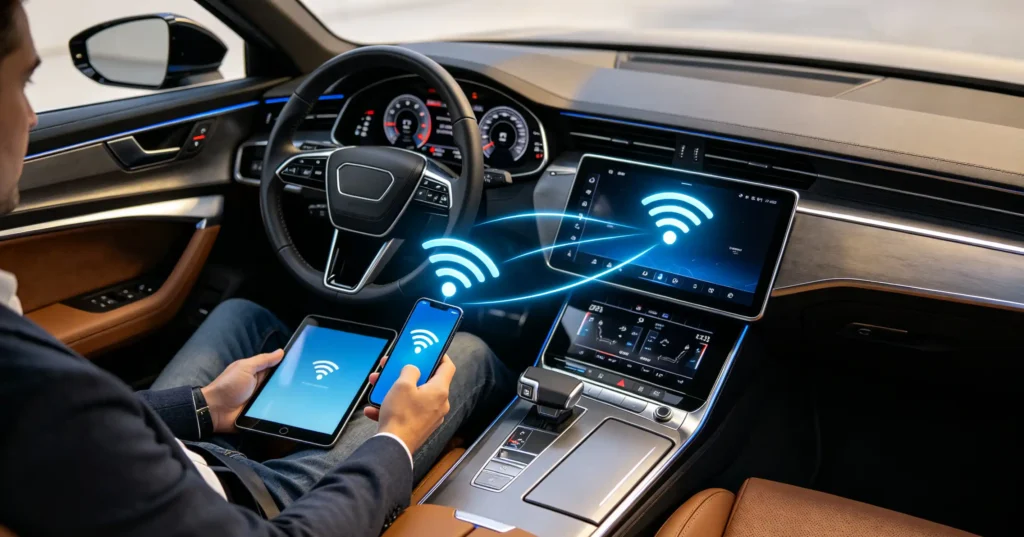
Volume and track buttons on a steering wheel are so ordinary that customers never think about them — right up until they stop working after an aftermarket head unit swap. That single missing feature generates a disproportionate share of after-sales complaints in this industry, and it almost always traces back to one thing: signal integration that wasn’t matched correctly to the vehicle.
This guide covers what steering wheel control integration actually is, how button mapping and signal types work, what interface modules do, the full integration workflow, and how to evaluate a solution before placing a bulk order. For foundational context on vehicle communication, see our what is CAN BUS guide.
What Is Steering Wheel Control Integration? Core Definition & Working Principle
Core Definition
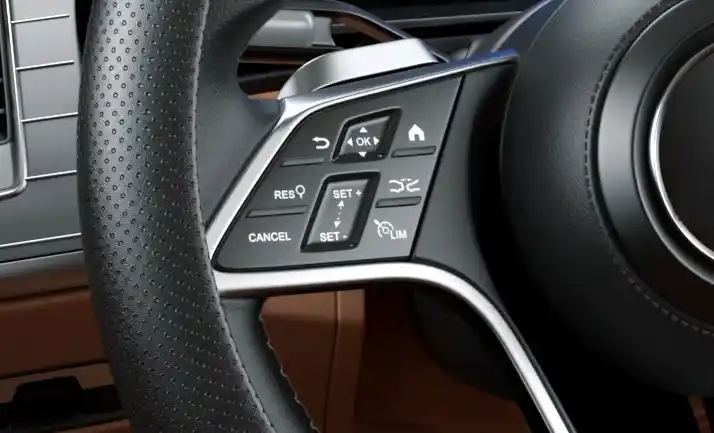
Steering wheel control integration is the process that lets an aftermarket head unit recognize and respond to a vehicle’s original steering wheel buttons — volume, track, source, phone, voice — through signal adaptation and dedicated interface hardware.
Why This Matters
This matters more than it might sound like it should. Steering wheel controls are a baseline expectation in modern vehicles, and losing them after an upgrade is one of the more common, and more frustrating, sources of after-sales complaints in this category — a customer notices immediately, and it reads as a defect even when the rest of the unit works perfectly.
The Working Principle
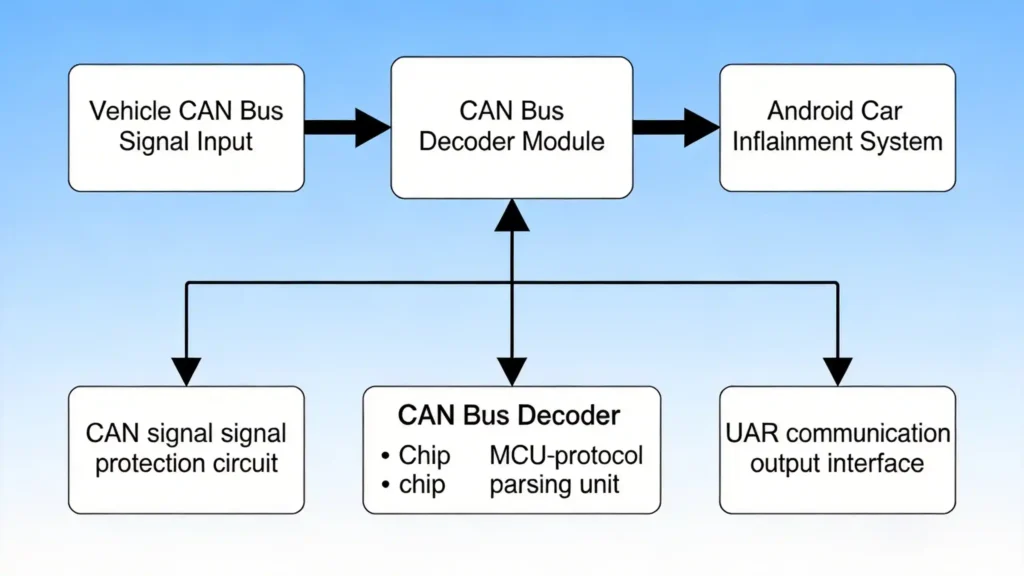
The working principle runs a consistent path: steering wheel buttons generate signals — CAN Bus messages, analog resistance, or LIN Bus, depending on the vehicle — an interface module reads and translates those signals, the head unit receives the resulting commands, and the corresponding function executes. A handful of components make this possible:
- Original vehicle steering wheel buttons — the physical controls generating the signal
- Signal interface module — a CAN Bus decoder or dedicated steering interface handling translation
- Wiring harness — connecting the module to both the vehicle and the head unit
- Compatible head unit — with a proper steering wheel control input to receive the translated commands
Integration quality here directly affects user satisfaction, product returns, and brand reputation for dealers and wholesalers — this isn’t a minor spec, it’s one of the more visible tests of whether a supplier’s CAN Bus work is actually solid.
Car Steering Button Mapping: Function Assignment & Configuration Logic
What Is Button Mapping?
Button mapping is the process of assigning specific steering wheel buttons to their corresponding head unit functions — volume up and down, track next and previous, source, phone answer and end, voice control, mute.
The process itself runs through the interface module: it reads a button’s signal, identifies which button was actually pressed, translates that into the correct head unit command, and the head unit executes the function. Vehicle brand matters more here than buyers often expect.
European vehicles — BMW, Audi, Mercedes — tend to run complex CAN Bus protocols. Japanese vehicles — Toyota, Honda, Nissan — often use analog resistance or simpler CAN implementations. American and Korean vehicles — Ford, GM, Hyundai, Kia — vary across a range of protocols depending on model and generation.
How the Process Works
Many interface modules support configurable mapping, which matters when a vehicle’s original button layout doesn’t line up cleanly with a head unit’s default function set — assigning “Mute,” for instance, to “Phone Answer” or “Voice” instead, if that better matches how the buttons are actually laid out.
For B2B buyers, the practical takeaway is straightforward: verify an interface module genuinely supports mapping for your specific target vehicle brands, since generic modules can fall short on less common button functions even when they claim broad compatibility.
Vehicle Multi-Function Switch Setup: Types & Compatibility
Four Signal Types
Four signal types cover nearly the entire steering wheel control landscape, and knowing which one a target vehicle uses is the first real compatibility question worth asking.
CAN Bus
CAN Bus is digital communication, the most common approach in modern vehicles built after roughly 2005, supporting multiple buttons over a single shared data bus.
Analog Resistance
Analog resistance works differently — each button carries a distinct resistance value, and the interface module reads the resulting voltage change to identify which one was pressed; it’s common in older vehicles and some Japanese brands specifically.
LIN Bus
LIN Bus offers lower-cost, lower-speed communication, and shows up for steering wheel controls in a meaningful share of modern vehicles.
Direct Wire
Direct wire is the simplest of the four — a straightforward switch closure — though it’s less common today and usually requires direct wiring to the head unit rather than going through a decoder.
Compatibility Requirements
Compatibility comes down to matching: the interface module has to support whatever specific signal type the target vehicle actually uses, and modules supporting multiple protocols simultaneously offer meaningfully broader compatibility across a mixed vehicle fleet.
Button Count Considerations
Button count varies by model and trim too, so it’s worth confirming an interface module supports every button on the target vehicle, not just the common ones. For B2B buyers stocking across a range of vehicles, matching interface modules to your actual target signal types — and favoring genuinely universal modules where possible — simplifies inventory considerably.
Auto Steering Interface Module: Hardware Role & Selection Standards
What Is a Steering Interface Module?
A steering interface module — often built into a CAN Bus decoder, sometimes standalone — is the hardware that reads steering wheel button signals and translates them into commands an aftermarket head unit can actually act on.
Three Core Functions
Three core functions define what it does: signal reading across CAN Bus, analog, or LIN inputs; signal translation, mapping specific buttons to head unit commands; and communication with the head unit itself, whether over a wired connection or a shared data bus.
When evaluating hardware, a handful of specifications matter most: protocol support (CAN Bus under ISO 11898, LIN Bus under ISO 17987, and analog resistance compatibility), vehicle coverage (200-plus models is a reasonable benchmark for a commercial-grade module), button support (typically 8 to 12-plus buttons), and configuration method — dip switches, software programming, or genuine auto-detection.
Commercial Priorities
Commercially, prioritizing modules with broad vehicle coverage and in-house protocol development pays off directly, since in-house capability adapts faster when a new vehicle model needs support. A few additional features worth checking for: programmability for custom mapping, OTA update capability, and integration with other vehicle functions like the reverse camera trigger or speed signal — features that round out a module’s real value beyond steering wheel buttons alone.
In-Wheel Control Signal Adaption: Protocol Matching & Signal Conversion
What Is Signal Adaptation?
Signal adaptation is the process of reading a vehicle’s native steering wheel signals and converting them into a format the aftermarket head unit can actually interpret — the technical work happening underneath what looks like a simple plug-and-play connection.
Three Protocols
Three protocols cover most of this work. With CAN Bus, each button press sends a specific message onto the bus, and the interface module reads and translates that message directly.
LIN Bus uses lower-speed serial communication for the same purpose in vehicles built around that standard.
Analog resistance takes a different approach entirely — each button carries a distinct resistance value, and the module identifies which button was pressed by reading the resulting voltage.
The Conversion Logic
The conversion logic follows a consistent chain regardless of protocol: the interface module reads the input signal, identifies the specific button based on that vehicle’s protocol, maps it to the correct head unit command, and sends that command through.
Complexity varies meaningfully by brand — European vehicles generally carry the most intricate CAN Bus protocols, Japanese vehicles often lean on simpler analog resistance, and American brands fall somewhere in between depending on model and generation.
Commercial Takeaway
The commercial takeaway: suppliers with genuine in-house protocol development adapt to new vehicle models faster, which directly reduces compatibility risk on bulk orders rather than leaving it to chance.
Car Steering Command Interface: Integration Workflow & Verification
Five-Step Integration Process
A complete integration runs through five steps, and skipping or rushing any one of them is usually where after-sales problems actually originate.
Step 1: Hardware Connection
Step 2: Protocol Matching
Configure the interface module to match the vehicle’s specific protocol. This could be CAN Bus, analog, or LIN. Configuration happens through dip switches or software programming, depending on the module.
Step 3: Button Mapping
Assign each steering wheel button to its correct head unit function. This includes volume up and down, track next and previous, source, phone answer and end, voice, and mute.
Step 4: Functional Verification
Test every single button individually. Confirm it actually works and the mapping is accurate. Do not just spot-check a few.
Step 5: Full System Testing
Check steering wheel controls alongside other head unit functions. Test navigation, media, and phone together. Catch any conflicts that might only surface when multiple systems are running simultaneously.
Verification Checklist
The verification checklist worth running every time:
- All buttons are recognized
- Functions execute correctly
- No lag or intermittent response
Complete this checklist before calling an installation complete.
B2B Sourcing Guide: Evaluation Standards & Common Risks
Five Evaluation Dimensions
Five evaluation dimensions cover what actually matters when sourcing steering wheel integration solutions for bulk orders.
1. Vehicle Coverage
Verify an interface module’s actual compatibility list against your target models. Ask specifically about brand and model coverage. Do not accept a general claim.
2. Protocol Support
Confirm CAN Bus, LIN Bus, and analog resistance support as needed. Verify whether protocol development happens in-house or through a third party.
3. Button Support
Confirm a module handles every steering wheel button on your target vehicles. This includes volume, track, source, phone, and voice. Do not assume it only covers the most common ones.
4. Ease of Configuration
Weigh dip switches versus software programming. Check whether auto-detection capability is available. Setup method directly affects installation time and cost at scale.
5. Reliability
Verify QC testing — 48-hour aging and high-temperature testing. Request actual failure rate data. Do not accept a general quality claim.
Common Risks
The common risks worth watching for:
- Partial button failure — some buttons work, others do not
- Incorrect mapping — wrong functions assigned to buttons
- Signal mismatch — buttons not recognized at all
- Compatibility gaps — certain vehicle models simply are not supported
Practical Sourcing Advice
Request vehicle compatibility lists. Test samples on your actual target vehicles. Verify protocol development capability before committing to volume.
FAQ
What are the most common signal types used for steering wheel controls in modern vehicles?
CAN Bus is the most common signal type in vehicles built after roughly 2005, supporting multiple buttons over a shared data bus. Analog resistance remains common in older vehicles and some Japanese brands, while LIN Bus covers steering wheel controls in a meaningful share of modern vehicles. Direct wire connections are the least common today, generally limited to simpler or older vehicle platforms.
Can all aftermarket Android head units support original steering wheel control integration?
Not automatically — integration depends on the head unit having a proper steering wheel control input and being paired with a compatible interface module or CAN Bus decoder for the target vehicle. Some head units support this natively, while others require an additional interface module. Always confirm compatibility with your specific vehicle model rather than assuming universal support across every Android head unit.
What is the difference between a dedicated steering wheel interface module and a CAN Bus decoder for steering wheel control?
A dedicated steering wheel interface module focuses specifically on reading and translating steering wheel button signals. A CAN Bus decoder is broader, often handling steering wheel controls alongside other vehicle data like the reverse camera trigger, climate display, and speed signal. Many commercial-grade products combine both functions into a single module rather than requiring separate hardware for each.
How many steering wheel buttons can typically be mapped and functional after integration?
Commercial-grade interface modules typically support 8 to 12 or more buttons, covering volume, track, source, phone, voice, and mute at minimum. The exact number depends on the specific vehicle’s button layout and the module’s actual capability, so it’s worth confirming full button support against your target vehicle’s trim level rather than assuming a standard count applies everywhere.
What vehicle brands have the most complex steering wheel control signal adaptation requirements?
European brands — BMW, Audi, and Mercedes in particular — generally present the most complex CAN Bus protocols, often requiring deeper in-house development to adapt correctly. Japanese brands tend to use simpler analog resistance or more straightforward CAN implementations, while American and Korean brands fall across a range of complexity depending on the specific model and generation.
Conclusion
Steering wheel control integration looks simple from the outside — buttons that should just work — but the signal type, protocol matching, and interface module quality underneath it are what actually determine whether that’s true after installation. Verifying vehicle coverage, protocol support, and reliability before a bulk order is what keeps a missing volume button from turning into a return.
Sourcing steering wheel control integration solutions for your target vehicles? Contact our team to discuss protocol support and vehicle compatibility, or explore our current interface module product lineup.