Ask any dealer what’s behind a customer complaint about a “slow” or “laggy” unit, and the answer is almost always the same component: the processor. Two platforms dominate this space, and the choice between them ripples into your product’s price tier, your target market, and how many returns you deal with six months down the line.
This guide covers what the processor actually does inside an Android head unit, what separates Snapdragon from MediaTek, and how to match the right platform to your sourcing scenario. For a complete technical overview of what an Android head unit is and how it is built, see our guide on Android head units.
What Is an Android Head Unit Processor? Core Role & Importance
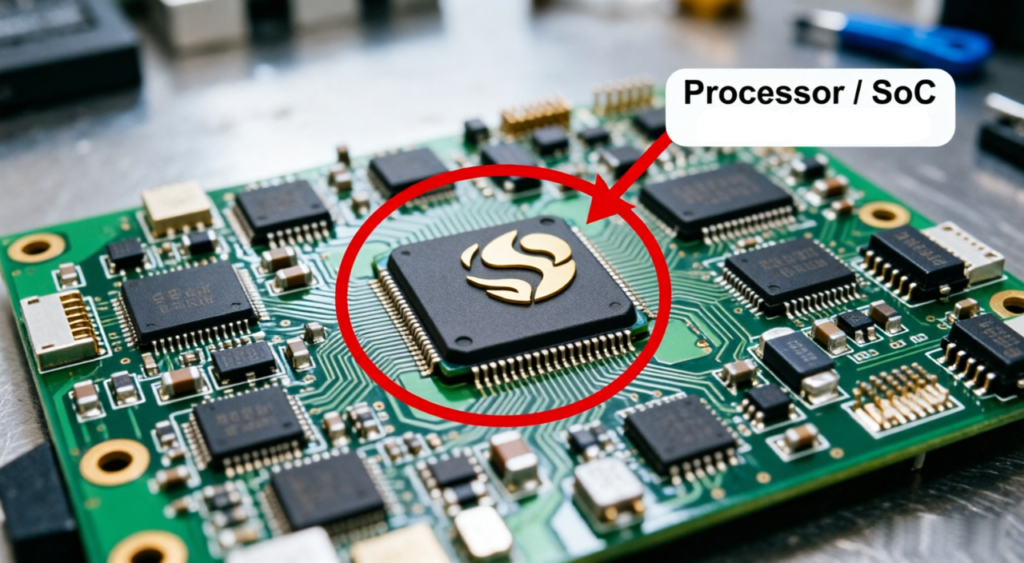
The processor — technically a System on Chip, or SoC — is the brain of an Android head unit. Every computing task runs through it: system operation, app processing, navigation, media playback, and whatever else is running at once.
More specifically, it controls boot speed, how responsive the system feels, how fast maps render, 4K video decoding, audio processing, and general stability. When a customer calls a unit “slow” or “laggy,” the processor is almost always the reason, whether or not they’d phrase it that way.
For B2B sourcing, this makes processor choice a direct line to customer satisfaction, return rates, and how long a product stays viable in the field. It also sets the performance tier a unit belongs to — entry-level, mid-range, or premium — which shapes what price it can actually command. Processor performance also depends on sufficient memory — for a detailed breakdown of RAM and ROM configurations and how they work alongside the processor, read our guide on RAM and storage for Android car stereos.
Two platforms cover most of the aftermarket Android head unit space: Qualcomm Snapdragon and MediaTek. Neither is objectively “better” across the board — they’re built for different priorities, which the next two sections get into.
Snapdragon Car Stereo Processors: Core Strengths & Automotive Advantages
Qualcomm’s Snapdragon automotive platform grew out of mobile phone chip technology, adapted for the car with better thermal management and more stability than a straight phone chip would offer.
- Strong single-core performance — faster app launches, quicker system response, and generally smoother UI navigation than similarly clocked competitors.
- Superior GPU — better graphics handling for smooth display rendering, capable 4K video playback, and interfaces that feel genuinely responsive rather than sluggish.
- Mature software ecosystem — broader compatibility across navigation apps, media platforms, and phone projection protocols, which in practice means fewer compatibility-related support calls.
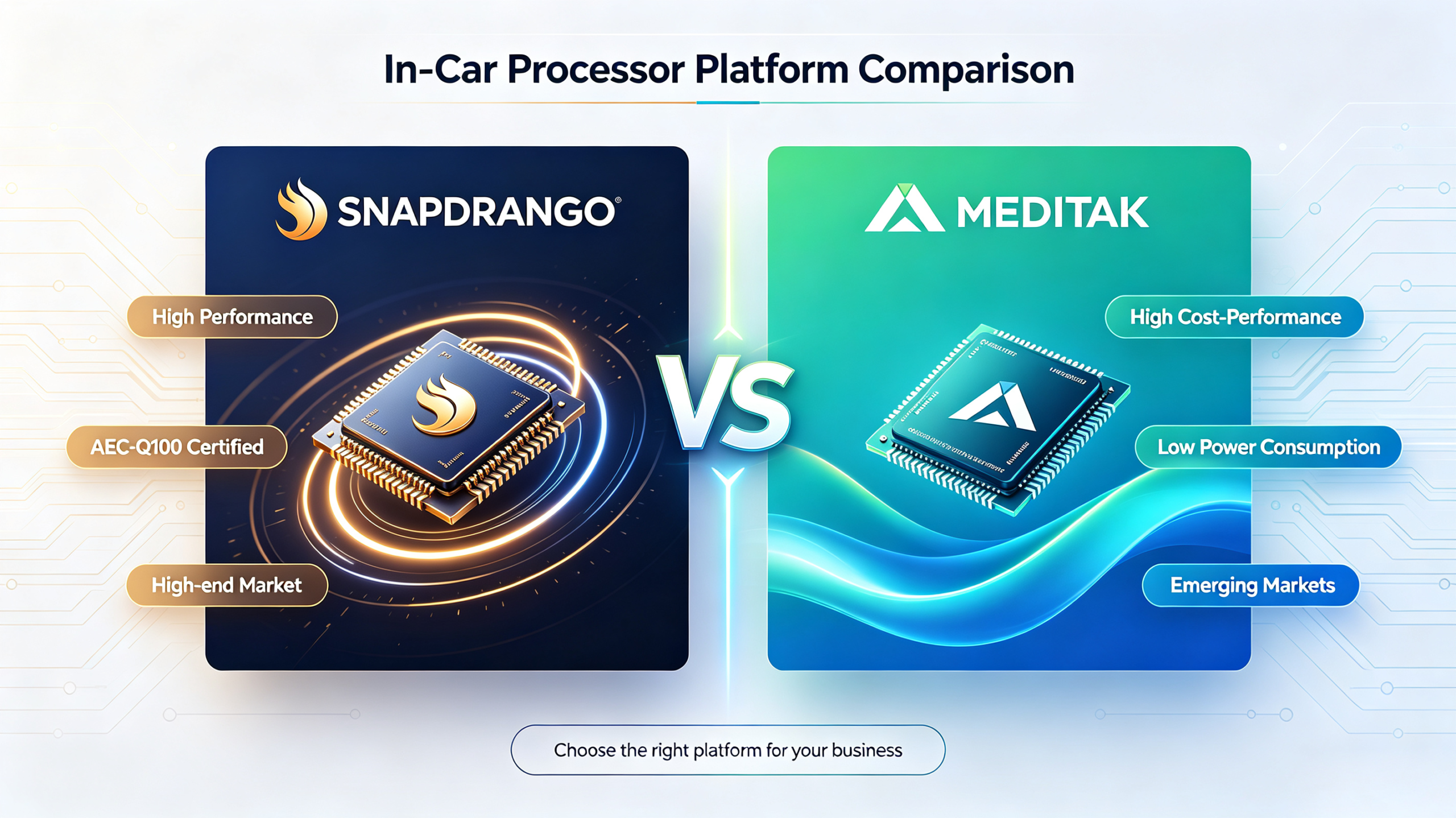
- Automotive-grade availability — some Snapdragon chips, the SA series specifically, are purpose-built for in-vehicle use and carry AEC-Q100 certification, which translates to better high-temperature stability and a longer service life than a repurposed mobile chip.
Put together, this is why Snapdragon-based units command higher retail prices and better margins. They’re the natural fit for mature markets and premium 4S dealership upgrade programs, where customers expect responsive performance as a baseline rather than a bonus.
MediaTek Car Stereo Processors: Core Strengths & Cost-Performance Edge
MediaTek built its name in cost-effective consumer electronics, and that reputation has carried over into the automotive aftermarket, where it’s become genuinely competitive rather than just a budget fallback.
- Competitive pricing — a lower per-unit cost than Snapdragon, which makes it the practical choice for cost-sensitive bulk orders and entry-level wholesale.
- Good multi-core performance — capable of handling the everyday load of navigation, media, and phone projection without needing flagship-tier specs to do it.
- Broad availability — a wide pool of reference designs lets manufacturers bring new products to market faster than starting from scratch.
- Power efficiency — generally lower power draw, which can matter in certain vehicle electrical setups.
This combination gives MediaTek-based units a strong price-to-performance ratio. It’s exactly why emerging markets, budget fleet orders, and entry-level wholesale channels lean on it — price is the deciding factor for these buyers, and MediaTek delivers enough performance not to become a liability.
Snapdragon vs MediaTek: Full Benchmark & Capability Comparison
| Dimension | Snapdragon | MediaTek |
|---|---|---|
| Single-core performance | Stronger — faster launches, quicker response | Competitive, generally a step behind |
| Multi-core performance | Strong | Competitive, often cost-efficient |
| GPU / 4K video | Higher-end rendering, smooth 4K playback | Adequate for most display needs |
| Boot speed | Fast | Fast to moderate |
| Power consumption | Moderate | Generally lower |
| AEC-Q100 automotive certification | Available on dedicated SA-series chips | Primarily adapted mobile chips |
| Software ecosystem | Broader, more mature | Improving, occasional edge cases |
| Typical market positioning | Premium | Cost-sensitive, mass-market |
| Price range | Higher | Lower |
The pattern holds across nearly every row: Snapdragon leads on raw performance, automotive-grade certification, and ecosystem maturity, while MediaTek competes hard on cost and multi-core efficiency at scale. This isn’t just a spec-sheet decision — it ripples into product pricing, target market fit, after-sales risk, and how your brand gets positioned in a customer’s mind.
How to Choose Between Snapdragon and MediaTek for Your B2B Business
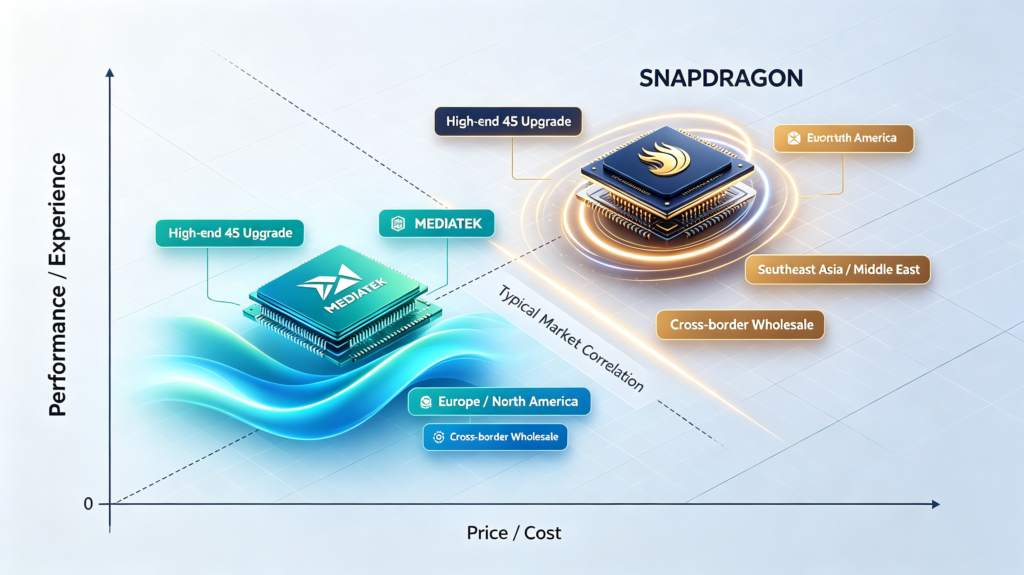
Premium 4S dealership upgrades and mature markets like the EU and North America generally call for Snapdragon. Its performance and brand recognition justify a higher retail price, and customers in these markets expect smooth, responsive operation without having to think about it.
Cross-border wholesale into emerging markets — Southeast Asia, the Middle East, South America — tends to favor MediaTek for its price-to-performance ratio. Cost-sensitive buyers still want decent performance, but affordability is what actually closes the sale. Fleet and commercial operators can usually run on MediaTek for basic navigation and media needs, reserving Snapdragon for cases where drivers genuinely demand premium multimedia performance.
OEM/ODM automaker projects tend to split along vehicle segment lines: Snapdragon for premium models, MediaTek where cost control matters more. Rungrace offers both platforms and supports custom processor selection for OEM/ODM clients who need to match a specific market or vehicle segment rather than defaulting to one option. For a complete framework on matching head unit specs to your business scenario — including 4S dealerships, cross-border wholesale, fleet operators, and OEM projects — read our guide: How to Choose an Android Head Unit for Your Vehicle.
The decision ultimately comes down to balancing what your target customers expect against per-unit cost and how much after-sales risk you’re willing to carry. Premium markets justify Snapdragon’s premium; price-sensitive markets favor MediaTek.
Common Processor-Related Sourcing Risks & Red Flags
A handful of patterns show up repeatedly in this market, and each is worth checking for directly before a bulk order ships.
Clone or counterfeit processors are the most damaging — some suppliers use low-cost chips branded as Snapdragon or MediaTek that perform well below the genuine part. Verifying the actual chip model with a diagnostic tool during sample testing is the only real defense. Mismatched software optimization is a quieter problem. Even a genuine, capable processor performs poorly on badly tuned firmware, so it’s worth testing units under real conditions — navigation, music, and phone projection running together — rather than trusting a spec sheet.
Overheating is a legitimate risk too, since processors without proper thermal management throttle or crash in hot conditions; ask for QC testing results at 60°C before ordering. Thermal performance and processor capability are among the key differentiators when comparing Android head units against factory stereos — for a broader comparison across performance, integration, and feature sets, read our guide: Android Head Unit vs Factory Car Stereo.
Before placing a bulk order: request samples, run performance tests, check actual chip models with a diagnostic app, request factory QC documentation, and test units in high-temperature conditions if you can.
FAQ
What is the core difference between automotive-grade and consumer-grade car stereo processors?
Automotive-grade processors, like Snapdragon’s SA series, carry AEC-Q100 certification, meaning they’re tested for stable performance across a wider temperature range and a longer service life than consumer-grade chips. Consumer-grade or adapted mobile chips can still perform well, but they carry a higher risk of thermal throttling or premature failure under the demands of a vehicle interior.
Which platform has lower long-term after-sales failure rates in bulk car stereo orders?
Genuine Snapdragon automotive-grade chips generally show lower failure rates over time, largely thanks to AEC-Q100 certification and better thermal management. That said, actual failure rates depend just as much on the specific chip tier and the supplier’s QC process — a poorly-vetted unit on either platform carries real risk regardless of brand.
Which platform is more cost-effective for cross-border e-commerce bulk sales to emerging markets?
MediaTek is generally the better fit for cross-border e-commerce into emerging markets, where price sensitivity outweighs the need for flagship performance. Its lower per-unit cost supports competitive retail pricing and faster inventory turnover, as long as the specific chip tier and QC process still clear a reasonable bar for performance and reliability.
What performance benchmarks must the processor meet to ensure smooth navigation and multi-tasking?
Look for a processor capable of smooth multitasking under real load — maps, music, and phone projection running together without stutter — paired with at least 4GB of RAM. Processor capability and memory work together; even a strong chip will lag if RAM is insufficient for the combined workload.
Can the processor platform be upgraded or replaced after the car stereo is manufactured?
No. The processor is soldered into the mainboard during production, so platform selection is locked in at the manufacturing stage rather than something that can be swapped or upgraded afterward. This is exactly why confirming the right platform before placing a bulk order matters more than it would for something like storage.
Conclusion
Snapdragon and MediaTek serve different sourcing priorities rather than different quality tiers in any absolute sense. Snapdragon fits premium markets willing to pay for top-tier performance and automotive-grade certification; MediaTek fits cost-sensitive markets where price-to-performance is what actually drives the sale. Matching the platform to your real buyers — and verifying the chip is genuine — is what protects your margins and your after-sales reputation.
Sourcing Android head units with the right processor platform for your market? Contact our team to discuss Snapdragon or MediaTek configurations, or explore our current Android head unit product lineup.