“Laggy” and “freezing” are the two words that show up most often in car stereo return complaints, and both usually trace back to the same component: the processor. Two decisions determine how a unit actually performs — how many cores it has, and which platform built it.
This guide breaks down both decisions: quad-core versus octa-core, and Qualcomm versus MediaTek, then maps each to the business scenario where it makes the most sense. For a full view of all hardware decisions, see our car stereo hardware components overview.
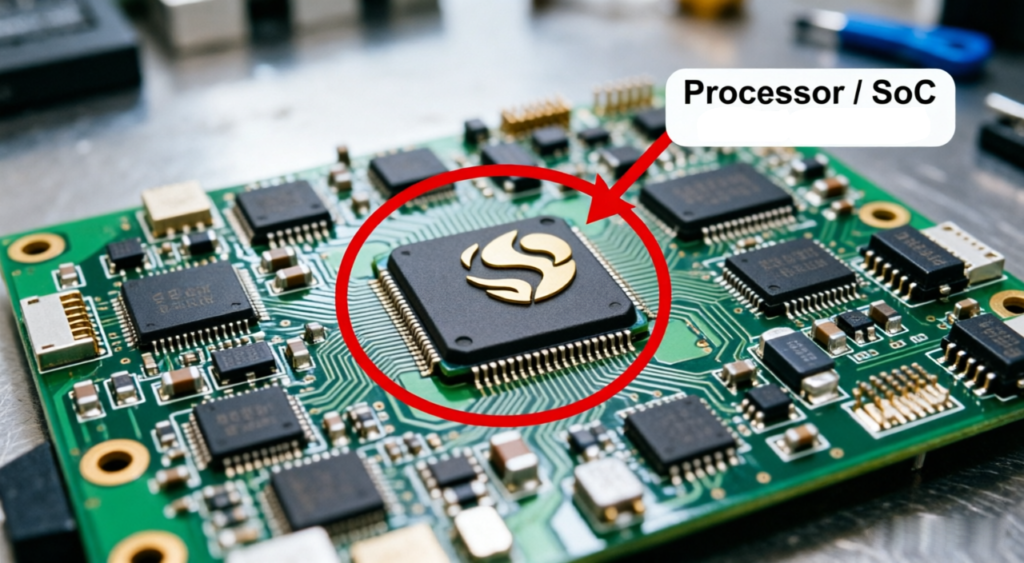
What Makes a Great Car Stereo Processor? Core Features & Business Value
A great car stereo processor is a System on Chip (SoC). It delivers smooth system operation, fast app loading, responsive navigation, and stable multimedia performance under real automotive conditions.
Quality here comes down to five factors: core count, clock speed, GPU performance, thermal management, and automotive-grade reliability. None of this is abstract — processor quality directly shapes system responsiveness, multitasking capability, and how long a unit stays reliable in the field.
The business case is straightforward. High-performance processors justify higher retail pricing and better margins. Weak processors generate exactly the complaints that erode both: lag, freezing, and the return-rate headaches that follow.
Two decisions drive nearly every processor sourcing conversation: how many cores the chip has, and which manufacturer built it — Qualcomm Snapdragon or MediaTek. The sections below cover both.
Processor Core Count: Quad-Core vs Octa-Core Car Stereo Processors
A quad-core processor has four processing cores. It’s sufficient for basic navigation, media playback, and light app usage, and remains the entry-level standard for budget car stereos.
An octa-core processor has eight cores, typically split between four high-performance cores and four power-efficient cores. That split delivers noticeably smoother multitasking, faster app loading, and better handling of navigation, media, and phone projection running together.
The real-world gap shows up under load. An octa-core unit handles navigation running alongside streaming music and phone projection without lag. A quad-core unit can start to slow down under that same combined workload, particularly as apps and map data grow more demanding over time.
That future-proofing angle matters for bulk sourcing specifically. Octa-core processors carry more headroom for future app updates and operating system versions, while quad-core units risk aging faster as software grows heavier. Commercially, octa-core is becoming the expected standard in mature markets. Quad-core remains a viable, cost-effective choice for entry-level markets where basic functionality is genuinely sufficient. For a detailed platform comparison, see our Qualcomm vs MediaTek for car stereos guide.
Snapdragon Processors: Core Strengths for Car Stereo Applications
Qualcomm’s Snapdragon automotive platform grew out of mobile phone chip technology, then got adapted for automotive use with improved thermal management and stability.
- Strong single-core performance — faster app launches and quicker system response than similarly clocked competitors.
- Superior GPU — smoother display rendering, capable 4K video playback, and visually rich interfaces.
- Mature software ecosystem — broader compatibility with navigation apps, media platforms, and phone projection protocols, which cuts down on compatibility-related support calls.
- Automotive-grade availability — dedicated SA-series chips carry AEC-Q100 certification, built specifically for in-vehicle use rather than adapted from a mobile design.
This combination positions Snapdragon as the premium option. Premium markets — the EU and North America — along with 4S dealerships handling upgrade sales, typically demand Snapdragon-based units. The platform justifies higher retail pricing and supports better margins. For display technology that pairs well with premium processors, see our IPS vs QLED display technology guide.
MediaTek Processors: Core Advantages for Car Stereo Applications
MediaTek built its reputation in cost-effective consumer electronics, and that positioning has translated directly into increasing competitiveness across the automotive aftermarket. For audio hardware that pairs with MediaTek platforms, see our DSP amplifier in car stereo guide. For audio hardware that pairs with MediaTek platforms, see our DSP amplifier in car stereo guide.
- Competitive pricing — lower per-unit cost than Snapdragon, which makes MediaTek a natural fit for cost-sensitive bulk orders and entry-level wholesale.
- Good multi-core performance — capable of handling typical car stereo tasks (navigation, media, phone projection) efficiently, without needing flagship-level specs.
- Broad availability — extensive reference designs let manufacturers bring new products to market faster.
Commercially, this adds up to a strong price-to-performance ratio. Emerging markets, budget fleets, and entry-level wholesale channels are the primary demand drivers for MediaTek-based units, where lower cost translates directly into faster inventory turnover.
Qualcomm vs MediaTek: Full Car Stereo Processor Platform Comparison
| Dimension | Qualcomm Snapdragon | MediaTek |
|---|---|---|
| Single-core performance | Stronger | Competitive |
| Multi-core performance | Strong | Competitive, cost-efficient |
| GPU capability | Higher-end, better 4K decoding | Adequate for most display needs |
| Power consumption | Moderate | Generally lower |
| Automotive-grade certification | Dedicated SA-series, AEC-Q100 | Primarily adapted mobile chips |
| Software ecosystem | Broader, more mature | Improving, occasional edge cases |
| Market positioning | Premium | Cost-sensitive, mass-market |
| Price range | Higher | Lower |
The gap is consistent across every dimension: Snapdragon leads on raw performance, automotive-grade certification, and ecosystem maturity, while MediaTek competes hard on cost and multi-core efficiency at scale. This choice ripples outward into product pricing, target market, after-sales risk, and brand positioning all at once — it’s rarely just a spec-sheet decision.
How to Choose the Best Car Stereo Processor for Your Business
- 4S dealership premium upgrades: Octa-core Snapdragon. Superior performance and brand recognition justify higher retail pricing and meet premium customer expectations.
- 4S dealership standard upgrades: Octa-core MediaTek. Good performance at a competitive cost, sufficient for most upgrade customers.
- Cross-border wholesale, mature markets: Octa-core is the expected standard on either platform — customers here notice and reject laggy performance regardless of price point.
- Cross-border wholesale, emerging markets: Quad-core MediaTek offers the best price-to-performance ratio for cost-sensitive buyers, with octa-core reserved for premium product lines.
- OEM/ODM automaker projects: Snapdragon for premium vehicle segments, MediaTek where cost control is critical. Both platforms are available for custom processor selection to match specific market demands.
Common Processor Quality Issues & Sourcing Red Flags
- Fake core count claims — suppliers advertising octa-core while shipping quad-core or weaker chips. Verify actual core count with a system diagnostic tool during sample testing.
- Clone or counterfeit processors — low-cost chips branded as Snapdragon or MediaTek that perform well below the genuine part. Verify the actual chip model directly rather than trusting the listing.
- Overheating in automotive environments — processors without proper thermal management throttle or crash in high heat. Ask for QC testing results at 60°C before ordering.
- Unrealistic price-to-performance claims — a unit priced like MediaTek but claiming Snapdragon-level performance is almost always running a lower-tier or counterfeit chip.
- Software optimization mismatch — even a genuine, capable processor performs poorly on badly optimized firmware. Test units under real-world usage, not just spec comparisons.
Before placing a bulk order: request samples and run diagnostic tools to confirm the actual chip model and core count. Request QC documentation, and test units in high-temperature conditions where possible.
FAQ
What is the minimum processor requirement for smooth phone projection, navigation, and multi-app operation?
An octa-core processor paired with at least 4GB RAM is a reasonable baseline for running phone projection, navigation, and media simultaneously without noticeable lag. Quad-core units can handle these tasks individually, but often show slowdowns when several run together — a common source of after-sales complaints in bulk orders.
Which is more cost-effective for bulk wholesale orders: quad-core or octa-core processors?
It depends on your target market. Quad-core MediaTek units offer the lowest per-unit cost for price-sensitive, entry-level buyers. Octa-core units cost more upfront but reduce return rates in markets where customers expect smooth multitasking. That often makes them the more cost-effective choice over the full product lifecycle, and supports better retail pricing too.
What is the core difference between automotive-grade and consumer-grade car stereo processors?
Automotive-grade processors, like Qualcomm’s SA-series chips, are certified to standards such as AEC-Q100, meaning they’re tested for stable performance across a wider temperature range and longer operational lifespan. Consumer-grade or adapted mobile chips can still perform well, but carry a higher risk of thermal throttling or premature failure in demanding in-vehicle conditions.
What performance benchmarks should a qualified car stereo processor meet for commercial use?
Look for smooth multitasking under real load — navigation, music, and phone projection running together without stutter — plus fast boot times and stable 4K video decoding if that’s relevant to your product line. Genuine octa-core architecture and verified automotive-grade testing matter more than marketing claims about clock speed alone
What are the most common fake processor specs in aftermarket car stereos?
Inflated core count is the most common issue — units advertised as octa-core that actually run quad-core chips, verifiable only through diagnostic tools rather than the product listing. Counterfeit chips branded as Snapdragon or MediaTek are another common pattern. So are processors paired with mismatched or inflated RAM figures — both worth testing for directly before a bulk order.
Conclusion
The best car stereo processor for your business depends on matching core count and platform to your actual target market, then verifying the chip is genuine before committing to volume. Octa-core versus quad-core determines how well a unit multitasks; Snapdragon versus MediaTek determines where it sits on the price-to-performance curve. Getting both decisions right protects your margins and your after-sales reputation.
Sourcing car stereos with the right processor for your market? Contact our team to discuss core count and platform options, or explore our current Android head unit product lineup.