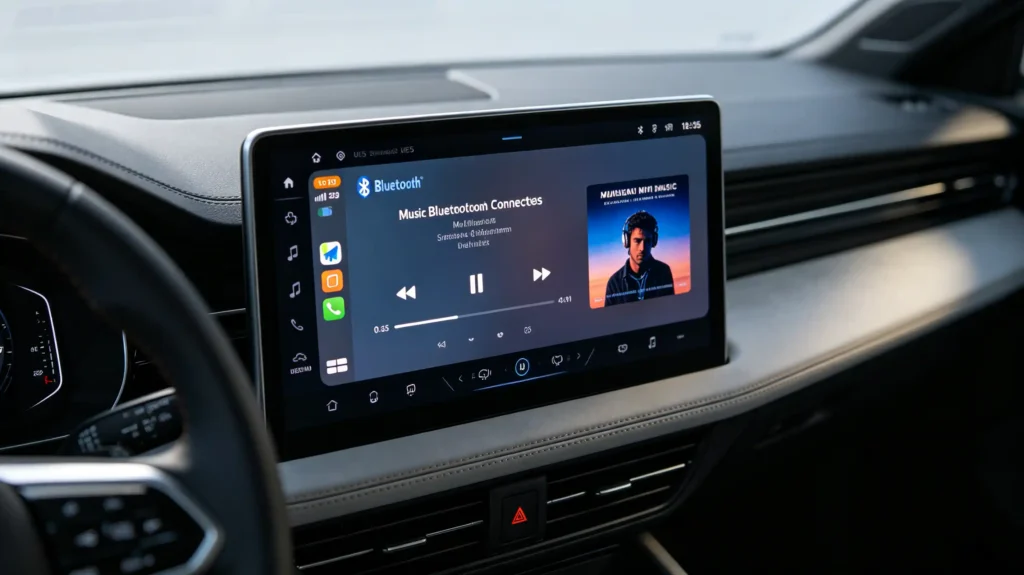

A fleet operator running vehicles through mountain routes with no cellular coverage will eventually ask the same question. An importer stocking head units for a market where mobile data is expensive will ask it too. Does this navigation system actually work without an internet connection? The answer depends on whether offline maps are supported. It also depends on what “offline” means at the hardware level.
This guide covers how offline navigation maps function. It covers what they require from head unit hardware. It also covers how to evaluate the capability when sourcing navigation systems. For a foundational overview of navigation systems, see our what is a car navigation system guide.
Offline Navigation Maps: Core Definition for Vehicle Systems
What Are Offline Navigation Maps?
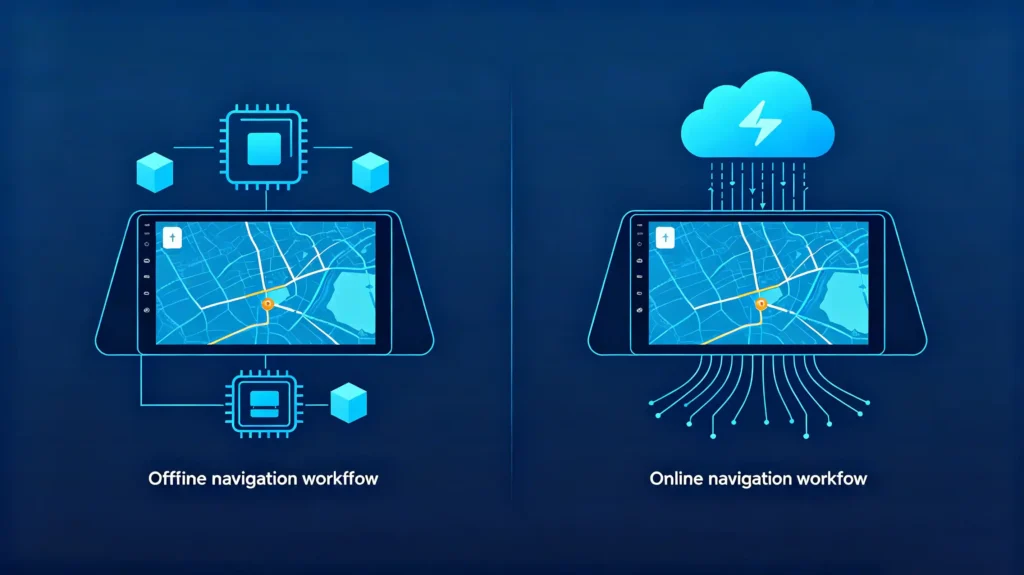
Offline navigation maps are map datasets downloaded in advance. They are stored directly on a head unit’s local storage. This lets the navigation system display maps and calculate routes without an active internet connection. This is a meaningful distinction from online navigation. Online navigation streams map tiles and traffic data from the cloud in real time. It stops functioning properly the moment cellular signal drops.
When Offline Capability Matters Most
Offline capability matters most in a specific set of scenarios. Rural driving and remote regions with sparse cellular towers. Tunnels and mountain routes that block signal entirely. Cross-border travel where roaming charges make constant streaming expensive. Fleet vehicles operating without reliable network infrastructure. For B2B buyers, this makes offline navigation less of a nice-to-have. It is more of a core requirement for certain markets — particularly regions with inconsistent cellular coverage. For more on hardware requirements, see our RAM and storage guide for Android car stereos.
How Offline GPS Navigation Operates Without Internet
Two Separate Components
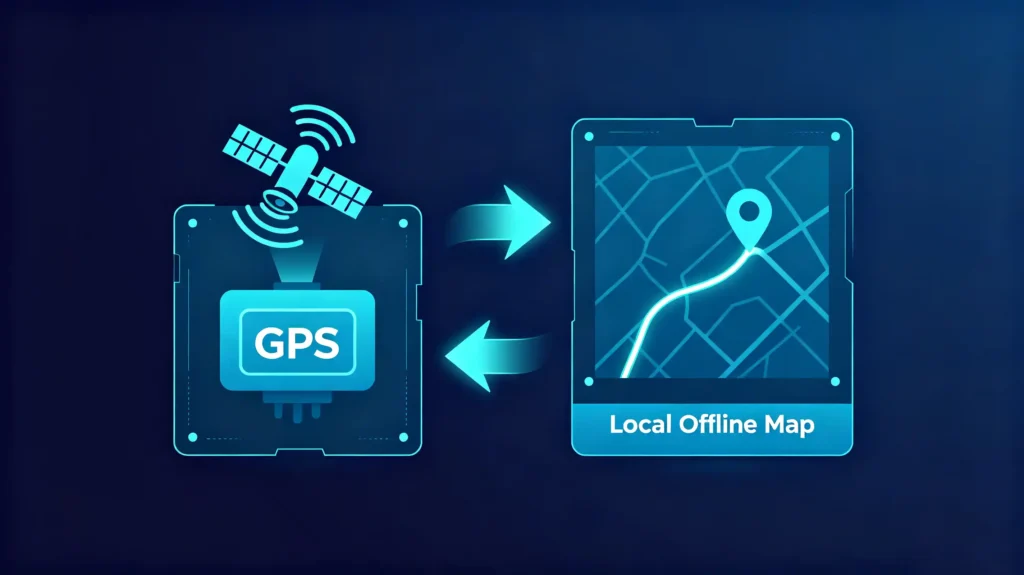
Understanding offline navigation starts with separating two components that often get conflated. GPS positioning and map data.
GPS Positioning
GPS, or more broadly GNSS, positioning works by receiving satellite signals. It calculates the vehicle’s exact location — latitude and longitude. This process never requires an internet connection, online or offline.
Map Data
What does depend on stored data is the map itself. The visual display, road names, and route calculation logic all pull from map data. This data either lives locally on the device or streams from a cloud server.
How They Work Together
Offline navigation combines these two pieces locally. GPS calculates position. The system retrieves matching map data from internal or external storage. The head unit displays position and calculates routes entirely on-device. Online navigation follows the same first step. But it pulls map tiles, live traffic, and points of interest from the cloud instead. This is why a vehicle can maintain accurate positioning even in a dead zone with zero cellular bars. GPS satellite reception and cellular network coverage are entirely unrelated systems. For more on GPS technology, see our how does a car navigation system work guide.
Offline-Map Data Storage and Hardware Requirements

Storage Space Requirements
Offline maps do not exist for free on a head unit. They consume real storage space. This is where hardware specification becomes a genuine sourcing consideration. It is not just a checkbox feature.
Where Maps Are Stored
Map datasets are typically stored in the head unit’s internal flash memory. They can also be stored on external storage such as a microSD card or USB drive where the hardware supports it.
Dataset Size
A full country or regional map dataset generally runs somewhere between 2 and 10GB. This depends on the region’s size and level of detail. Buyers planning multi-country coverage should account for that adding up quickly.
Recommended Storage
For units expected to hold multiple regions or handle periodic updates, 32GB or higher internal storage is a reasonable baseline. Ideally, the unit should be paired with a microSD card slot for expansion.
Entry-Level Limitations
Entry-level units with minimal onboard storage often cannot accommodate full offline map sets for more than one region. This is worth flagging to customers upfront. Do not discover it after a complaint about missing coverage.
Offline Navigation versus Online Vehicle Navigation
Comparison Table
| Dimension | Offline Navigation | Online Navigation |
|---|---|---|
| Internet required | No | Yes |
| Map data source | Stored locally | Streamed from cloud |
| Traffic information | Not available (unless via radio) | Real-time updates |
| Route calculation | Local | Cloud-assisted |
| Map updates | Manual download | Automatic, continuous |
| POI data | Static (from download) | Real-time |
| Data usage | None | Uses cellular data |
| Coverage dependency | Map coverage only | Cellular coverage required |
Key Trade-Offs
Offline navigation wins on reliability. It works anywhere the map data covers, regardless of signal. Online navigation wins on freshness. Live traffic, current points of interest, and continuous updates are features offline systems cannot match without a manual download.
Hybrid Approach
Many head units support both. They switch to online features when connectivity is available. They fall back to offline maps when it is not.
Real-World Benefits and Limitations of Offline Vehicle Navigation
Advantages
Offline navigation earns its place in a product lineup through clear practical advantages. It works without internet in remote areas and tunnels. It avoids cellular data charges — a real consideration for international fleet travel. It loads maps faster with no streaming delay. It performs consistently regardless of network conditions. It does not transmit location data to outside servers.
Trade-Offs
The trade-offs are just as real. Offline maps lack real-time traffic. Route guidance will not account for current congestion. They require manual updates. Roads that changed since the last download simply will not appear correctly. Storage capacity limits how much coverage a unit can hold at once. Point-of-interest data can go stale between updates.
Honest Framing
The honest framing for buyers: offline navigation solves a reliability problem. It does not solve a currency problem. It will not leave a driver stranded without a map. But it also will not know about a road closure from this morning.
Offline-Map Coverage, Storage Constraints and Update Requirements
Coverage Detail
Coverage detail is not uniform across offline map datasets. Urban areas typically get denser, more accurate mapping. Rural regions may have thinner coverage depending on the provider. Buyers stocking units for multiple countries need to plan storage allocation carefully. More regional coverage directly competes with space for other on-device data.
Update Management
Updates add another layer to manage. Most offline systems require manually downloading and installing new map versions. Update frequency varies by provider. Quarterly, biannual, or annual cycles are all common. Update files can run several gigabytes. Depending on licensing, updates may come free or require an ongoing subscription. Clarifying this cost structure with a supplier before finalizing an order avoids surprises for the end customer later.
B2B Selection Considerations for Systems Supporting Offline Navigation
Practical Checklist
For dealers, wholesalers, and OEM/ODM buyers evaluating navigation systems, offline capability comes down to a practical checklist.
Storage capacity — 32GB or higher internal storage recommended for full multi-region coverage.
External storage support — a microSD card slot for map expansion.
Map coverage — confirm offline maps are actually available for the target countries or regions.
Update method — USB, SD card, or over-the-air, and how frequently.
Update cost — free or paid, and who bears that cost long-term.
Map data source — a reputable provider generally means better accuracy and coverage.
Sample testing — test offline navigation on a sample unit in target regions before a full order.
Frequently Asked Questions
Does offline navigation still require a working GPS receiver?
Yes. Offline navigation still depends entirely on GPS or GNSS satellite reception to calculate position — only the map data is stored locally rather than streamed. Without a functioning GPS receiver, a head unit can’t determine location even with a full offline map set installed, since positioning and map display are separate functions working together.
How much storage does full-region offline navigation typically require?
A single country or regional map dataset generally runs between 2 and 10GB depending on size and mapping detail. Buyers planning multi-region coverage should look for 32GB or higher internal storage, ideally with microSD expansion, since storing several countries’ maps adds up quickly.
Can a navigation unit switch between offline and online modes?
Yes, many modern head units support both interchangeably. The system uses online data — live traffic, current points of interest — when connected, and falls back to stored offline maps when cellular signal drops. This hybrid approach gives buyers flexibility rather than forcing a strict choice.
What happens when offline map data becomes outdated on units already sold?
Outdated maps can misroute drivers around new roads, closures, or developments added since the last update. On mass-deployed units, this becomes a support burden without a clear update policy. Suppliers offering accessible update methods and coverage details help dealers manage this risk before it turns into complaint volume.
Can budget aftermarket Android head units skip offline map support entirely?
Some do, particularly units built around minimal internal storage that can’t hold a full map dataset. That’s a reasonable cost-saving choice for markets with strong cellular coverage, but it becomes a liability for regions with unreliable connectivity. Confirming offline support explicitly, rather than assuming it, is worth doing before ordering in volume.
Sourcing Navigation Systems With Reliable Offline Coverage
If your target market includes regions with inconsistent cellular coverage, offline map support and adequate storage capacity deserve the same scrutiny as screen size or processor specs. Contact our team to discuss your regional map coverage and storage requirements, or request a quotation for OEM navigation solutions built for offline reliability.