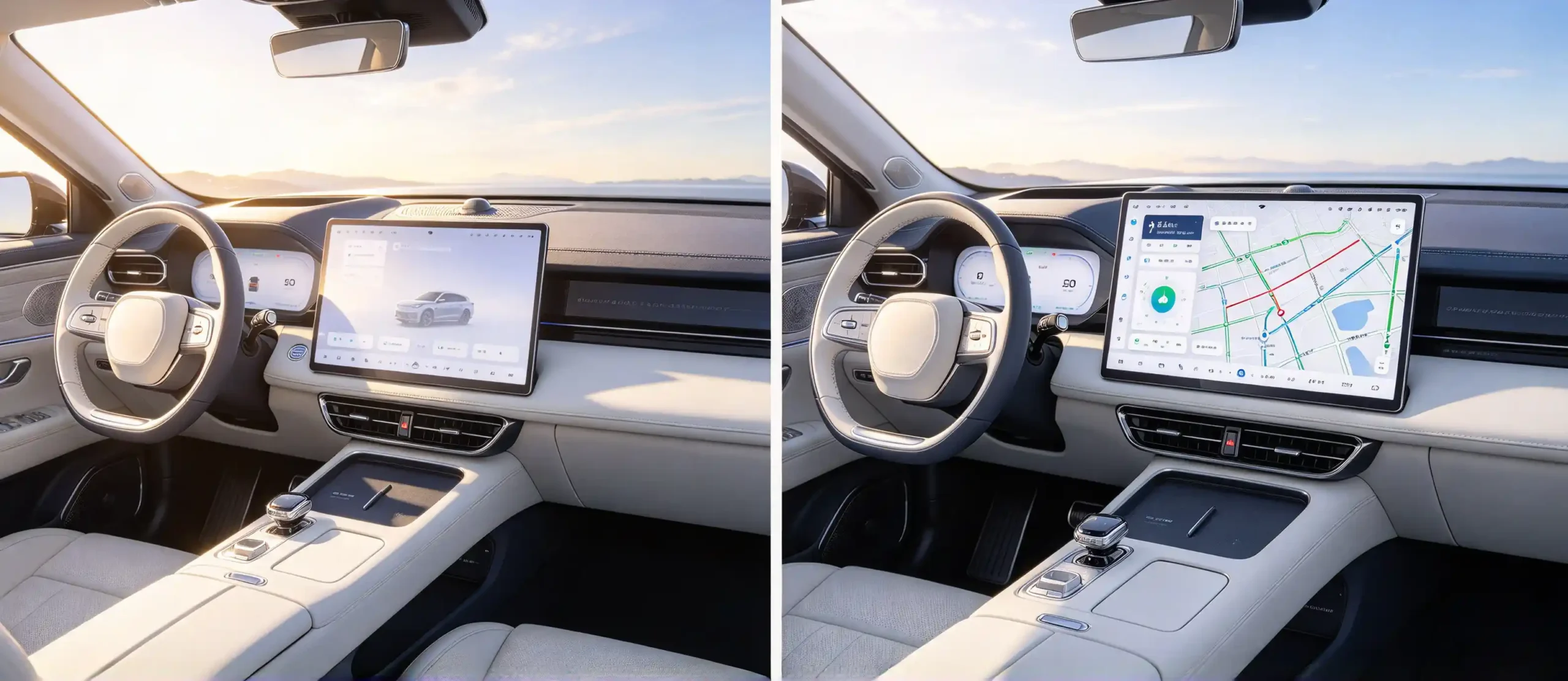
A head unit that looks sharp on a showroom bench can turn nearly unreadable the moment a driver pulls into direct afternoon sun. Car stereo display brightness is the spec responsible for that gap. It is one of the more commonly underspecified items on a sourcing sheet. Buyers compare screen size and resolution in detail. Then they treat brightness as an afterthought. That is right up until return requests start citing “can’t see the screen in daylight.”
This guide covers what display brightness actually means for a car stereo. It covers how nits are measured and what the numbers mean in practice. It covers how brightness affects sunlight readability. It covers the other factors that shape real-world visibility. It covers how brightness relates to screen size and resolution. It covers recommended brightness levels by driving environment. It also covers what to check when sourcing hardware for brightness performance.
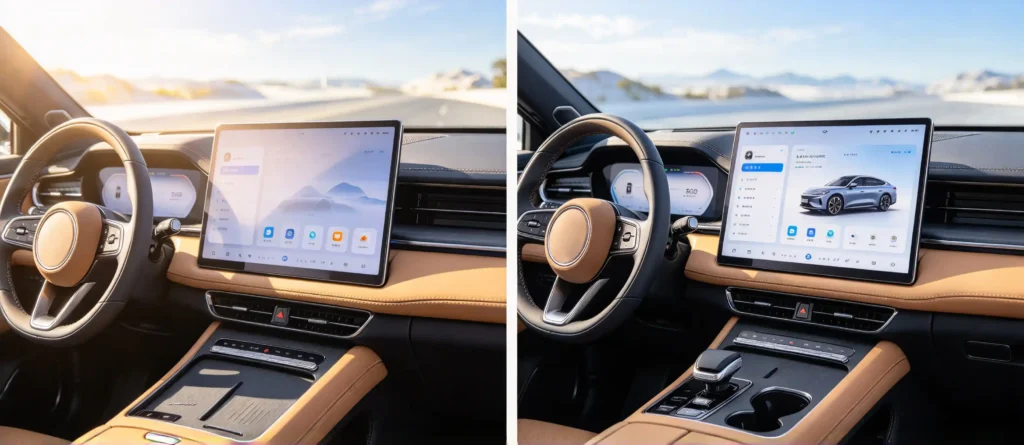
What Is Car Stereo Display Brightness?
Definition
Car stereo display brightness refers to the luminance of a screen. It is measured in nits (candela per square meter, or cd/m²). In practical terms, it determines how visible the screen stays as ambient light conditions change. That ranges from a dim garage at night to direct sunlight hitting the dashboard at midday.
Distinction from Other Specs
Brightness is distinct from a few other specs buyers often lump together with it. Contrast ratio describes the difference between the darkest and brightest points a screen can display. Resolution describes pixel density and image sharpness. Color accuracy describes how faithfully colors render. A screen can be sharp and color-accurate and still be nearly unreadable outdoors. That happens if the brightness rating is too low for the conditions it is used in. For more on display panel technology, see our IPS vs QLED display technology guide.
Why It Matters for B2B Buyers
For B2B buyers, this is not a cosmetic detail. Display brightness directly affects end-user satisfaction. It is one of the more common sources of after-sales complaints and returns. This is particularly true for products shipping into high-sunlight markets. Understanding the spec well enough to evaluate it properly is part of basic due diligence for automotive display sourcing. That includes not taking a nit figure at face value.
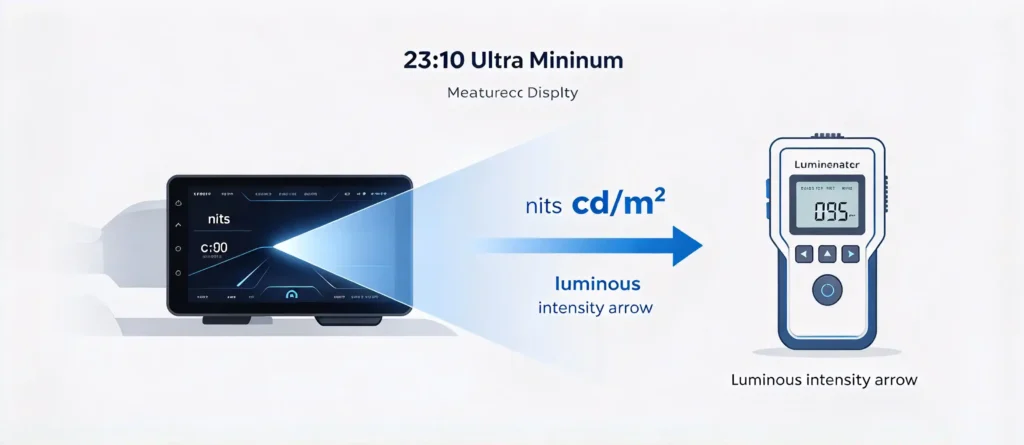
Indicative Brightness Ranges for Automotive Display Sourcing
How Nits Are Measured
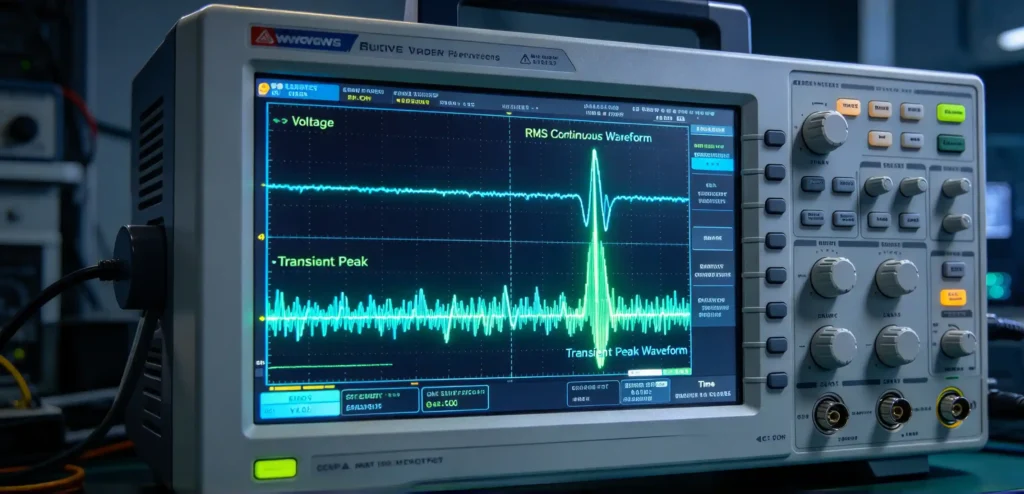
Car stereo display brightness is commonly specified as luminance, measured in nits (cd/m²). A nit indicates how much visible light a display produces per unit of surface area in a given viewing direction. The higher the nit rating, the more light the display produces. The better it generally holds up against competing ambient light.
Indicative Ranges
| Nit Range | Typical Readability |
|---|---|
| 200–300 nits | Adequate for indoor or shaded use; weak in direct sunlight |
| 400–500 nits | Workable in moderate outdoor light |
| 500–800 nits | Reasonably sunlight-readable for most driving conditions |
| 800–1000+ nits | Strong sunlight readability, suited to high-glare markets |
Important Caveats
These ranges are indicative sourcing guidelines. They are not universal industry standards. Actual daylight readability depends on luminance, reflectance, contrast, surface treatment, optical bonding, viewing angle, and installation conditions.
Measurement conditions matter as much as the number itself. A nit rating measured in a dark room does not tell you much about how a screen performs under simulated sunlight. Suppliers do not always specify which condition their stated figure comes from. Standardized, repeatable testing conditions are what make a nit figure actually comparable across suppliers.
It is also worth being clear that higher nits do not automatically mean better perceived brightness. A high-nit display paired with poor contrast or a reflective surface can still look washed out. Glare and reflectance work against raw luminance rather than independent of it. For sourcing purposes, a bare nit rating is a starting point, not a complete picture. Buyers should request the full optical specification, including contrast ratio and surface treatment. Do not evaluate brightness in isolation.
How Brightness Impacts Sunlight Readability for Car Stereo Screens
The Core Relationship
Ambient sunlight is the main adversary of screen readability inside a vehicle. Direct sun hitting the dashboard creates glare. Reflected light competes directly with whatever the screen is emitting. A low-brightness display gets washed out almost entirely under strong midday sun.
Brightness vs Glare
Higher nit ratings help the screen’s output overcome that reflected light. This is the core relationship buyers need to understand. Sunlight readability is not a separate spec from brightness. It is largely a function of it.
Complementary Factors
That said, brightness alone is not the whole story. Anti-reflective coatings and surface treatments play a complementary role. They reduce how much ambient light bounces directly off the glass and back toward the driver’s eyes. This effectively lowers the brightness threshold needed for comfortable viewing.
Limits of Brightness
It is worth being direct about the limits here too. Brightness alone cannot fully eliminate glare. Contrast and reflectance both still matter. A high-nit screen with poor anti-reflective treatment can still struggle in certain lighting angles. This is a familiar pain point across the industry. Drivers unable to read navigation prompts or media information clearly in bright daylight. That is usually traced back to a display that was not specified for the market it ended up in.
Key Factors That Affect Automotive Display Visibility
Beyond Nits
Nits are not the only variable shaping how well a car stereo screen performs across real-world conditions. A handful of other factors matter just as much.
Ambient Light Conditions
Direct sun, overcast daylight, and nighttime driving all demand different levels of screen performance.
Screen Surface Treatment
Anti-glare and anti-reflective coatings reduce reflected light. Matte surfaces generally handle glare better than glossy ones. Glossy surfaces can offer better color saturation indoors. For more on touchscreen quality, see our best touchscreen car stereo guide.
Viewing Angle and Mounting Position
A screen mounted at an awkward angle relative to the driver’s sightline can lose effective brightness. This happens even with a strong nit rating.
Contrast Ratio and Black Level
These determine how distinguishable on-screen elements remain under bright ambient light. They work independent of raw luminance.
Automatic Brightness Adjustment
This is a system-level feature that adapts screen output to ambient conditions. It reduces the burden on a fixed maximum brightness rating.
Combined Effect
None of these factors work in isolation from brightness. They shape how much of that rated nit figure actually translates into usable, comfortable visibility once the unit is installed and driving in real conditions.
Brightness in Relation to Screen Size and Resolution
Separate Specifications
Brightness, screen size, and resolution are three separate specifications. Conflating them is a common sourcing mistake.
Brightness and Screen Size
Nit ratings describe display luminance per unit area. Screen size does not by itself make a display brighter or dimmer. A larger screen may require a different backlight design and higher total optical output to achieve a given luminance level across its larger surface. For more on screen size considerations, see our car navigation screen size guide. But the specified nit value remains a luminance measurement.
Brightness and Resolution
Resolution affects image detail and sharpness. It does not automatically determine sunlight readability. Buyers should therefore evaluate brightness, screen size, and resolution as separate specification lines when comparing automotive displays. For more on resolution, see our car stereo display resolution guide.
Indicative Brightness Targets by Operating Environment
Environment Matters
Brightness requirements shift meaningfully depending on where and how a vehicle operates. This is where environment-specific sourcing decisions come into play.
Recommended Brightness Levels
| Operating Environment | Recommended Brightness |
|---|---|
| Standard cabin use (moderate climates) | 250–400 nits |
| High-sunlight markets (Middle East, parts of Southeast Asia) | 500–800+ nits |
| Commercial vehicles / open-cab environments | 800+ nits recommended |
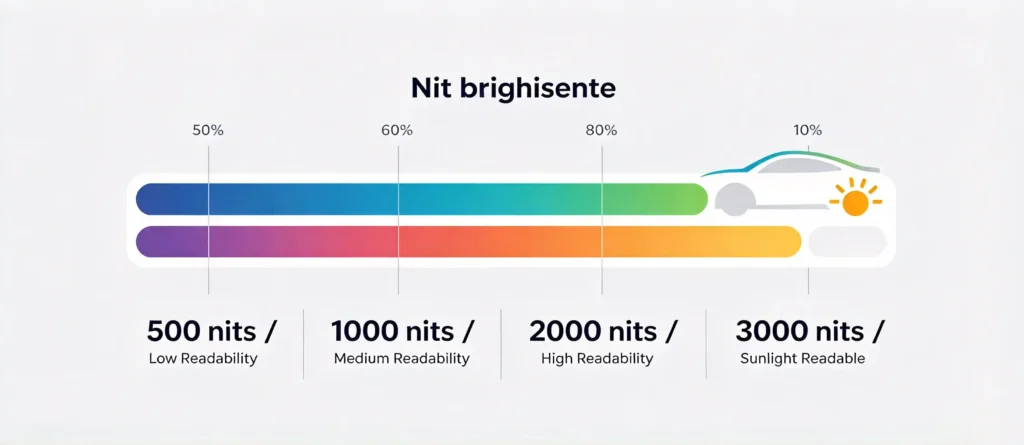
Practical Starting Points
The ranges above are practical starting points for B2B specification discussions. They are not mandatory industry standards. Final requirements should be validated using samples under representative lighting conditions.
Regional Climate
Regional climate plays a direct role here. Markets with consistently intense sunlight generally call for displays at the higher end of the brightness spectrum. This includes much of the Middle East and large parts of Southeast Asia. Standard cabin-rated screens tend to underperform in those conditions. Commercial vehicles and open-cab environments face similar demands. They often have even less shading from the vehicle’s own structure.
Multi-Market Sourcing
For B2B buyers sourcing across multiple regional markets, matching brightness specification to the target market’s actual climate conditions is effective. This is better than applying one standard spec globally. It is one of the more effective ways to reduce brightness-related complaints.
B2B Buyer Guidance: Evaluating Display Brightness When Sourcing Car Stereos
Sourcing Checklist
Turning this into a sourcing checklist, here is what is worth verifying before committing to a supplier.
- RFQ documentation — request the nit rating, contrast ratio, surface treatment, and viewing angle specification as separate, documented items, not a single vague brightness claim
- Sample validation — test samples under simulated sunlight conditions, check for visible glare, and verify brightness uniformity across the screen rather than relying on a center-point reading
- Supplier testing capability — confirm the supplier has actual optical testing equipment and conducts high-temperature aging tests to validate that brightness performance holds up under extended heat exposure, a real condition for dashboard-mounted displays
- OEM/ODM customization — ask whether the supplier can tune brightness specifications for a specific target market rather than offering only a fixed standard configuration
- Documentation rigor — clear display specifications in the product BOM, consistent with the kind of documentation expected under frameworks like IATF 16949 for automotive component traceability
FAQ
Can high-nit brightness fully eliminate screen glare in vehicles?
No. Brightness helps a screen’s output compete with reflected ambient light. But it does not eliminate glare on its own. Surface treatment — anti-glare or anti-reflective coatings — and contrast ratio both play a meaningful role. They determine how much reflected light actually reaches the driver’s eyes. A high-nit screen with a glossy, poorly treated surface can still show noticeable glare at certain angles. This happens even with a strong raw brightness figure.
Do same-nit-rated car screens perform differently under real-world sunlight?
Yes, often noticeably so. Two screens with identical nit ratings can behave quite differently. This depends on surface treatment, contrast ratio, and how the brightness was actually measured. A figure from a dark-room test does not guarantee the same real-world outdoor performance as one measured under simulated sunlight. This is exactly why sample testing under representative lighting conditions matters more than comparing nit numbers on a spec sheet alone.
How do regional market conditions affect required car-display brightness specifications?
Markets with consistently intense sunlight generally require displays toward the higher end of the brightness range. This includes much of the Middle East and parts of Southeast Asia. They often need 500 to 800-plus nits. Standard cabin-rated screens tend to underperform in that level of ambient light. Buyers sourcing for multiple regional markets should treat brightness as a market-specific specification. Do not apply a single global standard across all shipments.
What brightness-related specification gaps should wholesalers watch for from suppliers?
Watch for a nit figure given without the testing conditions behind it. A dark-room measurement and a sunlight-simulated measurement can tell very different stories. Also check whether contrast ratio and surface treatment are documented alongside the nit rating. Brightness alone is an incomplete picture of real-world visibility. Suppliers who cannot provide this level of detail, or cannot support sample testing under simulated sunlight, are worth treating with extra caution before a bulk order.
Conclusion
Display brightness is easy to overlook next to screen size or processor specs. But it is one of the first things a customer judges the moment they are driving in daylight. Use the evaluation criteria above to screen suppliers before committing to volume.