
Car navigation products aren’t one-size-fits-all, and stocking the wrong category is an expensive mistake. A 4S dealership balancing factory-spec replacements against retail upgrade demand faces a different inventory equation than a wholesaler importing budget units for a price-sensitive emerging market — the real procurement challenge is weighing turnover speed against customization cost.
Four categories dominate the industry: OEM factory-installed systems, aftermarket units, Android-based navigation, and portable touch screen radios. Each serves a distinct buyer profile, price point, and integration depth. For a foundational overview of what these systems are and how they’re built, see our guide: What Is a Car Navigation System?
This guide breaks down what a car navigation system is at a technical level, then walks through what separates the four types, who each suits best, and how to match a category to your sourcing goals.
OEM Factory-Installed Car Navigation Systems
What They Are
OEM navigation systems are installed during vehicle manufacturing, built to the exact specifications of a specific make and model. The dashboard fit, wiring, and CANBUS protocol are engineered around one vehicle platform from the start.
Advantages and Limitations
This produces a seamless result. The screen sits flush in the dash, and every original vehicle feature — steering wheel controls, climate display, parking sensors — works without extra adapters. Warranty coverage typically extends through the vehicle manufacturer too.
The trade-off is flexibility. OEM units are locked to their original vehicle line, and upgrading features later usually means a full replacement rather than a retrofit. Cost per unit also runs higher, since design and tooling are vehicle-specific.
Automakers, Tier-1 suppliers, and 4S dealerships handling factory-spec replacements are the primary buyers here. For manufacturers taking on OEM/ODM production work, this category demands deep CANBUS protocol development, not just hardware assembly. For a detailed breakdown of each hardware component that goes into these systems, read Components of a Car Navigation System Explained.
Aftermarket Car Navigation Systems
Definition and Fit Options
Aftermarket navigation systems are installed after a vehicle leaves the factory, whether at a dealership, an installer shop, or through a distributor network. They come in two flavors: universal 2-DIN units that fit a broad range of vehicles, and vehicle-specific fit kits engineered for one model’s dashboard.
Market Advantages
Aftermarket is where most of the wholesale and import trade happens. Price points span a wide range, from basic replacement radios to full-featured touchscreen head units, giving distributors room to serve different budget tiers with one supplier relationship.
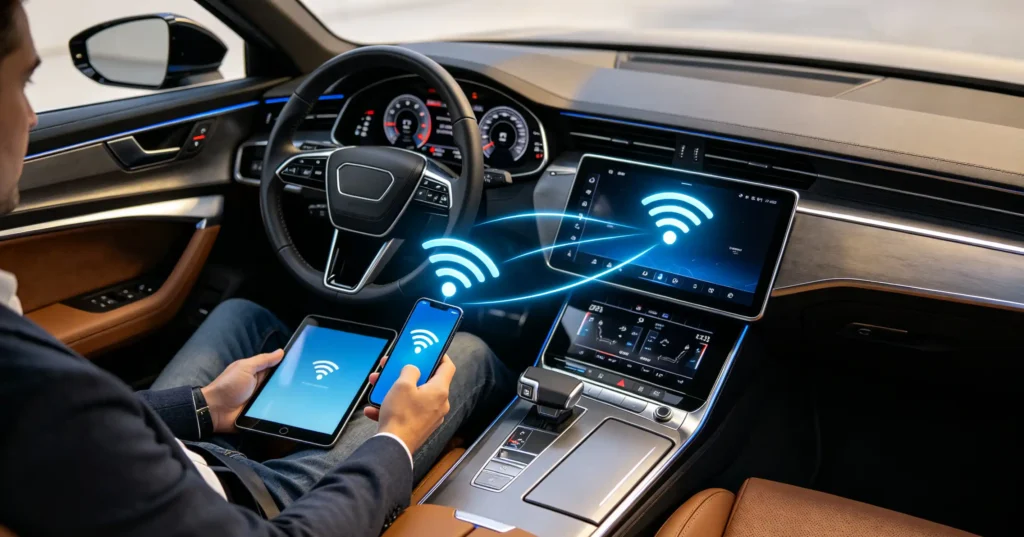
Current market demand is driven by two major trends: larger screens and deeper smartphone integration. Consumers increasingly expect even mid-range models to support smartphone connectivity.
Auto electronics wholesalers, 4S retail upgrade programs, and general car dealers make up the core buyer base. Aftermarket sourcing generally offers more flexibility on MOQ and customization than OEM contracts tied to automaker schedules. For a detailed side-by-side comparison of OEM and aftermarket approaches, read OEM vs Aftermarket Car Navigation.
Android-Based Car Navigation Systems
Features That Define This Category
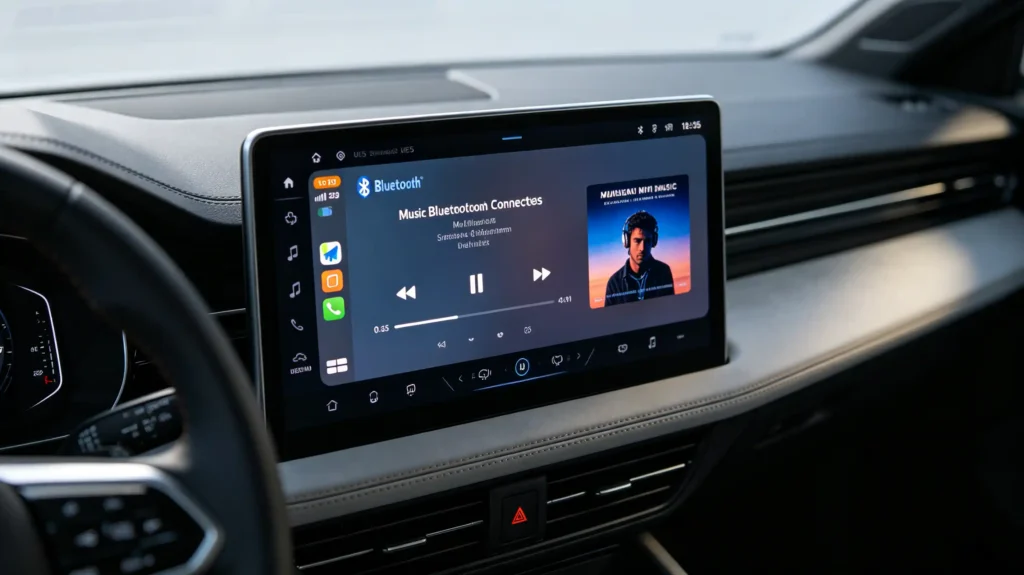
Android-based devices run the full Android operating system, meaning they feature larger touchscreens, support access to app stores, and offer native support for GPS navigation, multimedia playback, and smartphone screen mirroring via Bluetooth connectivity. If your sourcing interest leans specifically toward Android platforms, see our complete guide: What Is an Android Head Unit?
Customization and Business Value
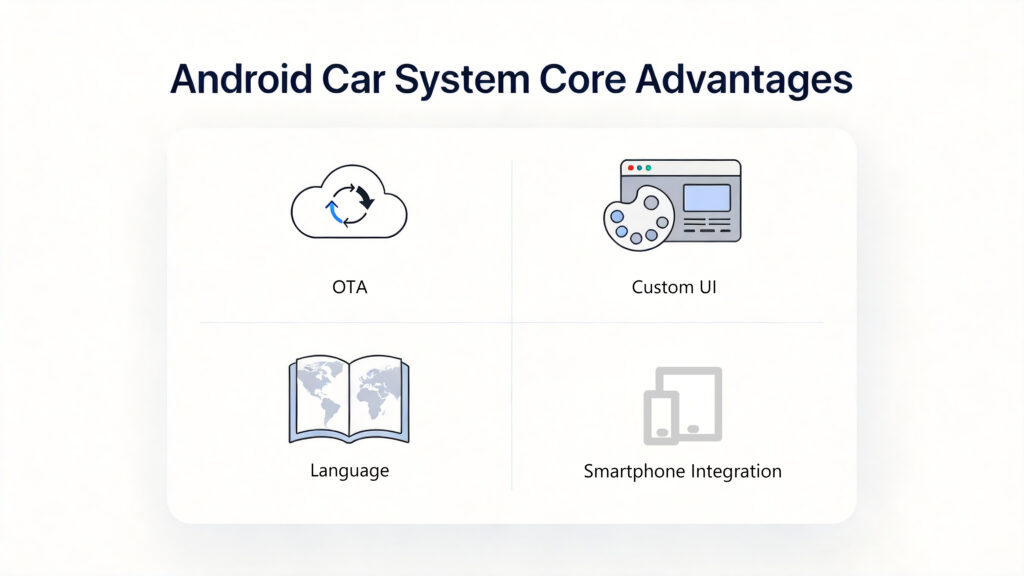
This is also the category where brand differentiation happens. Manufacturers can customize the UI, boot animation, and front-panel logo to match a distributor’s brand instead of shipping a generic interface. Multi-language support — often 30 or more languages — makes a single hardware platform viable across very different export markets.
On the technical side, OTA update capability lets firmware, UI, and vehicle protocol packages get pushed remotely, avoiding physical returns for updates. CANBUS integration, where the decoder is properly developed, syncs steering wheel controls and vehicle status data into the display.
Wholesalers, importers, 4S dealerships, and fleet operators typically gravitate toward Android systems when feature depth and long-term software support matter more than rock-bottom unit cost.
Portable Touch Screen Car Radio Navigation Units
Portable navigation units sit at the opposite end of the spectrum. These are standalone GPS devices — compact, battery-powered, typically suction-mounted to the windshield or dash, with maps stored locally on the device.
The appeal is straightforward: low cost, easy installation with no wiring work, and a unit that can move between vehicles. The limitations are just as clear. There’s no CANBUS integration, screens are smaller, and maps require manual updates rather than OTA delivery.
Demand for this category has been declining as integrated systems get cheaper, but it hasn’t disappeared. Emerging market distributors, budget-conscious fleet operators, and rental companies still order portable units where upfront cost outweighs feature depth.
Key Differences Between All Four Car Navigation System Types
The table below lines up the four categories across the dimensions that matter most for sourcing decisions.
| Dimension | OEM | Aftermarket | Android | Portable |
|---|---|---|---|---|
| Integration | Factory-installed, vehicle-specific | Retrofit, universal or vehicle-specific | Retrofit, full OS platform | None — standalone device |
| CANBUS support | Full, native | Varies by supplier | Available with proper decoder | None |
| Customization | Limited, automaker-controlled | Moderate | High (UI, logo, hardware config) | Minimal |
| Update method | Dealer service | Varies | OTA remote update | Manual, USB/SD |
| Typical buyer | Automakers, Tier-1s, 4S dealers | Wholesalers, distributors, dealers | Wholesalers, importers, fleets | Budget distributors, rental fleets |
OEM and Android systems are where most of the long-term feature growth is happening. Portable units remain a steady but shrinking niche, mostly in price-sensitive regions.
B2B Buyer Selection Tips by Navigation System Type
Matching category to business model saves time during supplier evaluation. A few starting points:
- Automakers and Tier-1 buyers sourcing OEM units should prioritize suppliers with proven CANBUS protocol development — ideally covering 200 or more vehicle models — since factory-fit integration depends on it.
- Wholesalers and distributors stocking aftermarket or Android units should weigh MOQ flexibility, customization support (UI, logo, packaging), and export certification readiness (CE, FCC, RoHS, ISO 9001 where applicable) before committing to volume orders.
- Budget-focused importers targeting portable units should confirm supplier reliability on basic QC, since these lower-margin products still need to survive shipping and real-world use.
Across all four categories, the same supplier fundamentals apply: verified production capacity, a documented QC process (IQC, IPQC, FQC, OQC, plus aging and burn-in testing), and responsive technical support for pre-order matching and after-sales troubleshooting.
FAQ
Which navigation system type offers the best profit margin for auto electronics wholesalers?
Android-based systems typically offer the strongest margins for wholesalers, since brand customization (UI, logo, packaging) lets distributors position them as differentiated products rather than commodity hardware. Aftermarket universal units move in higher volume but at thinner per-unit margins. The right mix usually depends on your target market’s willingness to pay for features versus price.
What is the key difference between standalone aftermarket units and Android navigation systems?
Aftermarket is a broad category that includes both basic replacement radios and full-featured Android units — Android navigation is essentially a subset of aftermarket defined by its operating system. The practical difference is capability: Android units support app-based features, OTA updates, and deeper CANBUS integration, while basic aftermarket radios may only handle audio and simple navigation.
Are portable touch screen navigation radios still viable for bulk export to emerging markets?
Yes, in specific segments. Budget fleet operators and price-sensitive markets still order portable units where low upfront cost matters more than feature depth. Demand is shrinking overall as integrated systems become more affordable, so it’s worth confirming current order volume trends with your target market before committing to large bulk orders.
Can OEM navigation units support post-factory function customization for automakers?
To a degree. Once a vehicle platform’s CANBUS protocol and hardware spec are locked in during initial development, further customization typically happens through firmware or software updates rather than hardware changes. Automakers working with a manufacturer on OTA-capable systems can push UI, language, or feature updates after production without a full hardware redesign.
Which navigation category do most 4S dealerships prefer for retail vehicle upgrades?
4S dealerships most often stock Android-based aftermarket units for retail upgrades, since they balance feature richness with installation flexibility across the multiple vehicle brands a dealership network typically services. OEM-spec units are used mainly for warranty replacements tied to the original vehicle model.
Conclusion
Choosing between OEM, aftermarket, Android, and portable navigation systems comes down to matching the category to your buyers and business model. Automakers need factory-grade CANBUS integration; wholesalers need customization and margin; budget importers need reliable low-cost hardware.
Understanding these distinctions upfront makes supplier evaluation faster and reduces the risk of stocking the wrong product for your market.
Sourcing a specific navigation system type for your market? Contact our team to discuss OEM/ODM customization, or explore our current Android and Linux navigation product lines.