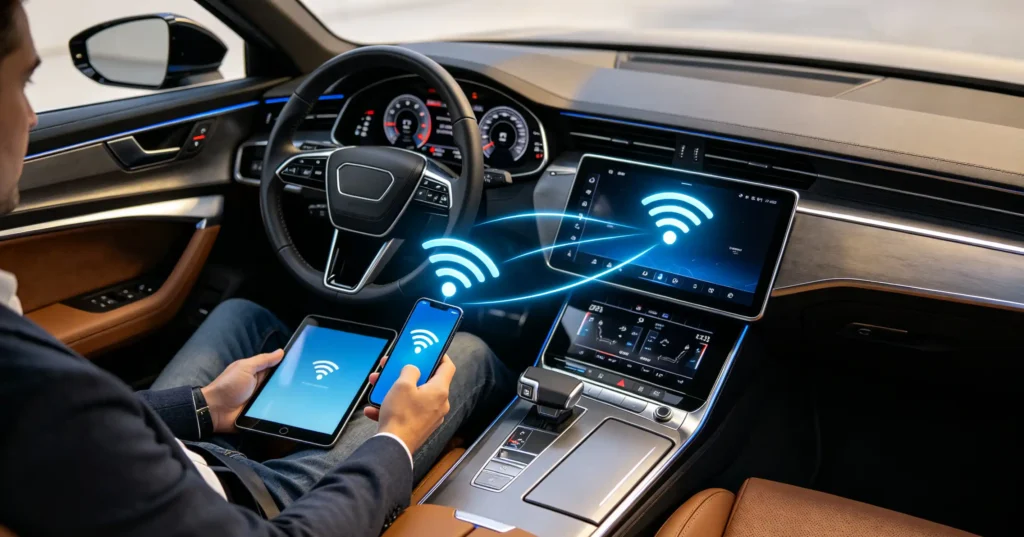
A wiring harness rarely gets the attention it deserves during sourcing conversations. That is right up until a batch of head units arrives and half of them will not connect to steering wheel controls. Or the connector simply does not match the vehicle. For dealers, wholesalers, and importers running retrofit or aftermarket projects, understanding harness types and compatibility requirements upfront prevents exactly this kind of costly surprise.
This guide breaks down what a car stereo wiring harness actually does. It covers the main types in circulation. It also covers what to verify before ordering at volume. For a full view of all hardware decisions, see our car stereo hardware components overview.
Car Stereo Wiring Harness – Definition and Core Functions
What Is a Wiring Harness?
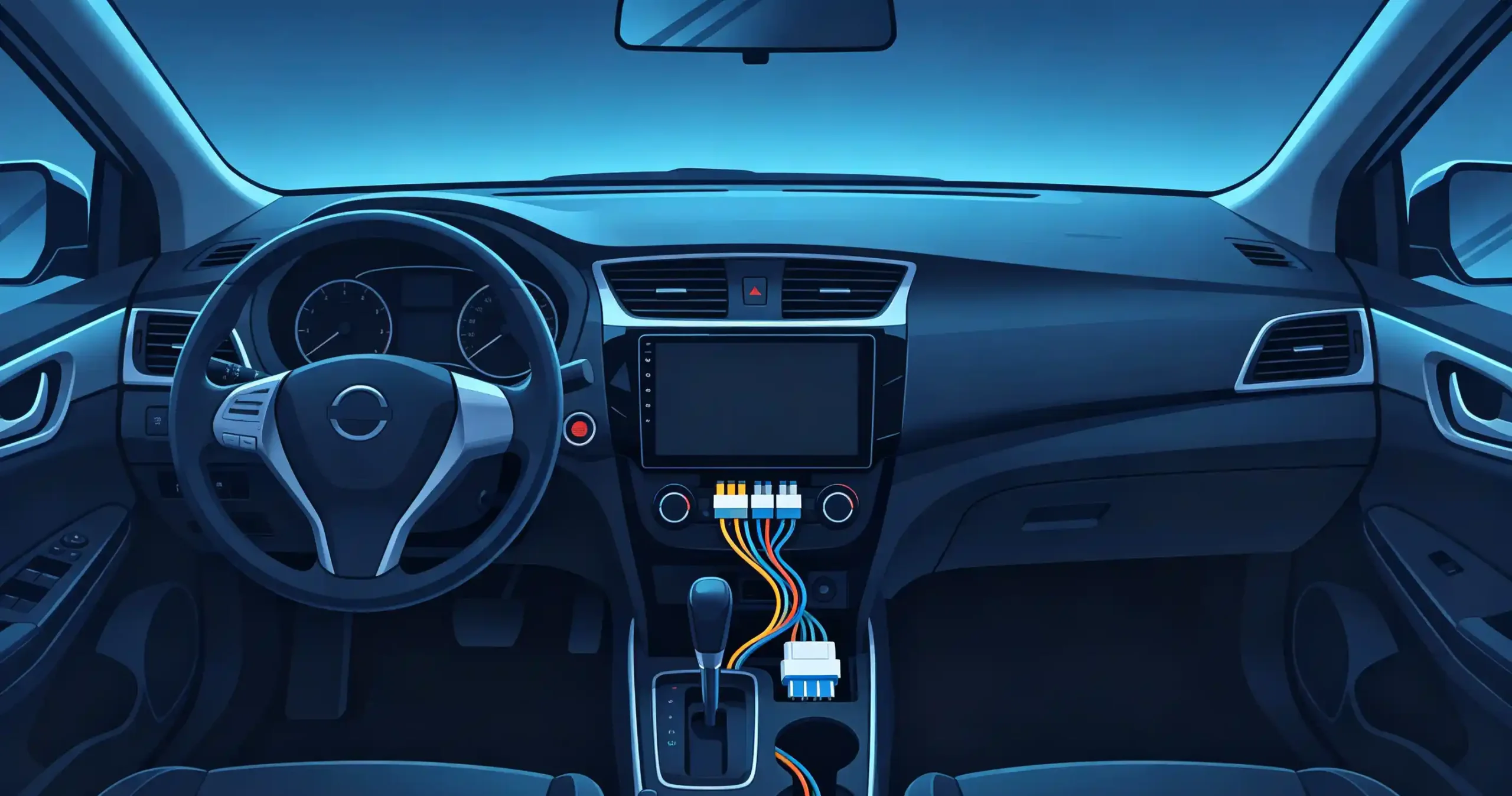
A car stereo wiring harness is a pre-assembled bundle of wires and connectors. It links the head unit to the vehicle’s electrical system. It covers power, ground, speaker connections, and various vehicle signals. It is the physical bridge that makes everything else about the head unit actually functional once it is mounted in the dashboard.
Three Core Functions
Three core functions run through every harness. Power delivery supplies 12V from the battery and ignition circuits. It also includes a ground connection. Audio signal transmission connects the head unit’s outputs to the vehicle’s speakers. Vehicle signal integration carries additional data — steering wheel control signals, reverse gear trigger, vehicle speed pulse, illumination, and parking brake status. These let the head unit interact properly with the rest of the vehicle. It does not operate in isolation.
Business Consequences of Getting It Wrong
Getting the harness wrong carries real business consequences. Mismatched connectors can stall an installation outright. Incorrect pin assignments risk actual hardware damage. This is not just a non-functioning feature. Poor wire quality — thin gauge, weak insulation, cheap crimped connectors — leads to shorts and intermittent connections. These surface as warranty claims well after the sale.
Common Car Stereo Wiring Harness Types and Use-Cases
Three Harness Categories
Three harness categories cover most of what shows up in aftermarket and OEM sourcing. Each fits a different project profile.
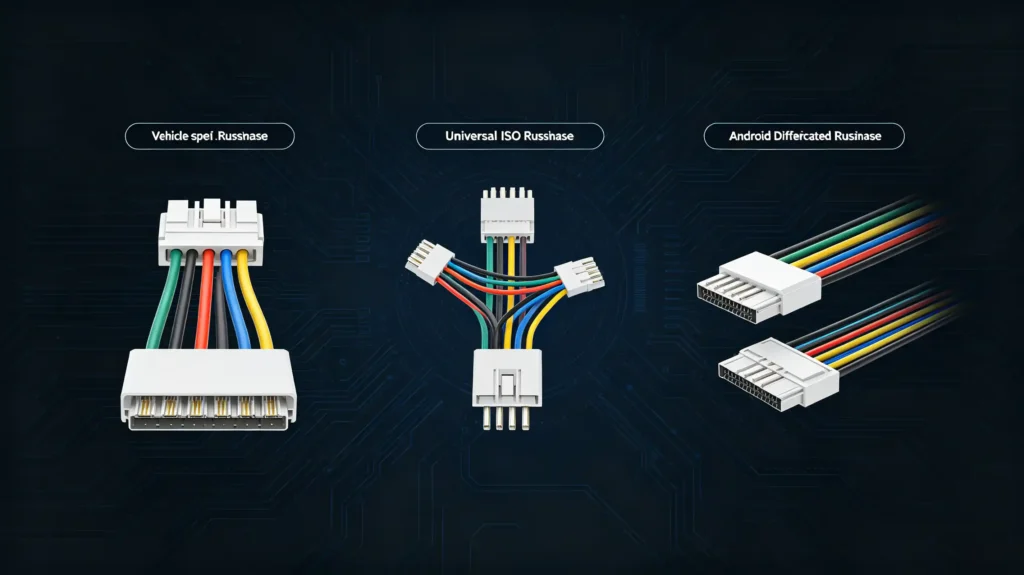
Vehicle-Specific Harness
A vehicle-specific harness is custom-built for a particular vehicle make, model, and year. It is designed to plug directly into the factory connectors already in the dashboard. It typically includes every required signal, from power through steering wheel controls, out of the box. This category fits OEM-grade installations and 4S dealership upgrade programs. Fitment precision matters more than flexibility in these cases.
Universal / ISO Harness
A universal / ISO harness is built around the standardized ISO 10487 connector. It is designed to fit across a wide range of vehicles rather than one specific model. It generally covers the basics well. But it often needs additional adapters to pick up vehicle-specific signals. This is the common choice for aftermarket installations and cost-sensitive retrofit projects.
Android Head-Unit Harness
An Android head-unit harness is similar in structure to a universal harness. But it is extended with additional wiring for Android-specific features. CAN Bus decoder connections. USB lines. Camera input. A GPS antenna connector. This category is what most modern Android head-unit installations actually require. The extra functionality genuinely needs the extra wiring to work. For step-by-step installation guidance, see our head unit installation guide.
Choosing Between Them
Choosing between these is not just a cost decision. It directly affects installation time. It also affects how much of the head unit’s feature set will actually function once it is connected.
ISO Wiring Harness and Standard Connector Connections
The ISO 10487 Standard
The ISO 10487 standard is worth understanding on its own. It is the closest thing this category has to a universal baseline. But it is more limited than its name suggests.
What the Standard Defines
The standard defines the physical connector and pin assignments across two main plugs. A power connector (8 pins) covers battery, ignition, ground, illumination, and antenna control. A speaker connector (8 pins) covers front left, front right, rear left, and rear right speaker connections.
Its Main Strength
Its main strength is exactly what the name implies. A standardized connector shape that fits a broad range of vehicles and head units. It is widely used across European and Asian vehicle platforms.
Its Limitations
Its limitations matter just as much as its coverage, though. The physical connector matching between two products does not guarantee the pin assignments actually line up. Different manufacturers have historically wired the same connector shape differently. This is a real source of installation failures. Critically, ISO 10487 does not touch CAN Bus signals, steering wheel controls, or other vehicle-specific data at all. Those require separate adapters or a more complete harness on top of the base ISO connector. Treating an ISO harness as a complete solution rather than a starting point is one of the more common assumptions that trips up first-time buyers in this category.
Android Head Unit Wiring-Harness Specifics
More Functionality Requires More Wiring
Android head units ask more of a wiring harness than a traditional stereo does. They support more functionality that needs a physical connection to work.
CAN Bus Decoder Wiring
CAN Bus decoder wiring connects to the vehicle’s CAN Bus network. It enables steering wheel control functionality. Reverse trigger detection. Speed signal input. Other vehicle data the head unit displays or acts on. For foundational context on CAN Bus, see our what is CAN BUS guide.
Additional Wiring
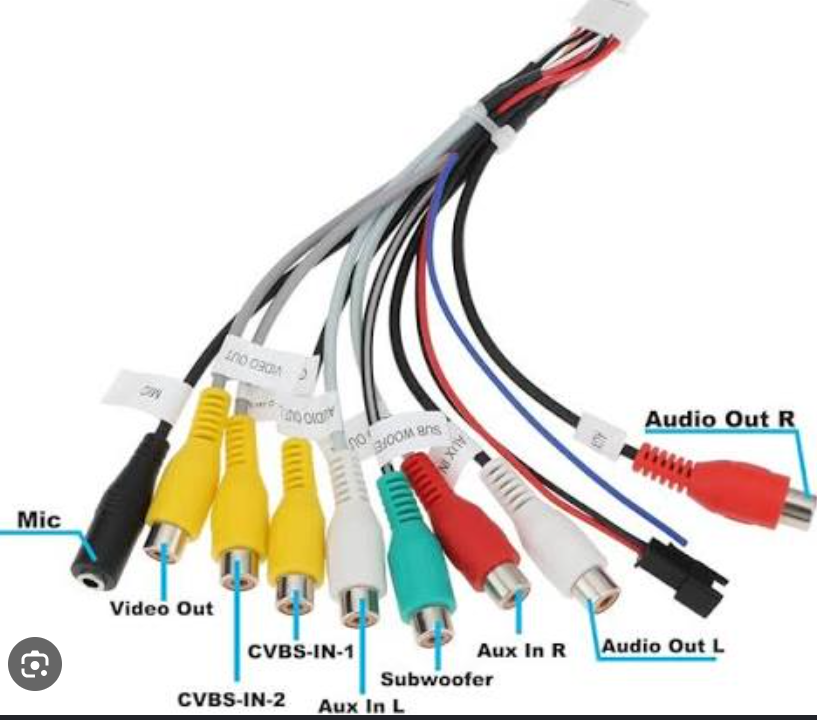
Beyond that, Android-specific harnesses typically add dedicated USB wiring for phone connectivity and media access. A camera input (RCA or AHD) for backup camera integration. An SMA connector for the GPS antenna. Separate antenna connections supporting Wi-Fi and Bluetooth.
Essential Additional Signals
A handful of additional signals matter specifically for feature completeness. The reverse gear signal triggers automatic camera activation. The speed pulse signal supports more accurate dead-reckoning during GPS signal loss. The parking brake signal restricts video playback while the vehicle is in motion, for safety compliance.
Not Optional Extras
None of these are optional extras if the buyer expects the corresponding feature to actually work. A harness missing the parking brake wire, for instance, means that safety restriction simply will not function. This holds regardless of how capable the head unit’s software is. Android head units generally draw more power than basic stereos. The harness and its wire gauge need to be sized for accordingly.
Head-Unit and Vehicle-Side Wiring-Harness Compatibility Factors
Multiple Layers of Compatibility
Compatibility is not a single yes-or-no check. It runs across several layers that all need to align for an installation to go smoothly.
Connector Form-Factor
Connector form-factor is the most visible layer. The physical shape needs to match on both the head unit and vehicle sides. Whether that is a standard ISO connector or a vehicle-specific plug.
Pin Assignment
Pin assignment is the layer that catches people off guard. Two connectors can share an identical physical shape. They can wire completely different signals to the same pin positions. This is exactly why requesting and comparing pin-out diagrams matters more than confirming the connector shape alone.
Signal Requirements
Signal requirements form a third layer. Whether the harness actually carries what the target vehicle needs — steering wheel controls, reverse trigger, speed pulse, illumination, parking brake. Whether the CAN Bus protocol implementation matches what that specific vehicle expects. CAN Bus signaling varies meaningfully across manufacturers and even model years.
Power Compatibility
Power compatibility rounds things out. Voltage type (12V standard, 24V for commercial vehicles). Wire gauge both need to match the head unit’s actual current draw.
No Check Substitutes for Another
None of these checks substitute for each other. A harness can pass on connector shape and power rating. It can still fail on pin assignment or CAN Bus protocol match.
Common Real-World Harness-Related Pitfalls in B2B Retrofit Projects
Recurring Problems
A handful of recurring problems account for most of the harness-related complaints that surface in bulk retrofit projects.
The Connector Fits But the Pin Assignment Differs
This is arguably the most deceptive failure mode. The installation appears to go smoothly right up until something malfunctions or gets damaged from a miswired signal.
Missing Signals
Missing signals is a simpler but equally frustrating issue. A harness that lacks steering wheel control wiring, a reverse trigger line, or a speed signal leaves the corresponding features simply unavailable. This is true no matter how capable the head unit itself is.
Poor Wire Quality
Poor wire quality — thin gauge, weak insulation, or cheap connectors — shows up over time as intermittent connections, shorts, or in worse cases a fire risk that is genuinely dangerous rather than just inconvenient.
Incorrect CAN Bus Decoder
An incorrect CAN Bus decoder, mismatched to the specific vehicle’s protocol, results in steering wheel controls or air conditioning display functions that simply do not respond.
Generic Low-Cost Harness Bundle
A generic low-cost harness bundle that skips Android-specific wiring entirely — no USB extension, no camera input, no GPS antenna connector — leaves buyers with a head unit that cannot use half its advertised feature set.
The Common Thread
Every one of these pitfalls traces back to a check that could have caught the problem before mass production. Not after units were already in the field.
B2B Selection and Specification Considerations for Wiring Harnesses
RFQ and Sample-Validation Checklist
Turning this into a practical RFQ and sample-validation checklist.
- Harness type — confirm whether vehicle-specific, universal/ISO, or Android-specific wiring is required for the project
- Connector compatibility — verify the physical connector matches both the head unit and target vehicle
- Signal completeness — confirm power, speaker, steering wheel control, reverse, speed, and parking brake signals are all present
- Wire quality — check wire gauge, insulation quality, and connector build
- CAN Bus decoder — verify decoder compatibility with the specific target vehicle model
- Documentation — request pin-out diagrams and full harness specifications, not just a connector-type description
- Sample testing — test the harness with an actual head unit and target vehicle before approving mass production
FAQ
Does a physical ISO connector guarantee full compatibility between harness, head unit, and target vehicle?
No. The ISO 10487 standard defines the connector’s physical shape and general pin layout. But individual manufacturers have historically implemented pin assignments differently even within that shared shape. A connector that physically plugs in without resistance can still deliver signals to the wrong pins. Matching connector shape alone is not sufficient. Pin-out diagrams need to be checked directly against the specific head unit and vehicle involved.
Why do some Android head-unit harness bundles lack steering-wheel-control signal support?
This usually comes down to cost-cutting in a generic or low-tier harness bundle. It is not a technical limitation of Android head units themselves. Steering wheel control support requires a CAN Bus decoder matched to the target vehicle’s protocol. Some budget harness packages simply omit this component to reduce cost. This leaves buyers with a harness that handles power and audio but nothing more. Confirming CAN Bus decoder inclusion explicitly, rather than assuming it is bundled by default, avoids this gap.
What documentation should B2B buyers require from suppliers for wiring-harness deliveries?
At minimum, request a pin-out diagram showing exactly which signal maps to which pin. Request a full list of supported signals — power, audio, steering wheel control, reverse, speed, parking brake. Request confirmation of which vehicle models or CAN Bus protocols the harness or decoder supports. For bulk orders, it is also worth requesting quality control documentation. This should confirm the harness passed incoming inspection and, ideally, vibration testing to simulate long-distance transport and driving conditions.
Can I modify a generic ISO harness to adapt it for a vehicle-specific retrofit project?
To a degree, yes. A generic ISO harness can often be adapted with additional connectors or an inline adapter to pick up vehicle-specific signals like steering wheel controls. This is provided a compatible CAN Bus decoder is added alongside it. This approach works reasonably well for lower-volume or one-off installations. But for bulk retrofit projects, sourcing a purpose-built vehicle-specific or Android-specific harness from the start is generally more reliable. It also reduces the installation-time cost of manual adaptation across every unit.
What sample-validation steps should wholesalers perform on wiring harness before approving mass production?
Start by physically connecting the sample harness to both the target head unit and an actual sample vehicle. Confirm every expected signal — steering wheel controls, reverse camera trigger, speed pulse — actually functions as intended. Follow that with a basic mechanical check on wire gauge and connector build quality. Where possible, request or replicate vibration testing to confirm connections hold up under simulated road conditions. Only after these checks pass does it make sense to commit to a full production run.
Conclusion
A mismatched or incomplete wiring harness is one of the more preventable causes of retrofit-project headaches. It is almost always caught by checking pin assignments and signal completeness before mass production rather than after.