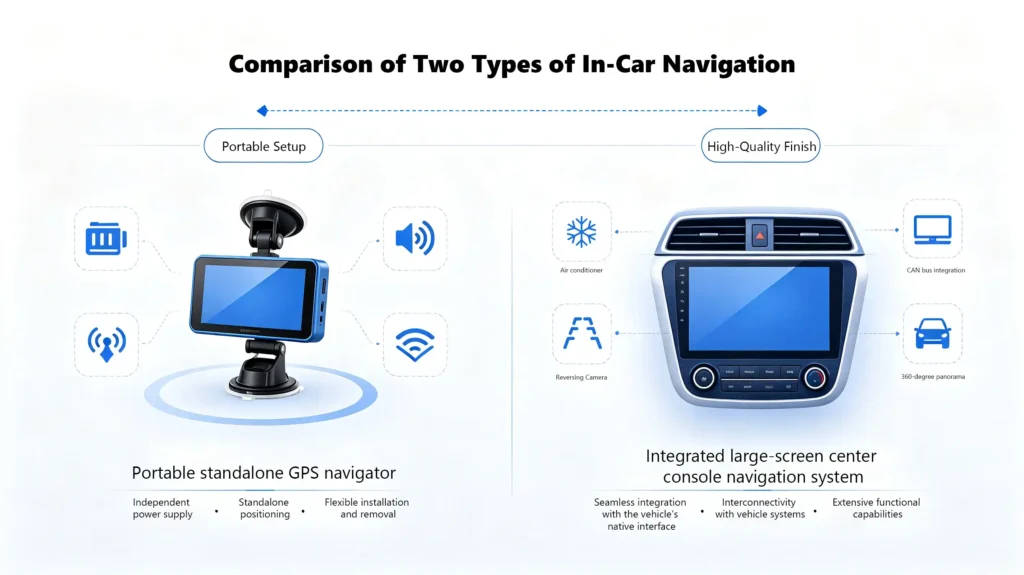
Buyers sourcing for a new market often ask the same question in different words. Should we stock standalone GPS units, or move to integrated car navigation systems? The answer isn’t just about price — it’s about what your customers actually expect to see when they turn the key. This guide breaks down the real differences between the two product categories — from hardware and software architecture down to which one fits your target market. You’ll be able to make a sourcing decision based on how these products actually perform in the field.
For a general overview of navigation systems and how they work, see our pillar guide: What Is a Car Navigation System?
Core Definitions: GPS Devices vs Integrated Vehicle Navigation Systems
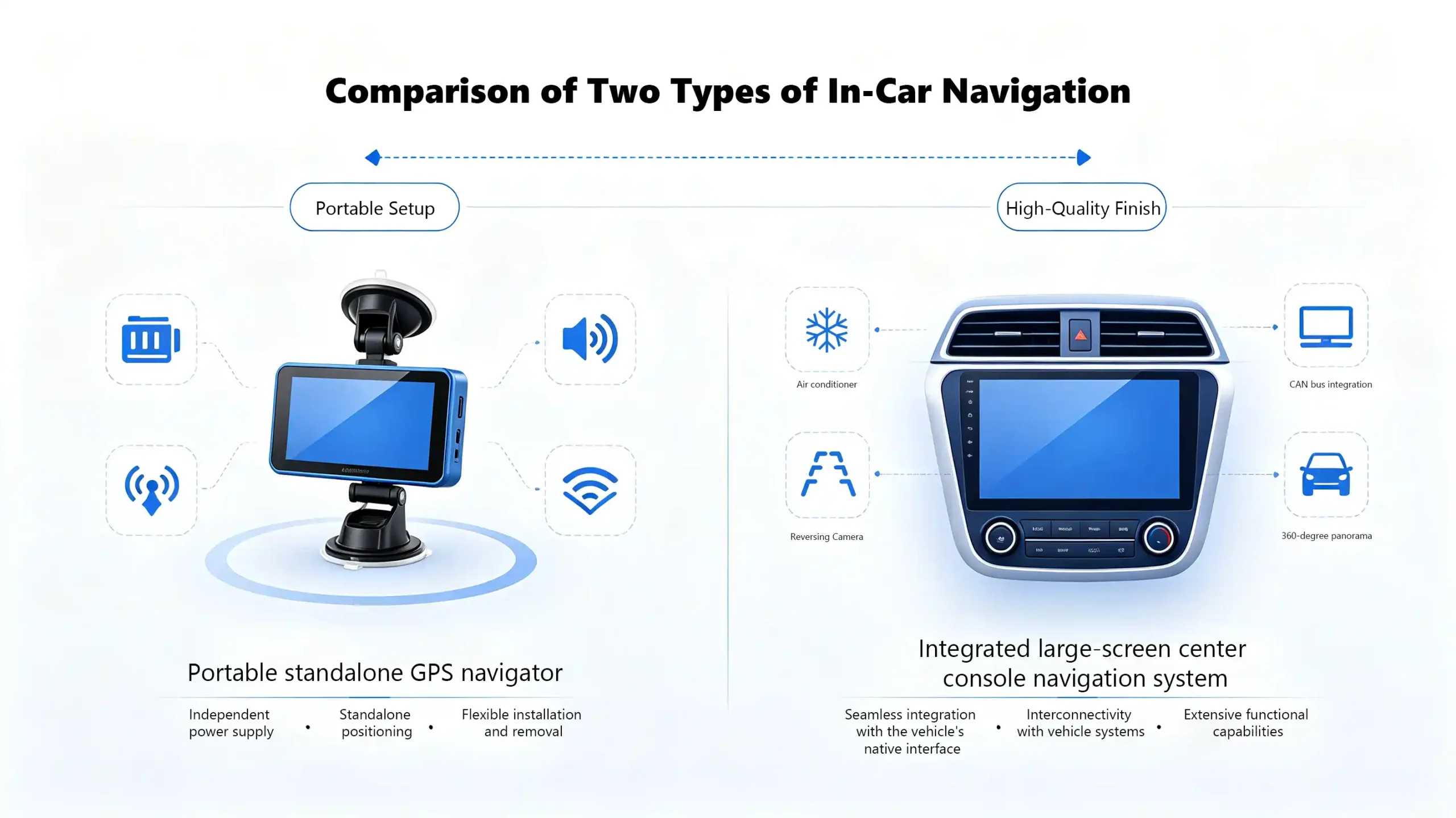
A standalone GPS device is a portable, self-contained unit. It has its own screen, speaker, internal battery, and is usually suction-mounted to a windshield or dash. It has one job: turn-by-turn navigation. There’s no wiring into the vehicle and no connection to anything the car itself is doing.
An integrated car navigation system is a different category of product entirely. It functions less like a gadget and more like the cockpit’s central hub. It’s a dashboard-mounted head unit that combines GPS positioning with map software, media playback, vehicle data display, and CAN bus connectivity.
This distinction matters because “GPS” and “car navigation system” aren’t interchangeable terms. Buyers often use them that way in casual conversation, but technically they refer to different things. GPS refers to the positioning technology itself. A car navigation system is the full product that uses GPS as one component among several. The sections below walk through the hardware, software, feature, and business differences that follow from that distinction.
For a full breakdown of navigation system categories, see our guide on types of car navigation systems.
Hardware and Software Structural Differences
The gap between these two product types starts at the component level. A standalone GPS device typically runs on a small processor with modest RAM, a 4–7 inch screen, a basic speaker, and an internal battery — there’s no CAN bus interface and no wiring into the vehicle’s electrical system at all.
An integrated navigation system is built differently from the ground up. It includes an automotive-grade SoC, a larger 7–10+ inch screen, more RAM and ROM, a CAN bus decoder, a full wiring harness, and power management circuitry designed for a vehicle’s electrical environment.
The software gap is arguably wider than the hardware gap. Standalone GPS units run a lightweight, single-purpose OS — map updates typically come via USB or SD card, and that’s the extent of what the device does. Integrated systems run a full Android or Linux operating system, support installed apps, receive OTA updates for both firmware and maps, and offer multi-language systems with customizable UI. If your sourcing interest leans specifically toward Android-based navigation platforms, see our complete guide on what is an Android head unit.
One is a navigation appliance. The other is a small automotive computer that happens to include navigation. For a detailed breakdown of each hardware and software component — from GPS module to CAN bus decoder — see our guide on components of a car navigation system explained.
Built-In GPS Functionality Inside Modern Vehicle Navigation Head Units
“Built-in GPS” specifically refers to the GNSS receiver module integrated onto the head unit’s mainboard — it is not a separate device sitting inside the car. That module has one narrow job: receive satellite signals and calculate position. It doesn’t render maps, calculate routes, or draw guidance on screen by itself.
How the Built-In GPS Module Works Inside the System
In an integrated system, the GPS module passes raw positioning data to the main processor, which handles everything downstream — map rendering, route calculation, display output, and touch interaction. Physically, this module is small — a chip or daughterboard mounted on the main PCB. It’s sometimes paired with an external antenna connection for better signal in vehicles with heavy windshield tinting or metal roofing.
This is the clearest way to explain the difference to a buyer who’s still mixing up the two terms: built-in GPS is a feature inside a larger product, not a product category by itself. A standalone GPS device, by contrast, packs positioning, processing, and display all into one self-contained unit. It doesn’t rely on any other vehicle system to function. For the complete end-to-end working logic — from satellite signal to on-screen guidance — read our guide on how a car navigation system works.
Core Feature and Integration Gap: Standalone GPS vs Full Vehicle Navigation Systems
The clearest way to see the gap between these two categories is side by side:
| Dimension | Standalone GPS Device | Integrated Car Navigation System |
|---|---|---|
| Typical price range | Low | Mid to high |
| Vehicle (CAN bus) integration | None | Full — steering wheel, climate, sensor data |
| Screen size | 4–7 inches | 7–10+ inches |
| Multimedia support | None | Full media playback, apps |
| OTA updates | No (USB/SD only) | Yes — firmware and maps |
| Expansion ports (camera, DVR, TPMS) | None | Yes |
| Typical buyer | Budget/mass retail | Installer, dealership, OEM |
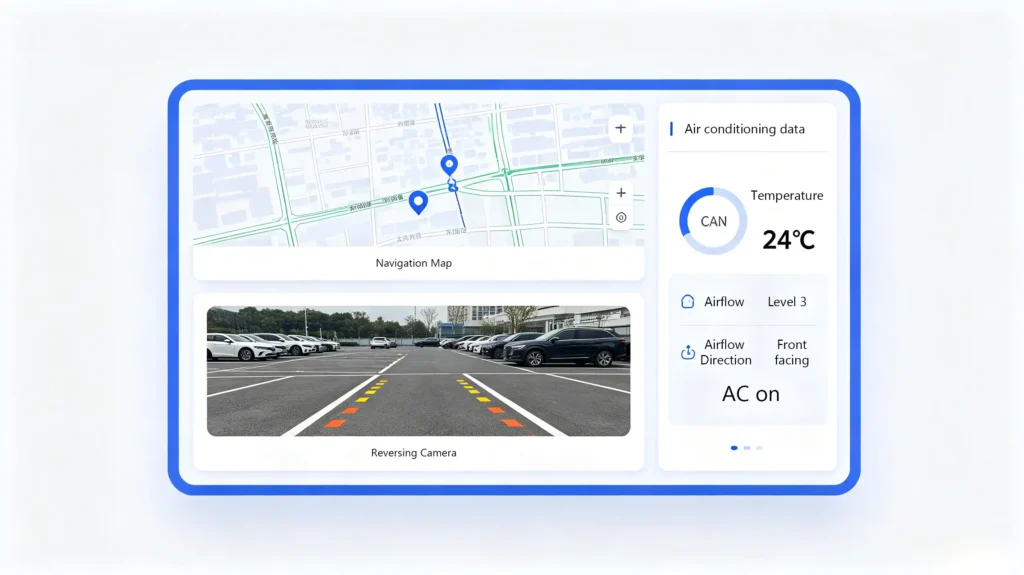
The vehicle integration gap is the most consequential line in that table. A standalone GPS unit has zero communication with the car — it doesn’t know what the car knows. An integrated system reads CAN bus data, so it can display steering wheel controls, climate information, door sensor status, and a reverse camera feed on the same screen.
That’s the difference between a single-purpose accessory and a full infotainment hub. For a wholesaler, it’s also the difference between selling one item and selling an entry point into a whole accessory line — reverse cameras, dash cams, TPMS sensors — that a standalone GPS unit simply has no path to support.
Advantages and Limitations of Each Solution
Neither product type is universally the “better” choice — the right one depends on what your customers actually need.
Standalone GPS keeps things simple: low unit cost, no installation labor, portable between vehicles, one SKU that fits nearly any car. The trade-off is a hard ceiling on retail price, declining demand in mature markets, and no upselling path into accessories.
Integrated navigation systems carry a higher retail price and better margin. CAN bus integration itself becomes a differentiator worth paying for. The accessory ecosystem — cameras, DVRs, TPMS — builds into a real product line, and OTA updates cut after-sales support costs over time. The trade-offs: higher unit cost, more SKUs since CAN bus matching is vehicle-specific, installation labor, and a more complex supply chain.
Fit depends on your target market’s maturity and how much customers pay for features. Your distribution network’s ability to support installation also matters.
B2B Buyer Selection Guide: Match GPS or Car Navigation to Your Market
A few scenarios come up repeatedly with buyers evaluating this decision:
- Emerging markets and budget-focused fleets are a different story. Standalone GPS is often still the right entry point due to low cost and simple logistics with no CAN bus matching required.
- Mature markets with high feature expectations (EU, North America) — integrated Android or Linux navigation is the expected standard; standalone units read as outdated.
- 4S dealerships offering retail upgrades — integrated systems with CAN bus matching, custom UI, and accessory bundling create the higher perceived value that supports dealership margin.
- OEM factory-installed applications — integrated navigation with built-in GPS is effectively the only option, since automakers don’t install standalone GPS on the line.
The practical question comes down to distribution: if you sell to installers and dealerships, integrated systems make sense. If you move volume through mass retail with no installation support, standalone GPS may still have a place.
FAQ
What profit margin difference exists between standalone GPS devices and integrated car navigation systems?
Integrated systems generally carry a higher retail price and stronger margin, since the CAN bus integration, larger display, and multimedia features justify a premium that standalone GPS units can’t command. Standalone GPS competes mainly on price, which compresses margin over time as it becomes a commodity item in most markets.
Can aftermarket standalone GPS connect to vehicle CAN bus to display original car data?
No. Standalone GPS units have no wiring into the vehicle’s electrical or data systems, so they can’t read steering wheel controls, climate data, or sensor information. CAN bus communication requires the wiring harness and decoder hardware built into an integrated navigation system.
Is built-in GPS in Android car navigation more accurate than dedicated portable GPS devices?
Accuracy depends more on the GNSS module and antenna quality than on whether the unit is standalone or integrated. A well-matched built-in GPS module with a properly placed external antenna can perform on par with, or better than, a portable device, particularly in vehicles with heavy window tinting that weakens internal antenna reception.
Why do most OEM car manufacturers adopt integrated navigation with built-in GPS instead of separate GPS devices?
Automakers need the head unit to communicate with the vehicle — displaying steering wheel controls, sensor data, and climate information on one screen. A standalone GPS device can’t do this, since it has no CAN bus connection. Integrated navigation is the only category that meets factory installation requirements.
Ready to Source the Right Navigation Solution?
If you’re weighing standalone GPS against integrated navigation for a specific market or vehicle lineup, the right call usually comes down to your distribution channel and customer expectations rather than price alone.
Contact our team to discuss your customized requirements, or request a quotation for OEM/ODM car navigation solutions built around your target market.