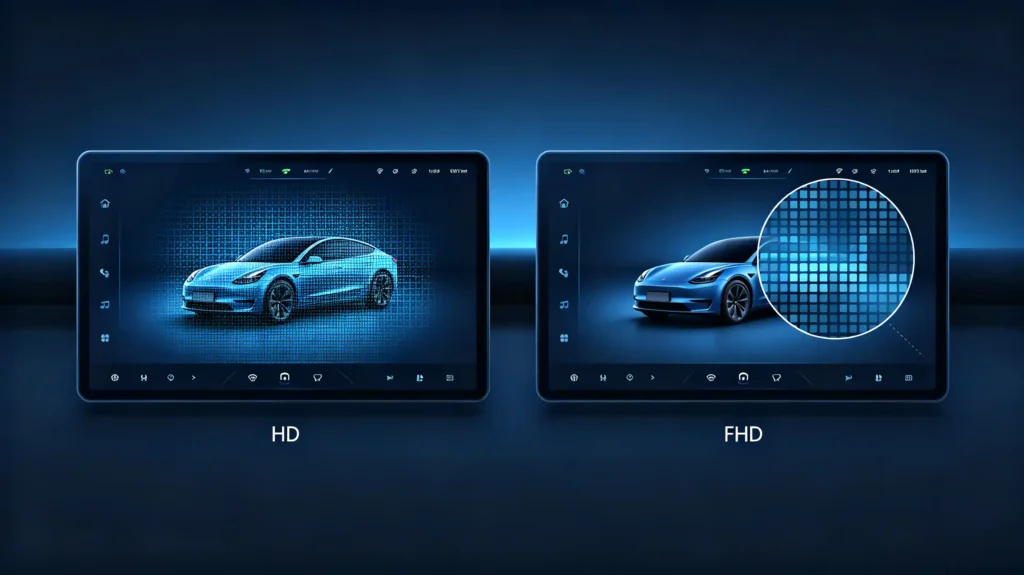
Polished feel, whereas HD remains fully functional but visibly less refined by comparison. Video and media playback tell a similar story. FHD supports full 1080p content with the detail intact. HD tops out at 720p. It still looks acceptable but noticeably softer side by side with an FHD panel.
That gap is most obvious on 9-inch to 10.1-inch screens. The extra pixels have more room to matter. On a 7-inch display, the difference is still visible on close inspection. But it is less dramatic. This is exactly why HD remains a reasonable choice at that smaller size rather than an automatic downgrade. For a full view of all display-related hardware decisions, see our car stereo hardware components overview.
Screen Size, Resolution and Pixel Density Relationship
Resolution Alone Is Not Enough
Resolution alone does not determine sharpness. Screen size has to be factored in through pixel density, or PPI (pixels per inch). PPI is calculated as resolution divided by the screen’s diagonal measurement.
The Same Resolution, Different Results
The same resolution produces very different results depending on what size screen it is spread across.
| Screen Size | Resolution | Approx. PPI | Result |
|---|---|---|---|
| 7-inch | HD (1280×720) | ~210 PPI | Good sharpness |
| 10.1-inch | HD (1280×720) | ~145 PPI | Noticeably softer |
| 7-inch | FHD (1920×1080) | ~315 PPI | Very sharp |
| 10.1-inch | FHD (1920×1080) | ~218 PPI | Good sharpness |
The Consistent Pattern
The pattern is consistent. A higher resolution on the same screen size raises PPI and sharpness. The same resolution spread across a larger screen lowers PPI and introduces visible pixelation. This is exactly why a 10.1-inch HD panel and a 7-inch HD panel do not look remotely similar side by side. They share an identical resolution spec. As a practical rule, HD is sufficient at 7-inch. FHD is the better match once screens reach 9-inch and above. For more on screen size considerations, see our car navigation screen size guide.
Resolution, Aspect Ratio and System-Level Display Compatibility
Resolution and Aspect Ratio Work Together
Resolution and aspect ratio work together. A mismatch between the two introduces compatibility problems that have nothing to do with pixel count.
What Is Aspect Ratio?
Aspect ratio describes the proportion of width to height. 16:9 is the standard widescreen format on most Android head units. Some designs use 16:10 or less common ratios like 4:3 or 5:3.
When Aspect Ratio Causes Problems
When a panel’s aspect ratio falls outside what an app expects, the results can be problematic. Stretched or distorted interface elements. Black bars or cropped content. Navigation maps that do not fill the screen properly.
Android’s Scaling Logic
The Android operating system automatically scales UI elements to fit different resolutions. But that scaling logic assumes a reasonably standard aspect ratio. Non-standard proportions can still produce layout issues the OS was not designed to smooth over.
App Compatibility
Most navigation apps are built and tested around common aspect ratios. Problems tend to surface more with non-standard or custom panel dimensions than with mainstream ones. For buyers, this means aspect ratio compatibility is worth confirming alongside resolution. Do not treat it as an afterthought.
Key Factors That Determine Perceived In-Vehicle Display Quality
More Than Just Resolution
Resolution sets the pixel count. But several other factors shape how good the screen actually looks once it is mounted in a dashboard under real lighting conditions.
Brightness (Nits)
Brightness, measured in cd/m² (nits), determines whether the screen stays readable in direct sunlight. Figures in the 400–600+ cd/m² range are generally considered adequate for automotive use. Lower brightness panels can become difficult to read on a bright day.
Contrast Ratio
Contrast ratio affects how deep the blacks look. It also affects how vibrant the overall image feels.
Color Performance
Color performance — both accuracy and gamut — determines how true colors appear on the map and interface.
Panel Type
Panel type plays a role too. IPS remains the standard baseline for automotive displays. It offers reliable color and wide viewing angles. QLED and OLED sit at progressively higher price points with stronger brightness or contrast performance. For a detailed comparison of panel technologies, see our IPS vs QLED display technology guide.
Viewing Angle
Viewing angle matters more in a vehicle than it might elsewhere. Passengers often view the screen from the side rather than head-on.
The Takeaway
None of these factors show up in a simple resolution figure. Comparing two “FHD” units on resolution alone can still miss meaningful quality differences.
B2B Considerations for Specifying Android Head-Unit Screen Resolution
Sourcing Checklist
Turning this into a sourcing checklist keeps resolution comparisons consistent across supplier quotes.
- Confirm resolution — HD (1280×720) or FHD (1920×1080) — appropriate to the screen size
- Calculate or request PPI, targeting roughly 200 PPI or higher for acceptable sharpness
- Verify aspect ratio (16:9 is standard) and confirm compatibility with target navigation and media apps
- Confirm panel type — IPS as a reasonable baseline for automotive use
- Check brightness specifications, aiming for 400–600+ cd/m² for adequate outdoor visibility
- Request sample units to test resolution, UI scaling, map readability, and video playback directly
- Do not rely on the datasheet alone
- Ask suppliers for accurate, verified display specifications rather than marketing-rounded figures
FAQ
Does higher FHD resolution always deliver a sharper display experience for car navigation map rendering?
Generally yes, but the improvement depends on screen size. On larger panels — 9-inch and above — FHD’s extra pixel count produces a clearly sharper map with more visible detail. On a 7-inch screen, the difference from HD is smaller because the pixel density gap narrows at that size. Buyers should weigh FHD’s benefit against the target screen size. Do not assume it delivers the same improvement across every display dimension.
Why can two head units with identical advertised resolution show large differences in real-world display quality?
Resolution only measures pixel count. It says nothing about panel brightness, contrast, color accuracy, or viewing angle. All of these affect how the screen actually looks in use. Two “FHD” units can use very different panel grades. One can produce washed-out colors or poor outdoor visibility despite matching resolution numbers on paper. This is why sample testing under real lighting conditions matters more than comparing spec sheets alone.
What risks arise when pairing a high FHD resolution panel with a non-standard aspect ratio on Android head units?
A high resolution does not protect against aspect-ratio compatibility problems. If the panel’s proportions fall outside what an app expects, the result can be stretched interface elements, black bars, or maps that do not fill the display correctly. This happens regardless of how many pixels the panel has. Confirming aspect ratio compatibility with target navigation and media apps is a separate check from confirming resolution. Both matter for a clean final result.
For a given screen physical size, what practical threshold of pixel density should B2B buyers target for in-vehicle use?
A general target is around 200 PPI or higher. This tends to produce acceptable sharpness for map text and UI elements at typical viewing distances inside a vehicle. Below that threshold, text and fine map details start to look noticeably soft. This is particularly true on larger screens. Calculating PPI (resolution divided by screen diagonal) before finalizing a spec helps confirm a chosen resolution will actually deliver the intended sharpness once installed.
Can Android OS version limit support for certain high-resolution display panels on aftermarket head units?
It can, depending on how the specific build handles display drivers and scaling for the given panel. Older or poorly optimized system builds sometimes struggle to render higher resolutions smoothly. This can result in UI lag or scaling inconsistencies even when the hardware itself supports the resolution. This is worth checking during sample testing. Do not assume resolution support is purely a hardware matter.
Conclusion
Resolution numbers are a useful starting point. But sharpness in the real world depends on how resolution, screen size, and panel quality work together.