Bluetooth is the feature nobody notices when it works and everybody complains about when it doesn’t. A dropped call, a pairing that fails to reconnect, music that lags behind video by half a second — these are small annoyances individually, but collectively they’re one of the most common sources of after-sales tickets in this category, regardless of how good the rest of a head unit actually is.
This guide covers what Bluetooth actually does inside a car system, how pairing and reconnection work, what defines a genuinely qualified BT module, real-world signal range, audio latency, and how to evaluate all of it before placing a bulk order. For a complete overview of connectivity, see our smartphone integration in vehicles guide.
Bluetooth in Car Systems: Core Roles Within Automotive Infotainment
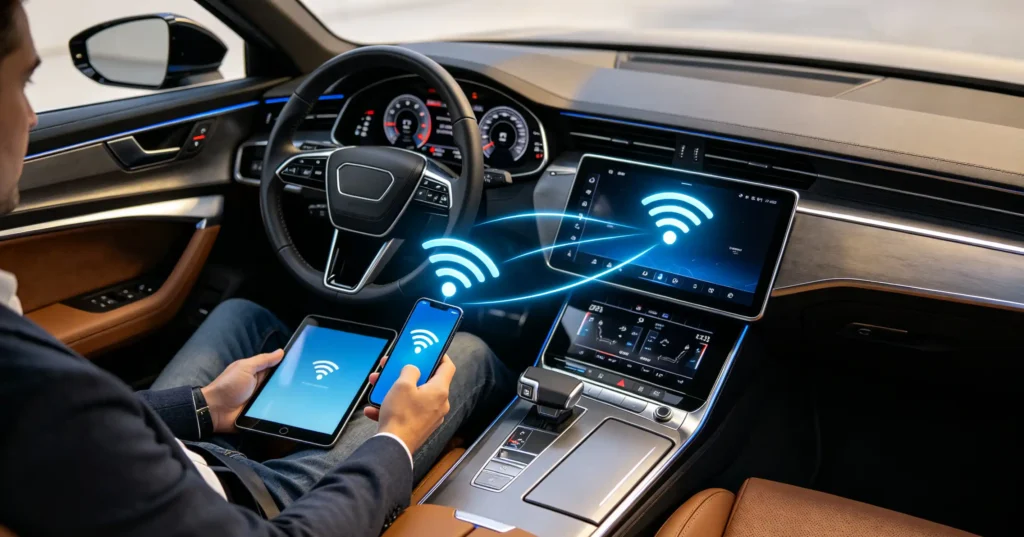
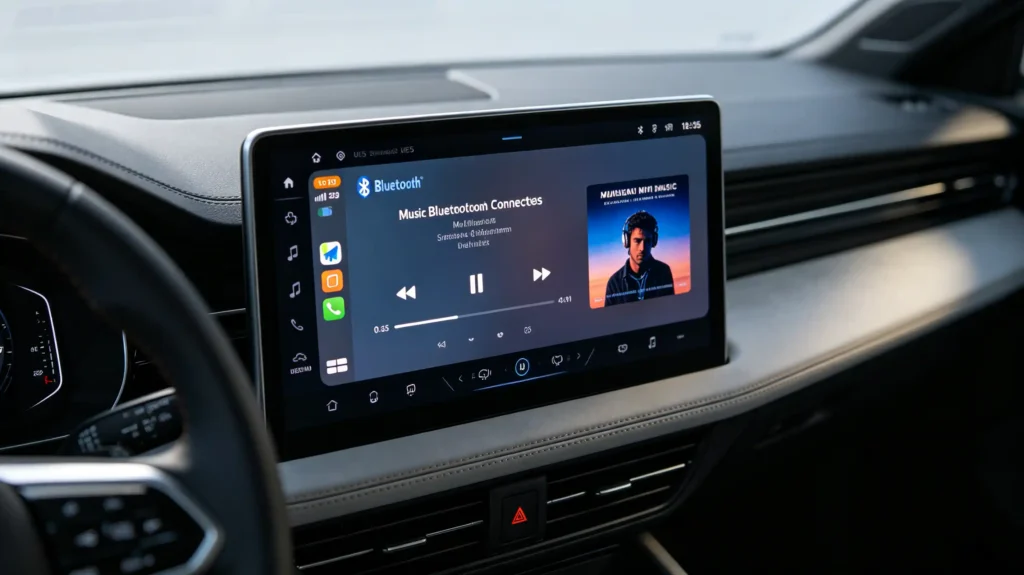
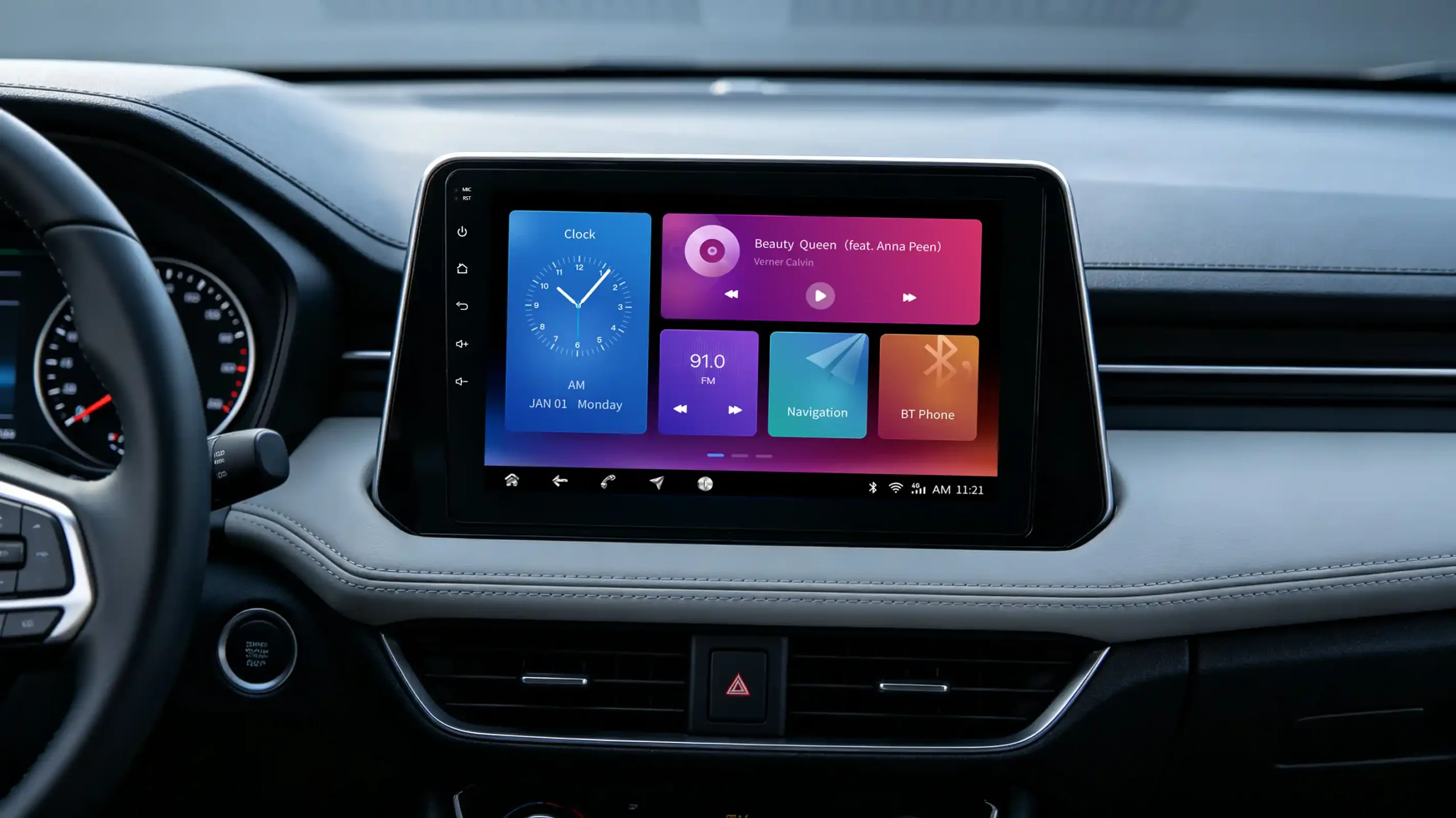
Bluetooth in a car system is short-range wireless communication technology built into the head unit, handling hands-free calling, wireless audio streaming, the initial pairing step for phone projection, and general device connectivity.
Four use cases cover most of what it actually does day to day:
- Hands-free calling — voice calls routed through the vehicle’s own speakers and microphone system.
- Wireless audio streaming — music, podcasts, and media playing from the phone straight to vehicle speakers.
- Phone projection connection — Bluetooth handles the initial pairing handshake; Wi-Fi typically takes over for the actual data transmission.
- Phonebook and contact sync — downloading contacts to support calling and messaging functions directly from the head unit.
For B2B buyers, Bluetooth performance carries outsized weight relative to how “basic” it might sound on a spec sheet: poor implementation — call quality issues, connection drops, pairing failures — is consistently a top source of after-sales complaints. It’s become a baseline expectation rather than a differentiator, and end-users reject products with unstable Bluetooth regardless of how strong the rest of the feature set is.
Car Bluetooth Audio Pairing: Device Connection & Pairing Process
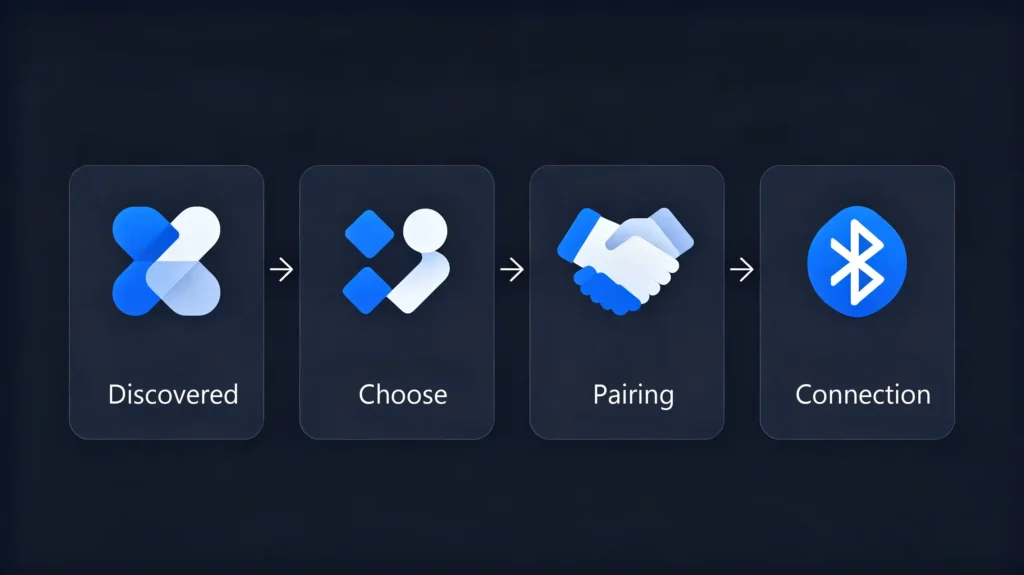
The Pairing Sequence
Pairing follows a predictable sequence: the head unit enters discoverable mode, the phone scans and finds it, the user selects it from a list, an optional PIN or passkey confirms the connection, and the devices are then stored in memory for future use.
Reconnection Logic Matters Most
Reconnection logic matters just as much as the initial pairing, arguably more: on an ignition cycle, the head unit should automatically reconnect to the last paired device if it’s still in range, and that should happen within 5 to 10 seconds — not require the driver to manually re-pair every time they start the car.
Multi-Device Management
Commercial-grade systems need to handle more than a single device too. Multi-device management — typically supporting 5 to 10 paired devices — lets multiple users switch between phones without re-pairing each time, and some systems add priority settings determining which device connects first when more than one is in range simultaneously.
Common Pairing Issues
Common pairing issues worth testing for directly:
- A device failing to enter discoverable mode correctly
- Phone OS quirks on older versions
- Head unit software bugs that only show up during real-world use
These issues often do not appear in a controlled demo.
The Commercial Bottom Line
Reliable automatic reconnection is a genuine must-have. Failure to reconnect consistently is one of the top sources of end-user frustration in this category.
Vehicle BT Module Performance: Audio & Hands-Free Communication Functions
Key Performance Indicators
A handful of performance indicators separate a genuinely qualified vehicle BT module from one that just technically has “Bluetooth” on the spec sheet. For a full view of all hardware decisions, see our car stereo hardware components overview.
Bluetooth Version
Bluetooth version comes first: 5.0 or newer is the minimum standard for commercial-grade automotive modules, delivering meaningfully better range, stability, and audio quality than older versions.
Supported Profiles
Supported profiles matter next:
- A2DP — advanced audio distribution
- HFP — hands-free calling
- PBAP — phonebook access
- AVRCP — remote control functions
All four are expected to be fully implemented. For a complete guide on Bluetooth profiles, see our Bluetooth profiles in car infotainment guide.
Audio Codec Support
Audio codec support rounds out the technical baseline. SBC is the universal fallback. AAC, aptX, and LDAC are available for meaningfully higher audio fidelity where supported.
Hands-Free Calling Quality
Hands-free calling quality depends on more than the Bluetooth radio itself. A proper microphone array for noise cancellation is needed. Echo cancellation matters. Wideband audio (HD Voice) support contributes directly to how clear a call actually sounds on both ends.
Audio Streaming Quality
Audio streaming quality should mean stable, uninterrupted playback with minimal dropouts. It should deliver genuinely good sound. It should not just be a technical connection that happens to work.
Module Reliability
Module reliability comes down to automotive-grade testing specifically. Temperature extremes from -40°C to +85°C must be handled. Vibration resistance is required. A long operational life is expected. None of these are guaranteed by a consumer-grade Bluetooth chip.
Before Ordering
Request documentation on Bluetooth version, profile support, and codec support. Test both audio quality and call clarity directly during sample evaluation.
Theoretical vs Practical Range
Bluetooth 5.0’s theoretical range runs up to 240 meters in open air. This number has almost nothing to do with what actually happens inside a vehicle cabin. Practical range typically shrinks to somewhere between 3 and 10 meters. This depends on placement and interference.
Factors That Reduce Range
A handful of factors explain that gap.
Vehicle metal body — works something like a Faraday cage. It attenuates radio signals simply by existing around the cabin.
Physical obstructions — a phone tucked in a pocket, bag, or closed center console loses signal strength compared to one sitting in open air.
Electromagnetic interference — from the vehicle’s own electrical system, the alternator, ignition, and other onboard electronics. This generates noise that competes with the Bluetooth signal.
Competing wireless devices — other Bluetooth gadgets, Wi-Fi, or nearby cellular signals. These can add congestion on top of all that.
Practical Implication
The practical implication is worth passing along to end-users directly. Phone placement genuinely matters. A phone left in the center console can perform noticeably worse than one sitting in a cup holder or dashboard mount closer to the head unit’s antenna.
Commercial Takeaway
Commercially, this is exactly why module and antenna quality matter. Systems with a stronger Bluetooth module and better antenna design hold a stable connection even in these genuinely challenging in-cabin signal environments. Weaker modules degrade noticeably under the same conditions.
Vehicle Bluetooth Audio Latency: Causes & User-Experience Impact
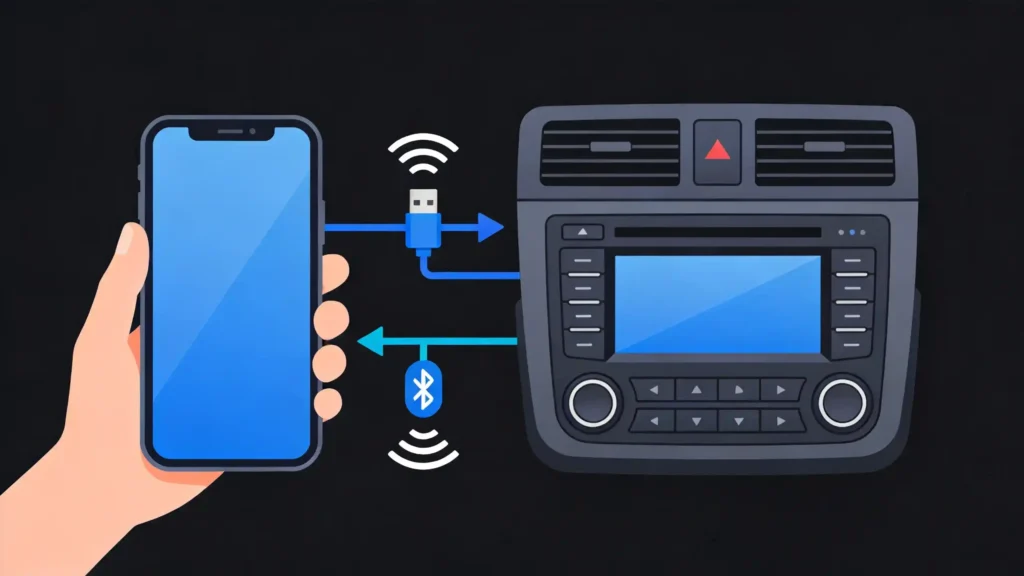
What Is Bluetooth Audio Latency?
Bluetooth audio latency is the delay between audio playing on the source device and actually being heard through the vehicle’s speakers. It is a genuine differentiator between low-quality and premium implementations. It is not just a number on a spec sheet.
Three Causes of Latency
Three things drive that delay.
Encoding and decoding — audio has to be encoded for transmission and then decoded again by the head unit. This round trip itself takes time.
Buffering — the receiving end holds a small buffer of audio data to smooth out transmission variations. This introduces its own delay.
Codec choice — SBC, the universal fallback, carries noticeably higher latency than aptX Low Latency, which is specifically engineered to minimize that gap.
User-Facing Consequences
The user-facing consequences are concrete. Video playback through the car’s speakers becomes noticeably out of sync with picture once latency climbs high enough. Audio trails behind lips on screen in a way that is hard to ignore once you notice it. Hands-free calling suffers too. High latency contributes to echo and double-talk issues. These make conversations feel stilted.
Working Benchmark
As a working benchmark: under 100ms is genuinely good. Anything above roughly 150ms becomes noticeable and problematic. This is particularly true for video sync specifically. he processor driving this performance is covered in our best car stereo processor guide. This is worth verifying directly during sample testing rather than trusting a spec sheet. Latency does not always correlate cleanly with a module’s other specs.
In-Car BT Connection Tuning: Hardware & Software Module Considerations
Hardware Factors
On hardware, chipset quality matters first. Bluetooth chips from established tier-1 suppliers generally outperform generic alternatives on stability and range. Antenna design plays a real role too. Placement and type both affect signal strength. An external antenna typically outperforms an internal PCB antenna for genuine in-cabin range. Automotive-grade component ratings — -40°C to +85°C operation and vibration resistance — separate modules built for a vehicle from ones adapted from consumer electronics.
Software Factors
On software, Bluetooth stack implementation is critical. This is the underlying software managing every connection. Poor engineering shows up as instability. Dropped calls, failed pairing, and inconsistent reconnection are common symptoms. Firmware updates matter for the same reason as everywhere else in this category. OTA-updatable firmware enables bug fixes and new phone compatibility without requiring a hardware swap.
Codec Selection
Codec selection should happen automatically in firmware. It should support SBC, AAC, and aptX. It should pick the best available option rather than defaulting to the lowest common denominator every time.
Aftermarket-Specific Challenge
For aftermarket products specifically, tuning has to support a genuinely wide range of phone brands and OS versions. Unlike an OEM system built for one phone-vehicle pairing, an aftermarket unit cannot be optimized for a single device.
Commercial Takeaway
Prioritize suppliers with in-house firmware development and real OTA update capability. Avoid those reselling a fixed, unmodifiable Bluetooth implementation.
B2B Sourcing Guide: Bluetooth-Related Evaluation for In-Vehicle System Selection
Six evaluation dimensions cover Bluetooth-specific sourcing decisions. Bluetooth version should be verified as 5.0 or newer, since older versions fall short on range, stability, and audio quality. Profile support means confirming A2DP, HFP, PBAP, and AVRCP are all genuinely present, not just implied by “Bluetooth support” on a listing. Codec support should be verified directly — SBC, AAC, aptX or higher — and tested with different codecs rather than assumed.
Audio latency needs testing with actual video playback to check audio-video sync, with under 100ms as the acceptable benchmark. Pairing and reconnection should be tested through a full ignition cycle, confirming reconnection within 5 to 10 seconds rather than a longer, frustrating wait. Call quality deserves direct testing too, ideally with background noise and echo present, since wideband audio (HD Voice) support is a meaningful indicator of higher call quality overall. The sourcing advice ties it together: order samples, test pairing and reconnection behavior, test audio quality and latency directly, and verify module specifications rather than trusting a general “Bluetooth-enabled” claim.
FAQ
What module-level indicators should B2B buyers check to assess real-world car Bluetooth audio-latency performance?
Check which audio codecs a module supports — aptX Low Latency performs meaningfully better than SBC on delay — and request the manufacturer’s actual latency figures rather than a general quality claim. Testing with real video playback during sample evaluation is the most reliable way to confirm latency stays under the roughly 100ms threshold where audio-video sync starts to feel natural.
Why do some aftermarket car systems fail stable automatic re-pairing after ignition-cycle power-off?
This usually traces back to poor Bluetooth stack implementation in the firmware, inconsistent power management during the ignition cycle, or outdated software that doesn’t properly store and recall the last paired device. Suppliers with in-house firmware development and genuine OTA update capability are generally better positioned to fix this kind of issue quickly than those reselling a fixed, third-party Bluetooth implementation.
How does vehicle cabin metal structure influence practical auto Bluetooth signal range?
A vehicle’s metal body acts something like a Faraday cage, attenuating Bluetooth radio signals simply by surrounding the cabin, which is why practical in-car range (roughly 3 to 10 meters) falls well short of Bluetooth’s theoretical 240-meter open-air range. Antenna design and placement can meaningfully offset this effect, which is why module quality matters more inside a vehicle than the raw Bluetooth version number alone suggests.
What risks come from deploying low-cost generic Bluetooth modules in aftermarket car-stereo bulk orders?
Generic modules commonly underperform on signal range, audio latency, and call quality, and they’re more prone to connection drops and pairing failures — all of which tend to surface as after-sales complaints once units are actually in customers’ vehicles rather than during a quiet showroom demo. They also frequently lack automotive-grade temperature and vibration ratings, raising long-term reliability risk on top of the immediate performance gap.
What practical sample-test cases should wholesalers run to validate Bluetooth performance before mass-ordering?
Test pairing and automatic reconnection through a full ignition cycle, verify audio streaming quality and check for dropouts, test hands-free call clarity with background noise present, and confirm latency stays acceptable during video playback. Running these tests with multiple phone models and OS versions — not just one — gives a more realistic picture of how the module will actually perform once it’s out in a bulk order.
Conclusion
Bluetooth performance in a car system comes down to specifics most spec sheets gloss over — module quality, profile and codec support, real-world signal range, and latency — and any one of them falling short is enough to generate after-sales complaints regardless of how strong the rest of the unit is. Testing pairing, audio quality, and call clarity directly on samples, rather than trusting a general “Bluetooth 5.0” claim, is what keeps that risk out of a bulk order.
Sourcing head units with reliable Bluetooth performance for your market? Contact our team to discuss module specifications and audio quality requirements, or explore our current Bluetooth-enabled car stereo lineup.