
An installer swaps in a new Android head unit. They connect it to the factory speakers. The customer immediately notices the sound is thinner and quieter than before. This happens despite the new unit’s spec sheet promising better audio than the old one. This is one of the most common complaints dealers field after a navigation head unit upgrade. It almost never comes down to the head unit being defective. It comes down to how navigation, audio output, and the vehicle’s existing sound system were integrated — or were not. This guide covers what that integration actually involves. It also covers what buyers should evaluate before sourcing units at scale. For a full view of all hardware decisions, see our car stereo hardware components overview.
What Audio-Navigation Integration Actually Means
Definition
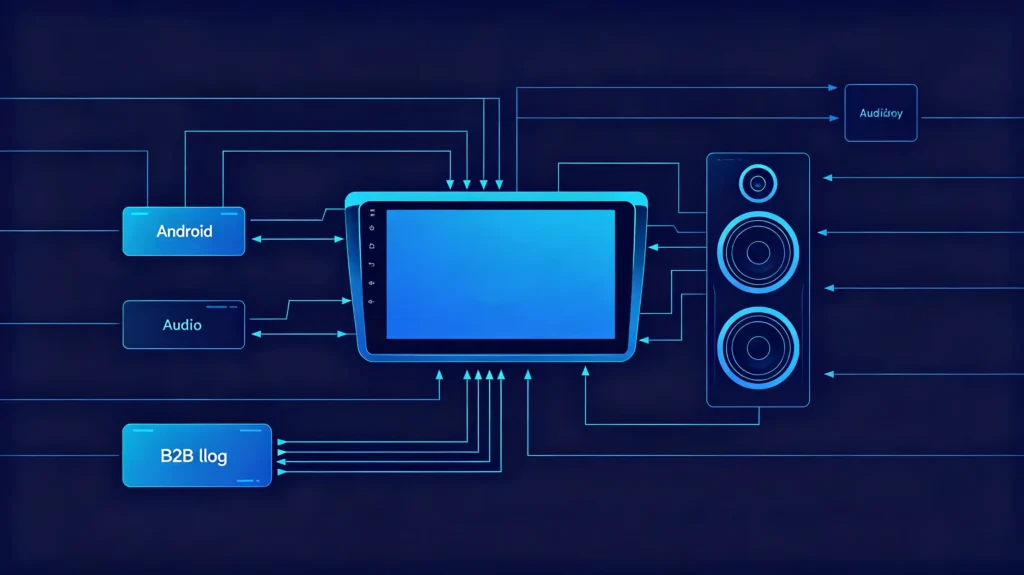
Car navigation audio system integration refers to how a head unit’s navigation, media playback, and voice guidance functions work together with the vehicle’s speakers, amplifier, and sound processing hardware.
Not Operating in Isolation
A head unit does not operate in isolation. Its audio output has to interface correctly with whatever sound system already exists in the vehicle. This could be a basic factory setup or a more elaborate aftermarket configuration with a dedicated amplifier and subwoofer.
Commercial Implications
This matters commercially because a head unit that performs well on a test bench can still sound noticeably worse once installed. This happens if the audio integration was not handled correctly. Dealers who understand this distinction can diagnose the actual cause of a sound complaint rather than assuming a hardware fault. This saves both time and unnecessary returns.
Voice Guidance and Audio Ducking
One of the more technical but customer-facing aspects of navigation-audio integration is how a system handles voice guidance interrupting music or other audio playback.
When a turn-by-turn instruction needs to play, a well-integrated system automatically lowers, or “ducks,” the music volume. It delivers the spoken instruction clearly. It then restores the original volume level once the instruction finishes.
A poorly implemented system either does not duck audio at all — meaning voice instructions get drowned out by music. Or it handles the transition abruptly, with a jarring volume drop and snap-back. Customers notice and dislike this even if they cannot articulate exactly what is wrong.
Smooth ducking behavior is a genuine quality marker worth testing directly on a sample unit. It is the kind of detail that separates a system that feels polished from one that merely functions.
Connecting Navigation Systems to Amplifiers and Sound Systems
External Amplification Integration
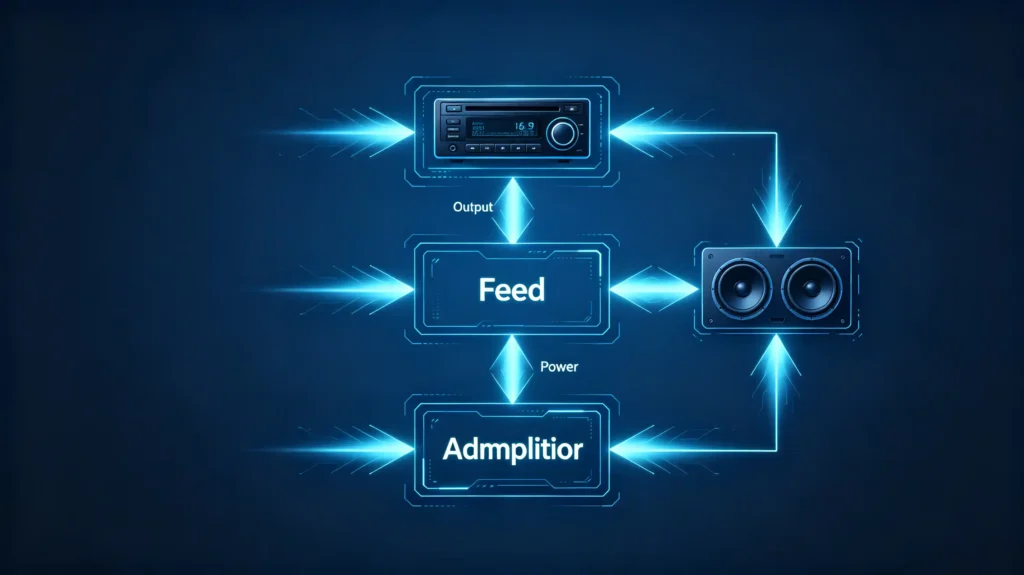
For vehicles with more than a basic factory speaker setup, how the head unit connects to external amplification becomes a central integration question.
RCA Pre-Outs
Head units intended to work with external amplifiers need RCA pre-out connections. These are separate audio output channels. They feed a clean, unamplified signal to an aftermarket amplifier. They do not rely on the head unit’s built-in amplification. Without RCA pre-outs, connecting an external amp typically requires a speaker-level-to-RCA converter. This adds a point of potential signal loss. It also adds additional cost to the installation. For a complete guide on amplifier integration, see our car stereo amplifier integration guide.
Factory-Amplified Systems
This is a common friction point in vehicles that originally shipped with a factory-amplified sound system. Some factory setups route audio through a manufacturer-installed amplifier. An aftermarket head unit needs to either bypass or work alongside it. Getting this wrong is a frequent source of the “why does this sound worse than before” complaint mentioned earlier. Confirming whether a target vehicle has factory amplification is important. Confirming whether the head unit’s CAN Bus integration properly accounts for it is equally important. This should happen before installation rather than after.
DSP and Sound Tuning Considerations
Some head units include a built-in digital sound processor, or DSP. This allows adjustment of equalization, speaker time alignment, and crossover settings to match a specific vehicle’s speaker configuration.
This matters more for buyers serving customers who care about sound quality rather than treating navigation as the sole priority. A head unit without meaningful DSP capability limits how much an installer can fine-tune audio. For more on DSP, see our DSP amplifier in car stereo guide. It becomes harder to compensate for a vehicle’s cabin acoustics or speaker limitations. This becomes a real differentiator for dealers serving audio-conscious customers.
Common Integration Issues and How to Avoid Them
Recurring Issues
Beyond ducking and amplification, a handful of recurring integration issues show up across installations.
Steering Wheel Audio Controls
Steering wheel audio controls sometimes stop functioning correctly after a head unit swap. This happens because the CAN Bus protocol was not properly matched to the vehicle. This frustrates customers who expect the same controls to work identically to the factory setup.
Bluetooth Audio Quality
Bluetooth audio quality can also suffer. This happens if the head unit’s Bluetooth implementation does not support a high-enough audio codec. The result is noticeably compressed sound compared to a wired connection.
Prevention
Addressing these issues starts with confirming CAN Bus compatibility and codec support before installation. Do not wait until after a customer complaint. A dealer who builds this verification step into a standard installation checklist avoids a meaningful share of post-installation callbacks.
Speaker Impedance Mismatches
Speaker impedance mismatches are another quieter contributor to complaints. A head unit’s built-in amplifier is generally designed around a specific speaker impedance range. Connecting speakers outside that range — whether through an aftermarket upgrade or an unusual factory configuration — can produce distortion at higher volumes. In more extreme cases, it can stress the internal amplifier circuitry over time. This is worth checking during installation planning. Do not assume any speaker configuration will work equally well with any head unit.
B2B Considerations for Sourcing Integrated Navigation-Audio Systems
For dealers, wholesalers, and OEM/ODM buyers, audio-navigation integration quality is a sourcing decision. It is not just an installation detail. It directly affects customer satisfaction and repeat business.
The buyer needs a head unit whose audio integration is properly matched to the specific vehicle models a dealership services regularly. A generic configuration that works adequately everywhere but excellently nowhere is not enough. Companies usually evaluate whether a supplier’s CAN Bus decoder development covers the vehicle protocols needed to preserve steering wheel controls and factory amplifier compatibility. This determines how smoothly a head unit integrates into an existing vehicle’s audio system.
Buyers comparing navigation-equipped head units for audio integration quality tend to check a consistent set of things. Whether the unit includes RCA pre-outs for external amplification. Whether DSP functionality is genuinely available for sound tuning. How the system handles voice guidance ducking during real-world testing rather than a quiet demo environment. Whether CAN Bus decoder support covers the specific vehicle models a dealer network services.
This last factor tends to matter most over a long-term supplier relationship. A dealer network that regularly services a particular set of vehicle brands benefits from a supplier who already has CAN Bus decoders developed for those models. They also benefit from a supplier who can develop new ones as the dealer’s business expands into different vehicle lines. Asking about this development capability upfront, rather than discovering a compatibility gap after a bulk order arrives, avoids a costly mismatch between inventory and installation needs.
Frequently Asked Questions
Why does audio sound worse after installing a new navigation head unit?
This is usually an integration issue rather than a defective unit. Common causes include a mismatched CANBUS connection that doesn’t properly interface with a factory-amplified sound system, missing RCA pre-outs requiring a signal converter, or DSP settings that haven’t been tuned to the vehicle’s specific speaker configuration. Confirming these details before installation prevents most sound quality complaints.
What is audio ducking, and why does it matter for navigation?
Audio ducking automatically lowers music volume when a voice guidance instruction needs to play, then restores it afterward. A smooth, well-timed ducking implementation lets drivers hear turn instructions clearly without an abrupt volume change disrupting the listening experience. Poor ducking either buries voice instructions under music or creates a jarring, noticeable volume shift that customers tend to complain about.
Do I need a head unit with RCA pre-outs if my vehicle has a factory amplifier?
Generally yes, if you plan to add or work with external amplification. Without RCA pre-outs, connecting an amplifier requires a speaker-level-to-RCA converter, which adds cost and a potential point of signal degradation. For vehicles with factory-amplified systems specifically, confirming CANBUS compatibility with that amplifier setup matters just as much as the RCA output itself.
Can navigation-audio integration be customized for OEM or ODM projects?
Yes, primarily through CANBUS decoder development matched to specific vehicle protocols and DSP tuning for particular speaker configurations. Confirming a supplier’s ability to develop or adjust CANBUS decoders for your dealership’s most common vehicle models is worth doing early in an OEM sourcing conversation, since this directly determines how well navigation and audio integrate once installed.
Ready to Source Head Units Built for Clean Audio Integration?
Whether your installations involve factory-amplified sound systems or aftermarket amplifier setups, getting CANBUS matching, RCA outputs, and DSP tuning right reduces the sound quality complaints that come from mismatched integration rather than defective hardware. Contact our team to discuss your CANBUS and audio integration requirements, or request a quotation for OEM navigation solutions built for your vehicle lineup.