A head unit that sounds decent on its own internal amplifier can fall apart the moment a customer asks for a subwoofer or a premium sound upgrade. Car stereo amplifier integration is what determines whether that upgrade path is even possible. For dealers and installers fielding these requests regularly, the head unit’s output specifications matter just as much as its screen or processor.
This guide covers what amplifier integration actually involves. It covers the main connection methods between a head unit and an external amplifier. It compares RCA and speaker-level outputs. It covers the electrical compatibility factors that trip up installers. It explains the difference between factory and aftermarket amplifier setups. It also covers what to check with a supplier before sourcing head units for amplifier-heavy projects. For a full view of all hardware decisions, see our car stereo hardware components overview.
Car Stereo Amplifier Integration Fundamentals
What Is Amplifier Integration?
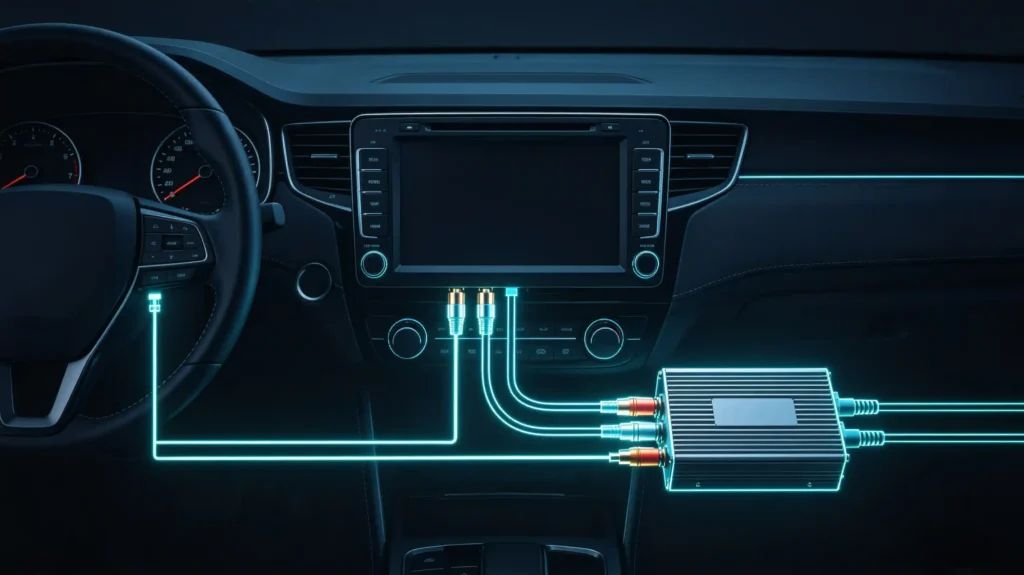
Car stereo amplifier integration is the process of connecting an aftermarket head unit — Android or otherwise — to an external amplifier. The goal is to boost sound quality, increase power output, or add audio processing capability beyond what the head unit alone can deliver.
Built-In vs External Amplifier
Most head units ship with a built-in amplifier. It is typically rated around 4×15W to 4×50W RMS. That is fine for a basic factory-style sound system. But it runs out of headroom quickly. An external amplifier delivers considerably more power — commonly 4×50W up to 4×150W or more. It also offers cleaner output, lower distortion, and far more tuning flexibility.
When External Amplifier Integration Is Needed
External amplifier integration comes up in a handful of recurring scenarios:
- Upgrading a factory sound system that is underpowered for the speakers installed
- Adding a subwoofer, which needs its own dedicated amplifier channel
- Building out a premium audio system where sound quality is the main selling point
- Professional audio upgrades handled through a 4S dealership
What Buyers Should Look For
For any of these, head units with high-quality preamp (RCA) outputs are the preferred starting point. Buyers evaluating hardware for these projects should confirm exactly which outputs are available. They should also check how clean the signal actually is. Do not assume a unit is amplifier-ready without verification. For more on audio hardware, see our DSP amplifier in car stereo guide.
Head Unit to External Amplifier: Main Connection Methods
Four Common Methods
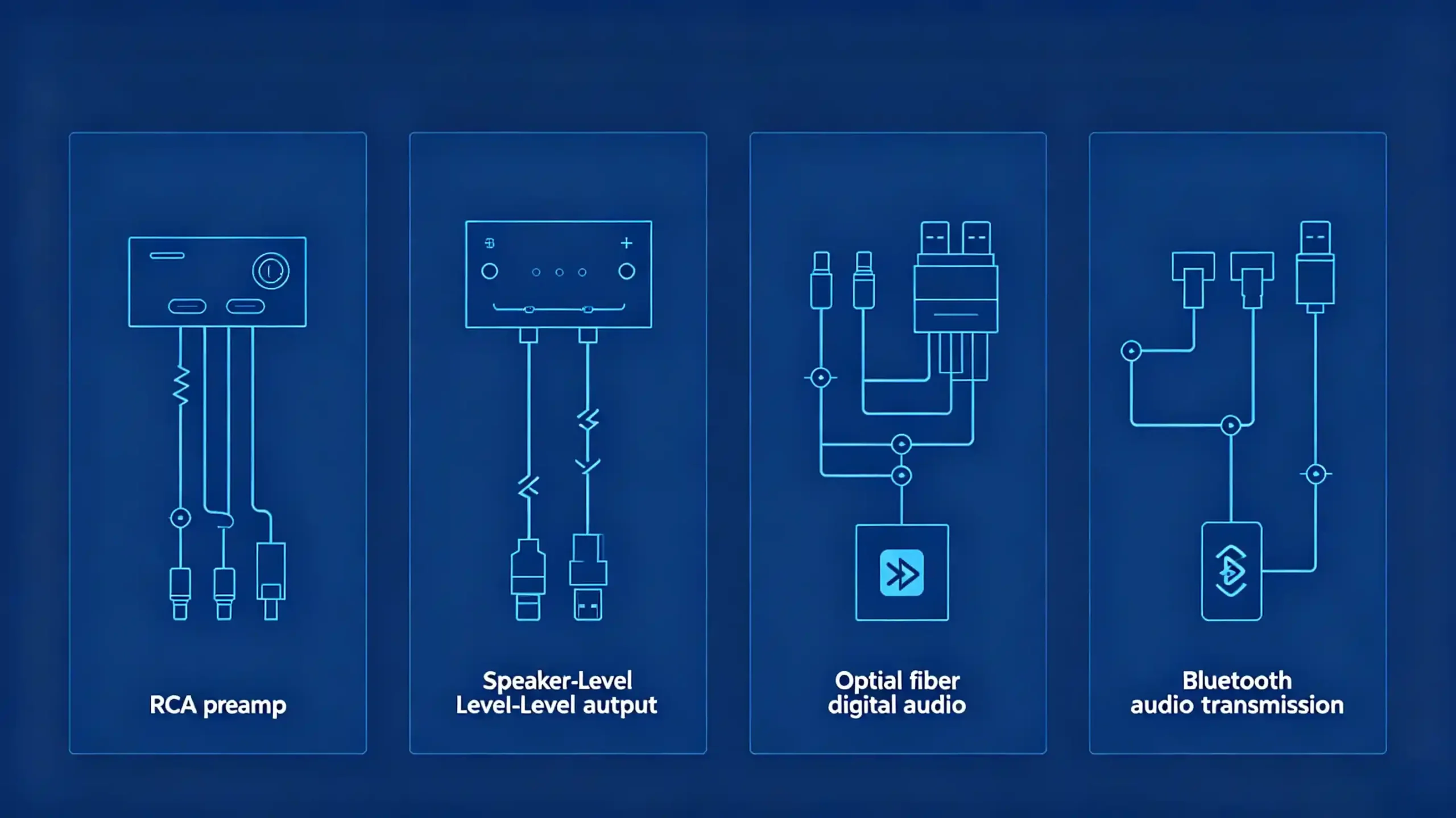
There are four common ways to link a head unit to an external amplifier. They are not interchangeable in terms of signal quality.
RCA (Low-Level) Connection
RCA connection carries a preamp signal, typically between 0.5V and 5V, through RCA cables. This signal has not passed through the head unit’s internal amplifier. It stays clean. This is the preferred method whenever high audio quality matters.
Speaker-Level (High-Level) Connection
Speaker-level connection taps the amplified speaker output instead. This is up to around 50W. It needs a line output converter (LOC) to bring that signal down to a level an external amplifier can accept. It is the fallback option when a head unit does not offer RCA outputs.
Digital Connections
Digital connections — optical or SPDIF — carry a pure digital signal. They offer the highest quality of the four. They are less common outside premium aftermarket systems.
Bluetooth
Bluetooth rounds this out as a wireless option. It is convenient. But it has noticeably lower audio quality than any of the wired methods. This rules it out for serious sound system builds.
Signal Path Comparison
In terms of signal path, RCA is the cleanest option available. Speaker-level introduces extra processing steps. It also introduces more opportunity for noise to creep in.
What to Verify
Before sourcing head units for amplifier-integration projects, buyers should confirm exactly which connection methods a given unit supports. RCA availability specifically is worth verifying rather than assuming.
RCA Pre-Output vs Speaker-Level Output Interfaces
Same Goal, Different Behavior
RCA and speaker-level outputs solve the same basic problem — getting audio out to an amplifier. But they behave very differently in practice.
RCA Preamp Output
RCA preamp output runs a low-voltage analog signal, typically 0.5V to 5V. It is unamplified. It uses standard RCA jacks for front, rear, and subwoofer channels. These are usually color-coded red and white. The advantage is a clean, high-quality signal. It is completely unaffected by whatever noise the head unit’s internal amplifier might introduce. This makes it the preferred choice for higher-end audio builds. The main limitation is that it requires an amplifier with RCA inputs. Because the signal voltage is relatively low, some amplifiers need more gain to compensate.
Speaker-Level Output
Speaker-level output works differently. It is already an amplified, higher-voltage signal — up to around 50W. It is sent over standard speaker wire. This makes it compatible with any amplifier that accepts high-level input. Alternatively, an LOC can be used in between for amplifiers that do not accept high-level input. It is a practical fallback when a head unit lacks RCA outputs. But the signal can carry noise picked up from the head unit’s internal amplifier. Most external amplifiers will still need an LOC to use it properly.
Which Is Better?
In practice, RCA is the better choice whenever it is available. The signal is cleaner and the sound quality ceiling is higher. Speaker-level exists as a workaround for units without RCA. It is not a preferred method. Either way, checking amplifier input compatibility before committing to a connection method saves a lot of rework later.
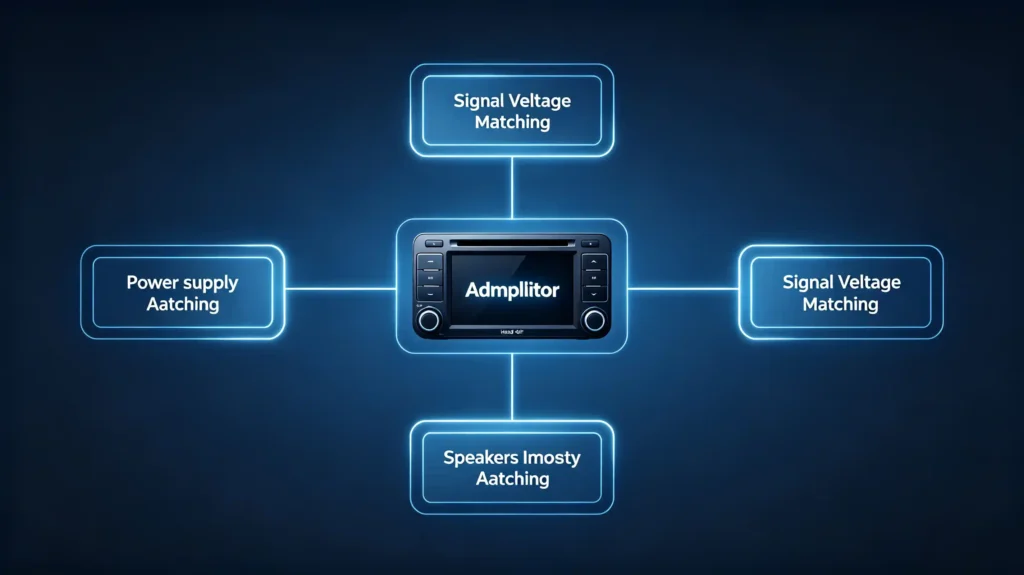
Power, Signal-Level, and Impedance Compatibility Considerations
Power Considerations
Beyond the connection method itself, a handful of electrical factors determine whether an amplifier integration actually works reliably once it is installed.
On the power side, the amplifier’s power draw needs to stay within what the vehicle’s electrical system can actually supply. Alternator and battery capacity both matter here. Wiring gauge that is too thin for the load causes voltage drop and, in worse cases, overheating. Fuse sizing needs to be correct to protect against shorts.
Signal Voltage
Signal voltage is the next factor. RCA output typically falls somewhere between 0.5V and 5V. The amplifier’s input sensitivity needs to be set to match. A mismatch here tends to show up as clipping or unwanted noise. Speaker-level output runs much higher, up to roughly 50W RMS. It has to be brought down with a line output converter before most amplifiers can use it cleanly.
Impedance Matching
Impedance matching rounds this out. Head units are typically designed around 4Ω. Amplifiers vary more widely, supporting anywhere from 2Ω to 8Ω depending on design. Getting this wrong does not just hurt sound quality. It can cause amplifier overheating. It can cause reduced power output. It can trigger the head unit’s built-in protection shutdown.
Verification Advice
Verifying output specs against amplifier input specs before finalizing a build is the simplest way to avoid all three of these issues.
Factory OEM Amplifier vs Aftermarket External Amplifier Integration
Factory OEM Amplifier Integration
Whether a vehicle keeps its factory amplifier or gets a standalone external one changes the integration project considerably.
With factory OEM amplifier integration, the head unit connects to the vehicle’s existing amplifier through proprietary wiring. This is often CAN Bus controlled. Retaining the original audio functions requires a dedicated integration interface — typically a wiring harness paired with an interface module. Integration complexity here ranges from moderate to high depending on the vehicle brand. Getting the interface wrong risks losing factory audio functions entirely. It can also introduce noise into the system. European brands in particular — BMW, Audi, Mercedes — tend to have more complex factory amplifier systems than average.
Aftermarket External Amplifier Integration
Aftermarket external amplifier integration is comparatively simpler. The head unit connects directly to the amplifier through RCA or speaker-level outputs. It uses universal, well-established connection standards rather than a proprietary interface. That lower complexity also comes with more flexibility. Multiple amplifier channels, dedicated subwoofer support, and DSP tuning options are available. Factory systems rarely offer these.
Buyer Takeaway
For buyers, the practical takeaway is to confirm factory amplifier integration requirements for target vehicle models specifically. Do not assume a single approach covers a mixed fleet or product line spanning multiple brands. For foundational context on vehicle communication, see our what is CAN BUS guide.
Audio Performance and System-Configuration Factors
Signal-to-Noise Ratio
Once the connections and electrical compatibility are sorted, a smaller set of configuration factors determines how the finished system actually sounds.
Signal-to-noise ratio (SNR) is one of the more telling specs. A higher SNR means less background noise and cleaner reproduction. It is directly affected by the quality of the head unit’s RCA output. Higher-quality head units generally reach SNR above 95dB.
Gain Matching
Gain matching is just as important on the amplifier side. Setting the amplifier’s gain to match the head unit’s output voltage prevents clipping. It also gets the most usable dynamic range out of the system. Gain set too low leaves the output weak. Gain set too high introduces distortion.
System-Level Factors
A handful of system-level factors round out the final result. Amplifier placement — proper mounting and cooling matter more than people expect. Cable quality and shielding on the RCA or speaker runs are important. Grounding is critical — poor grounding is a common source of alternator whine. DSP tuning, where the amplifier supports it, can meaningfully improve sound staging and frequency response.
Integration Approach
None of these factors work in isolation from the head unit’s own output quality. Buyers should verify both head unit output specs and amplifier input compatibility together. Do not treat them as separate evaluations.
B2B Product & Supplier Selection for Amplifier-Integration Projects
Sourcing Checklist
Turning this into a sourcing checklist, here is what is worth verifying before ordering head units for amplifier-integration projects.
Preamp Outputs (RCA)
Confirm how many are available (front, rear, subwoofer). Four or more is preferable for multi-channel systems.
RCA Output Voltage
2V or higher is a reasonable baseline. 4V or higher for premium builds.
Speaker-Level Outputs
Confirm availability as a fallback if RCA is not present. Check the rated power output (W RMS).
Digital Outputs
Optical or SPDIF support is relevant for premium audio system projects.
Factory Amplifier Integration
Ask directly whether the head unit supports OEM amplifier integration with the correct interfaces for your target vehicles.
Signal-to-Noise Ratio
Request the SNR spec. Above 95dB is a reasonable benchmark.
Beyond the Spec Sheet
Beyond the spec sheet, ask whether the supplier actually provides documented audio output specifications. Ask whether they will support sample testing before a bulk order goes out. This is where a lot of amplifier compatibility issues surface early. They surface before installation, not after.
FAQ
What risks arise when a head unit only provides speaker-level outputs for driving an external amplifier?
Speaker-level output requires a line output converter to bring the signal down to a level most amplifiers can use. This adds an extra component and potential noise source into the signal chain. The signal itself can also carry noise from the head unit’s internal amplifier. It has already been amplified once before reaching the LOC. For buyers building higher-end systems, this generally means settling for a lower quality ceiling than RCA would allow. This is true even with a properly matched LOC in place.
Can aftermarket Android head units reliably work with retained OEM factory amplifiers without additional adapters?
Generally, no. Factory amplifiers are usually connected through proprietary wiring. This wiring is often CAN Bus controlled and specific to the vehicle brand. An aftermarket head unit typically needs a dedicated integration interface — wiring harness plus interface module — to communicate correctly. Skipping this step risks losing factory audio functions entirely. It can also introduce noise. Buyers should confirm factory amplifier integration requirements for each target vehicle model before assuming plug-and-play compatibility
What key spec points should buyers verify to assess head unit RCA pre-output quality for external-amplifier usage?
Check the number of RCA channels available (front, rear, subwoofer). Check the output voltage — 2V or higher is a reasonable baseline, 4V+ for premium systems. Check the signal-to-noise ratio, ideally above 95dB. Together, these three specs give a reasonably clear picture of whether the head unit can deliver a clean signal suitable for a serious amplifier build. They do more than just confirm that RCA jacks exist.
Why does impedance mismatch between head unit and amplifier create hardware-protection or audio-quality issues?
Head units are typically designed around 4Ω. Amplifiers support a range from 2Ω to 8Ω depending on their design. When the two are not properly matched, the amplifier can run hotter than intended. It can deliver reduced power output. It can introduce distortion. In some cases, the head unit’s built-in protection circuitry will shut the output down entirely to prevent damage. Verifying both sides’ impedance specifications before finalizing a build avoids all of these outcomes.
Conclusion
Amplifier compatibility is easy to overlook when comparing head units on screen size or processor specs. But it is one of the first things a customer notices once they try to upgrade their sound system. For guidance on processor selection that complements audio performance, see our best car stereo processor guide. Use the evaluation points above to screen suppliers before committing to volume.