For automotive electronics buyers, choosing the right car navigation manufacturer is one of the most critical decisions in the supply chain. Whether you are a wholesaler, importer, automaker, or 4S dealership, the difference between a factory-direct supplier and a middleman can affect your product quality, customization options, and long-term profitability.
This guide establishes a complete framework for evaluating car navigation manufacturers—covering their business role, differences from trading companies, factory capabilities, OEM/ODM services, quality control systems, and practical selection criteria. For foundational technical context on the product itself, see our what is a car navigation system guide. By the end, you will have a clear understanding of what to look for when qualifying a manufacturing partner for bulk orders.
What Is a Car Navigation Manufacturer? Core Business Role
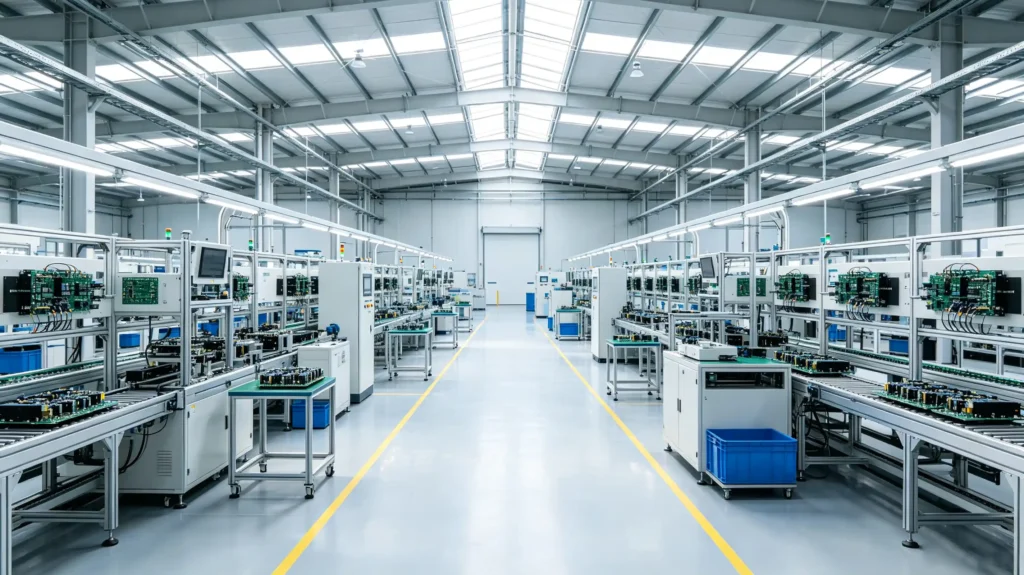
A car navigation manufacturer is a company that designs, produces, and assembles car navigation systems and head units in its own factory. Unlike trading companies or simple distributors, a true manufacturer controls the entire production process from component sourcing to final assembly. This allows them to deliver factory-direct pricing, direct quality control, and flexible customization that other types of vendors cannot match.
Core Business Activities
A legitimate car navigation factory typically engages in the following activities:
- R&D (hardware and software): In-house development of Android/Linux systems, PCB design, UI design, and CAN Bus protocol development
- SMT assembly: Surface-mount technology production lines for PCB manufacturing
- Product assembly: Manual and automated assembly lines for final product integration
- Quality control: Full QC chain from incoming materials to pre-shipment inspection
- Direct supply: Factory-to-buyer sales without intermediaries
Value Proposition for B2B Buyers
For businesses placing bulk orders or requiring customization, sourcing from a direct manufacturer offers several distinct advantages:
- Competitive pricing: No middleman markups; factory-direct cost structure
- Direct quality control: Full visibility and control over production standards
- Customization capability: OEM and ODM services for branding, hardware configuration, and software development
- Shorter communication chains: Direct technical support and faster problem resolution
Car Navigation Manufacturer vs Supplier vs Trading Company
Understanding the practical differences between a car navigation manufacturer, a general supplier, and a trading company is essential for B2B qualification. Many vendors may claim to be manufacturers, but their actual capabilities vary significantly.
| Dimension | Car Navigation Manufacturer | General Supplier | Trading Company |
|---|---|---|---|
| Production Ownership | Owns factory and production lines | May include manufacturers, distributors, or traders; unclear production capability | Does not own production; resells from multiple factories |
| Customization Capability | Full OEM/ODM customization | Varies widely; often limited | Minimal or no customization |
| Pricing | Factory-direct; best for bulk orders | Variable; often includes markups | Higher unit costs due to multiple margins |
| MOQ | Moderate-to-high MOQs; suitable for bulk procurement | Flexible; may offer low MOQs | Often low MOQs but higher per-unit cost |
| Quality Control | Direct QC oversight; full traceability | Depends on the specific vendor | No direct quality control |
| Best Use Case | Bulk orders, customization projects, long-term partnerships | General product searches | Small orders, product variety testing |
Qualification Verification
To avoid misrepresentation, buyers should verify a vendor’s manufacturing status through:
- Factory tour (in-person or video)
- Production line photos and equipment documentation
- Business license and production capacity documentation
- Request for sample evaluation before bulk orders
For a detailed comparison of product types, see our OEM vs aftermarket car navigation guide.
Car Navigation Factory Core Capabilities & Production Workflow
A qualified car navigation factory should demonstrate in-house capabilities across R&D, production, and quality control. Understanding the production workflow helps buyers assess whether a factory can deliver consistently.
Core Capabilities
R&D Capability:
- In-house hardware development (PCB design, processor platform selection)
- Software development (Android/Linux systems, UI design)
- CAN Bus protocol development for vehicle-specific integration
- Vehicle adaptation (steering wheel control, reverse camera trigger, climate display)
Production Capability:
- SMT assembly lines for PCB manufacturing
- Manual assembly lines for final product integration
- Testing equipment for functional verification
- Packaging and warehousing facilities
Quality Control:
- Full QC chain (IQC, IPQC, FQC, OQC)
- Environmental testing (aging test, high-temperature test, vibration test)
- Certification compliance (ISO 9001, CE, FCC, RoHS)
Production Workflow Stages
The typical production workflow for a car navigation system follows these stages:
SMT Mounting → PCB Testing → Assembly → Function Test → 48-Hour Aging Test → Final QC Inspection → Packaging → Warehouse Delivery
Each stage is critical for ensuring product reliability. The 48-hour aging test, for example, involves continuous power-on operation to identify early failures before products reach customers. High-temperature testing (60°C for 72 hours) simulates real-world conditions to verify durability.
Production Capacity Indicators
When evaluating a car navigation manufacturer, consider these benchmark indicators:
- Factory size: 3,000㎡+ benchmark
- Production lines: 10+ benchmark
- Monthly output: 50,000+ units/month benchmark
- Workforce: 50+ employees, 5+ R&D engineers, 10+ QC engineers
Car Navigation OEM and ODM Services Explained
For B2B buyers, understanding the distinction between OEM and ODM services is key to selecting the right cooperation mode.
OEM (Original Equipment Manufacturer)
In an OEM arrangement, the car navigation manufacturer produces products according to the buyer’s specifications. The buyer provides the product design, specifications, and branding requirements. The manufacturer handles production, quality control, and delivery.
OEM services typically include:
- Custom PCB design
- RAM/ROM configuration selection
- Screen resolution and display type selection
- Power module configuration
- Brand logo and packaging customization
- UI and boot animation customization
ODM (Original Design Manufacturer)
In an ODM arrangement, the car navigation manufacturer designs and produces products that the buyer can brand and sell. The manufacturer provides the product design and development, allowing buyers to benefit from the manufacturer’s R&D expertise without building their own design team.
ODM services typically include:
- Full product development from concept to production
- Hardware and software design
- CAN Bus protocol development
- Vehicle-specific adaptation
- Complete product testing and validation
Commercial Implications
- OEM is suitable for buyers with existing designs or clear specifications who need reliable production
- ODM is suitable for buyers needing full development support, especially for vehicle-specific applications
Product Customization & Development Capabilities From Manufacturers
A reliable car navigation manufacturer should offer comprehensive customization options to meet diverse B2B requirements. Here are the key areas where customization is typically available.
Hardware Customization
- Processor platform selection: Snapdragon/MediaTek or other platforms. For a detailed comparison of processor platforms, see our Qualcomm vs MediaTek for car stereos guide.
- RAM/ROM configuration: 2GB/4GB/6GB+ RAM, 32GB/64GB/128GB+ ROM
- Screen resolution and display type: HD/FHD, IPS/QLED
- Interface expansion: USB/HDMI ports, power module configuration for different voltage standards
Software Customization
- UI themes: Custom desktop, icons, color schemes, menu layout
- Boot animation: Custom startup animation with brand logo
- System functions: Modify functions, add dedicated vehicle protocols, optimize performance, adapt regional radio frequency
- Phone projection feature support: Smartphone mirroring and screen mirroring capabilities
Vehicle Adaptation
- CAN Bus protocol development: In-house development for new vehicle models
- Vehicle-specific compatibility: Steering wheel control, reverse camera trigger, climate display
Branding and Packaging
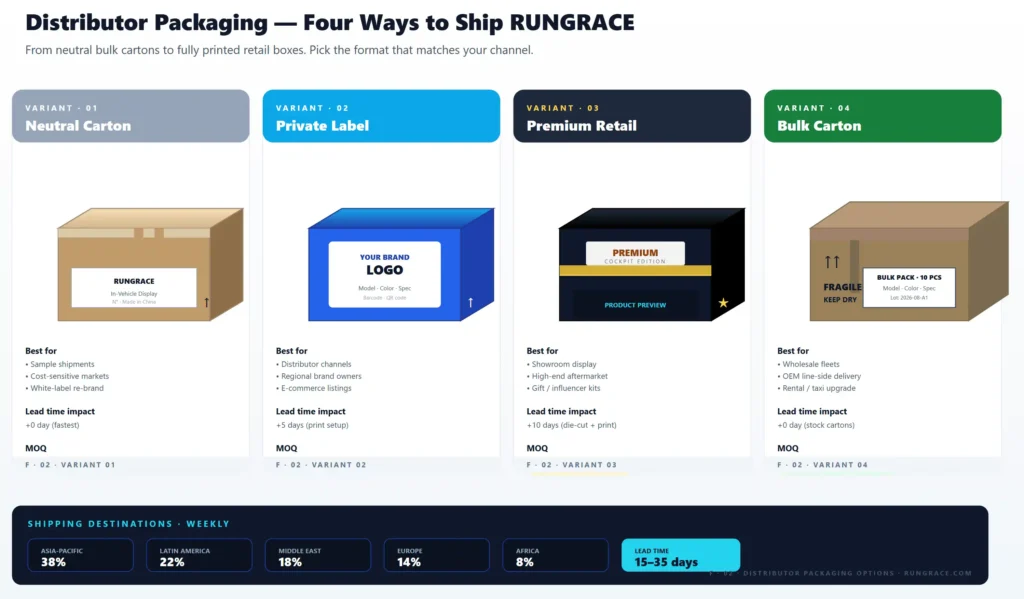
- Logo customization: Silk-screen logo on front panel, back shell, remote control, packaging
- Packaging customization: Custom color boxes, printed outer cartons, foam protection
Development Timeline
Typical custom OEM/ODM projects take 15–20 working days depending on scope. Complex projects involving new vehicle protocol development may require additional time.
Quality Control, Testing and Production Consistency Requirements
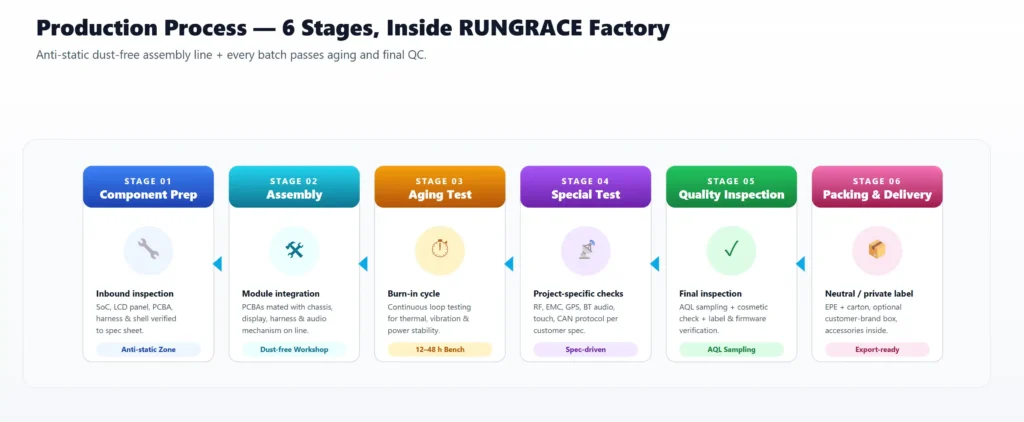
Quality control is the backbone of reliable car navigation manufacturing. A credible factory should implement comprehensive QC workflows to ensure batch-to-batch consistency.
QC Process Overview
| QC Stage | Description |
|---|---|
| IQC (Incoming Quality Control) | Raw material inspection for all incoming components |
| IPQC (In-Process Quality Control) | Patrol inspection during production |
| FQC (Full Function Test) | Function testing on finished units (touchscreen, Bluetooth, GPS, audio, steering wheel control, CAN Bus) |
| OQC (Outgoing Quality Control) | Pre-shipment random sampling inspection |
Environmental and Durability Testing
- 48-hour aging test: Continuous power-on operation to identify early failures
- 60°C high-temperature durability test: 72 hours to simulate extreme conditions
- Vibration test: Simulates real road conditions to verify mechanical integrity
- Packaging inspection: Carton firmness, foam integrity, accessories verification
Certification Requirements
Buyers should look for these certifications:
- ISO 9001: Quality management system
- IATF 16949: Automotive quality management
- CE/FCC/RoHS: Export compliance for international markets
Production Consistency
Documented QC processes ensure batch-to-batch consistency. Finished products should be traceable through the production chain, allowing for quality issue identification and resolution.
B2B Manufacturer-Selection & Supplier-Evaluation Criteria
For B2B buyers evaluating potential car navigation manufacturing partners, here is a practical checklist to guide the qualification process.
Evaluation Criteria Checklist
1. Factory Verification
- Confirm the vendor is a direct manufacturer (not a trading company)
- Request factory tour (in-person or video)
- Request business license and production documentation
2. Production Capacity
- Factory size and number of production lines
- Monthly output capacity (50,000+ units/month benchmark)
- Ability to scale for large orders
3. R&D Capability
- Number of R&D engineers (5+ benchmark)
- In-house software/hardware development
- CAN Bus protocol development capability
4. QC and Testing
- Documented QC process (IQC/IPQC/FQC/OQC)
- 48-hour aging test, high-temperature test, vibration test
- Sample evaluation availability
5. Customization Capability
- Hardware, software, UI, logo, and packaging customization
- Ability to develop new vehicle protocols
6. Certifications
- ISO 9001, IATF 16949, CE, FCC, RoHS
- Request current documentation
7. After-Sales Support
- Spare parts availability
- Warranty terms
- Technical support response time
Frequently Asked Questions
What is the typical MOQ difference between OEM-project and ODM-project for car-navigation manufacturers?
MOQ for OEM projects typically depends on the complexity of customization. Standard OEM projects with minimal hardware changes may have MOQs of 100–500 units, while full ODM development projects (new product design) generally require higher MOQs of 500–1,000 units to justify tooling and development costs. Always discuss MOQ with the manufacturer during initial negotiations.
How can B2B buyers verify whether a vendor is a real direct car-navigation manufacturer instead of a trading company?
Request a factory tour (in-person or video), business license, production capacity documentation, and production line photos. Legitimate manufacturers will typically be transparent about their facility and operations. Trading companies often cannot provide detailed production documentation or factory tour evidence.
What customisation items are usually included within standard OEM service versus paid ODM development?
Standard OEM service typically includes logo and packaging customization, UI theme adjustments, and RAM/ROM configuration selection. Paid ODM development includes full product design, hardware/software development, CAN Bus protocol development, and vehicle-specific adaptation. The scope of ODM is significantly broader and more expensive.
What quality-testing items should buyers ask a car-navigation factory to demonstrate during sample evaluation?
Request the factory to demonstrate IQC (incoming material inspection), FQC (full function test), 48-hour aging test, and 60°C high-temperature test. These tests verify product reliability and identify potential failures before mass production.
Partner With a Trusted Car Navigation Manufacturer
Choosing the right car navigation manufacturer is essential for product quality, customization flexibility, and supply chain reliability. Whether you need OEM build-to-spec manufacturing, ODM product development, or custom UI and hardware configurations, working with a factory-direct manufacturer ensures you get competitive pricing, quality control, and technical support.
Contact our team today to discuss your customized car navigation requirements. Our factory-direct capabilities, comprehensive QC systems, and R&D expertise are ready to support your next project.