“Bluetooth supported” on a spec sheet tells a buyer almost nothing useful. A head unit can pair with a phone just fine. It can still fail to stream music. It can fail to let the driver skip a track. It can answer calls with audio that never reaches the microphone. Pairing and functionality are not the same thing.
Android head unit Bluetooth profiles are what actually determine which of those features work. For dealers and wholesalers running retrofit programs, the gap between “Bluetooth works” and “Bluetooth profiles are fully implemented” shows up as customer complaints after the sale.
This guide breaks down the core profiles behind everyday Bluetooth functionality. It also covers what to verify before sourcing. For a technical overview of the hardware platform, see our What Is an Android Head Unit guide.
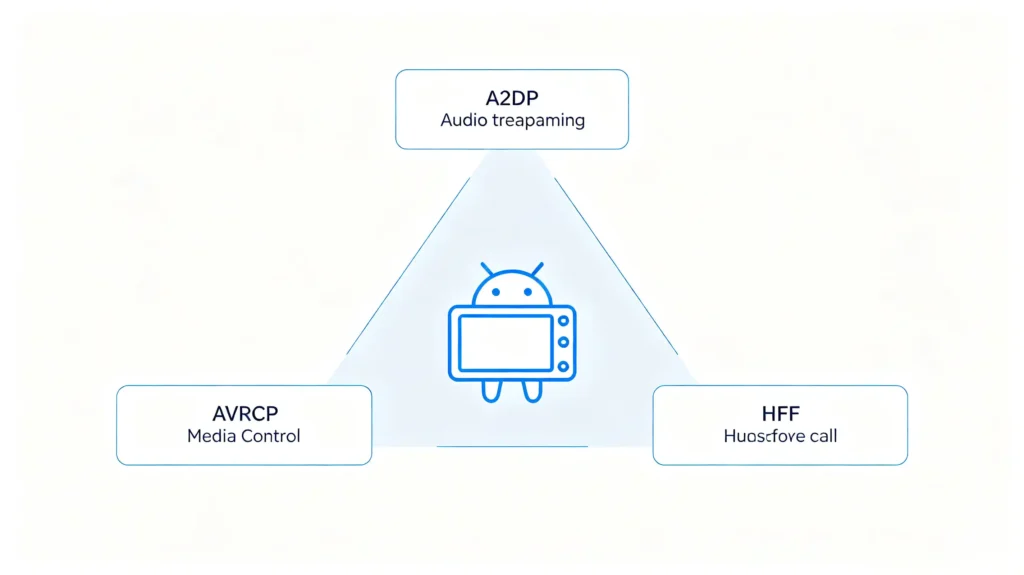
Bluetooth Profiles – Core Definition for Android Head Units
What Are Bluetooth Profiles?
Bluetooth profiles are standardized specifications. They define how two Bluetooth devices communicate for a specific function — audio streaming, playback control, or calling, among others. A Bluetooth connection between a phone and a head unit does not automatically mean any particular feature works. Both devices need to support the matching profile for that specific function to work correctly.
Three Core Profiles
Three profiles cover most of what drivers expect from Bluetooth day to day. A2DP handles music streaming. AVRCP handles media control — play, pause, skipping tracks. HFP handles hands-free calling.
What Happens When a Profile Is Missing
When one of these is missing or only partially implemented, the failure is specific and noticeable. No A2DP means music simply will not stream. No AVRCP means the driver cannot control playback from the head unit even if audio is streaming fine. No HFP means hands-free calling does not work at all.
Partial Implementation
Partial implementation is arguably the trickier case. Some features work while others quietly do not. This is harder to catch during a quick demo. For B2B buyers, this means checking specific profile support rather than accepting a general “Bluetooth” claim at face value. For a complete guide on Bluetooth performance, see our Bluetooth in car systems guide.
Main Bluetooth Profiles Commonly Deployed on Android Head Units
Core and Supporting Profiles
Beyond the three core profiles, aftermarket head units typically draw from a slightly wider set depending on their positioning.
The Three Baseline Profiles
A2DP (Advanced Audio Distribution Profile) covers wireless music streaming. AVRCP (Audio/Video Remote Control Profile) covers playback control. HFP (Hands-Free Profile) covers hands-free calling. These three form the baseline most buyers actually care about.
Supporting Profiles
A few supporting profiles round out higher-tier implementations. PBAP (Phone Book Access Profile) downloads the phone’s contact list to the head unit. MAP (Message Access Profile) enables message access. SPP (Serial Port Profile) handles data transfer for accessories like OBD-II adapters.
Profile Support by Price Tier
In practice, profile support tends to track with price tier. Entry-level units often implement basic A2DP and HFP with limited AVRCP functionality. Music plays, but control from the head unit is minimal. Mid-range units typically cover the full trio of A2DP, AVRCP, and HFP. Premium implementations add PBAP and MAP on top. This gives the fuller experience end users increasingly expect. Knowing where a target head unit sits on this spectrum before committing to volume avoids finding out the hard way that a “budget” unit’s Bluetooth stack is missing more than expected.
A2DP Profile for Wireless Audio Streaming
What A2DP Does
A2DP, or Advanced Audio Distribution Profile, is what makes wireless music playback possible. It streams stereo audio from a phone to the head unit’s speakers without a cable. Its scope is limited to that one job. Moving audio data over the Bluetooth connection. Nothing more.
Version Matters
Version matters here, though it is rarely advertised clearly. A2DP 1.0 through 1.2 covers basic audio streaming. A2DP 1.3 and later adds support for higher-quality codecs.
Codec Support
Codec support is the practical variable buyers should pay attention to. SBC is the standard baseline. It is universally supported across essentially every Bluetooth device, so it always works as a fallback. AAC delivers better quality and is common on Apple devices. aptX offers higher quality still, but only on Android devices that support it. It also requires both the phone and the head unit to support the same codec.
What A2DP Does Not Do
It is worth being clear about what A2DP does not do. It streams audio, full stop. It has no built-in ability to pause, skip, or control anything. That is a separate profile’s job entirely. For more on audio output routing, see our car stereo RCA output guide.
AVRCP Profile for Media Playback Control
What AVRCP Does
AVRCP, the Audio/Video Remote Control Profile, is what lets a driver actually control what is playing from the head unit rather than reaching for the phone.
Core Functions
Core functions include play and pause. Skipping to the next or previous track. On some versions, volume control directly from the head unit. Later versions add metadata display — showing the song title and artist on screen — starting with AVRCP 1.3.
Version Determines Control
The version in use determines how much control is actually available. AVRCP 1.0 covers only basic play, pause, and stop. AVRCP 1.3 adds the metadata display most users now expect to see. AVRCP 1.4 introduces browsing and absolute volume control. AVRCP 1.5 and 1.6 add further refinements like shuffle and repeat support.
AVRCP Depends on A2DP
AVRCP does not work in isolation. It depends on A2DP already streaming the audio. AVRCP simply adds the ability to control that stream. Without it, a head unit might still play music perfectly well through A2DP. But the driver would have no way to skip a track without picking up the phone.
HFP Profile for Bluetooth Hands-Free Calling
What HFP Does
HFP, the Hands-Free Profile, is what makes calling through the vehicle’s own speakers and microphone possible. It means the driver does not have to hold a phone to their ear.
Core Functions
Its functions cover answering and ending incoming calls. Dialing outgoing calls from either the head unit or the phone. Routing call audio to the vehicle’s speakers. Sending microphone audio back to the phone. Adjusting call volume.
Version and Implementation Quality
Version and implementation quality both affect the actual calling experience. HFP 1.5 covers basic calling functionality. HFP 1.6 and later adds wideband speech, commonly marketed as HD Voice. This noticeably improves audio clarity over the older narrowband standard. HFP 1.7 and beyond can add refinements like additional noise reduction and echo cancellation.
Hardware Factors
Beyond the profile version itself, voice quality on a call comes down to real hardware factors. Microphone quality. How well echo cancellation is tuned. How effectively background noise gets suppressed. Two head units both claiming “HFP support” can sound noticeably different on an actual call because of these implementation details.
Key Factors Determining Android Head Unit Bluetooth Compatibility
Profile Version Mismatches
Even with all three core profiles present, real-world compatibility issues still crop up. They tend to fall into a handful of recognizable categories. Profile version mismatches are common. A head unit might support AVRCP 1.3 while a phone expects AVRCP 1.5. This leads to reduced functionality rather than an outright failure.
Partial Profile Implementation
Partial profile implementation is trickier to catch. A head unit might technically claim HFP support while only implementing basic call handling. It may not properly route microphone audio. This looks fine on a spec sheet but fails the moment someone tries to actually talk during a call.
Smartphone OS Variance
Smartphone OS variance adds another layer. Different Android and iOS versions implement Bluetooth profiles with their own quirks.
Codec Mismatches
Codec mismatches affect audio quality specifically. SBC will always connect since it is universally supported. But aptX only delivers its benefit when both the phone and head unit support it.
Firmware Bugs
Plain firmware bugs, independent of profile version, can cause connection drops or intermittent feature failures. These have nothing to do with the profile specification itself. Given this range of failure modes, testing across multiple phone models and OS versions is the only reliable way to confirm real-world compatibility. Do not rely on a spec sheet claim.
B2B Considerations for Evaluating Bluetooth Profile Support
Sourcing Checklist
Turning this into a sourcing checklist, buyers should verify seven things before finalizing a head unit order.
- A2DP version and codec support — SBC as the baseline, plus AAC or aptX if higher quality matters for the target market
- AVRCP version — 1.3 or higher if metadata display is expected
- HFP version — 1.6 or higher needed for wideband speech quality
- Supporting profiles — whether PBAP, MAP, or SPP are actually required for the project
- Compatibility testing — across multiple phone models and OS versions rather than a single test device
- Direct functional verification — of music streaming, media control, and calling rather than just confirming a successful pairing
- Sample testing — across the full profile set before committing to volume
FAQ
If a datasheet lists “Bluetooth supported,” does it guarantee full A2DP, AVRCP, and HFP profile implementation?
No. “Bluetooth supported” only confirms the hardware can pair with another device. It says nothing about which profiles are implemented or how completely. A unit could support A2DP for music streaming while implementing only a stripped-down version of AVRCP or HFP. Buyers should request specific profile and version documentation. Do not treat a general Bluetooth claim as proof that calling, media control, and streaming all work correctly.
What real-world user symptoms appear when a head unit supports A2DP but lacks functional AVRCP?
Music plays through the vehicle’s speakers just fine, since A2DP handles the actual audio stream. But the driver has no way to pause, skip tracks, or see song information from the head unit itself. Anyone wanting to change tracks has to pick up the phone directly. This defeats much of the convenience a Bluetooth-connected head unit is supposed to provide. This combination — audio working, control missing — is a telltale sign of incomplete AVRCP implementation.
Why may HFP calling have working incoming audio but no microphone-transmit audio on some low-cost Android head units?
This usually points to an incomplete HFP implementation rather than a fundamental profile failure. The head unit correctly routes the caller’s voice to the vehicle speakers. But it does not properly capture and transmit the driver’s voice back through the microphone. It can stem from microphone hardware issues. Incorrect audio routing in firmware. Or a cost-driven implementation that only fully built out the easier half of the call path. Testing actual two-way calls, not just answering a call, is the only way to catch this before a bulk order.
Can differences in Bluetooth profile versions between smartphone and head unit break core music-streaming or calling functions?
Version mismatches do not usually cause a complete failure. But they typically reduce functionality to the lowest common feature set both devices support. A phone expecting AVRCP 1.5 features paired with a head unit that only supports AVRCP 1.3 will still stream and play music. But advanced features like shuffle or repeat control from the head unit may simply not be available. The connection works, just with a narrower feature set than either device is technically capable of on its own.
Conclusion
Bluetooth profile support determines whether music streaming, playback control, and hands-free calling actually work the way your customers expect. That is rarely visible from a spec sheet alone.