Every navigation system looks reliable in an open parking lot with a clear sky overhead. The real test comes the moment a vehicle enters a tunnel, drops into an underground garage, or drives between a row of tall buildings downtown. In these situations, GPS signal disappears or gets unreliable. The system either keeps tracking the vehicle’s position or it does not.
GPS dead reckoning for car navigation is what fills that gap. How well it is implemented varies significantly between suppliers. For dealers, wholesalers, and OEM/ODM buyers, understanding what dead reckoning actually does — and where it falls short — matters more than seeing the term listed on a spec sheet.
This guide covers the core mechanics. It covers the sensor data behind it. It also covers what to check before sourcing at volume. For a foundational overview of navigation systems, see our what is a car navigation system guide.
GPS Dead Reckoning – Core Definition for Automotive Navigation
What Is GPS Dead Reckoning?
GPS dead reckoning is a positioning method. It estimates a vehicle’s current location by tracking its movement — speed and direction — from a known starting point. It is used specifically when GPS satellite signals are not available.
Its Core Function
Its core function is keeping navigation working through the moments when satellite reception drops out. Whether that is a tunnel, an underground parking structure, or a dense urban canyon between tall buildings.
What Happens Without It
Without it, the consequences are immediate and visible to the driver. Navigation loses its position fix. Guidance freezes or stops updating. The moment satellite signal returns, the system has to figure out where the vehicle actually is before it can resume useful instructions.
What Dead Reckoning Covers
That gap is exactly what dead reckoning is meant to cover. Estimating vehicle positioning continuously, using inertial and vehicle-sensor data, until GPS reception comes back.
Why This Matters for B2B Buyers
For a B2B buyer, this is not a niche feature. Poor dead-reckoning performance shows up as position drift and lost guidance in exactly the driving conditions — tunnels, city centers, parking structures — where a system’s reliability actually gets tested. It is a differentiator that separates a well-engineered navigation unit from a basic one.
Why Dead Reckoning Is Required for Real-World Vehicle Navigation
Not a Rare Edge Case
GPS signal loss is not a rare edge case. It is a routine part of everyday driving.
Tunnels
Tunnels block satellite signal completely. Sometimes for hundreds of meters at a stretch.
Underground Parking Garages
Underground parking garages offer no signal at all. This leaves the system to track movement purely by estimation until the vehicle exits.
Urban Canyons
Urban canyons, where tall buildings on both sides of a street block or reflect GPS signals, degrade positioning even when some signal is technically present.
Dense Tree Cover
Dense tree cover attenuates the signal enough to reduce accuracy. It does not necessarily cut it off entirely.
Multi-Level Roads and Bridges
Multi-level roads or bridges can confuse a GPS-only system about which level the vehicle is actually on.
The Practical Result Without Dead Reckoning
Without dead reckoning covering these gaps, the practical result is a system that freezes or drifts off its actual position. It stops delivering turn-by-turn guidance right when the driver needs it most. It leaves drivers missing exits or turns because the instructions simply stopped.
A Baseline Requirement
These are not rare failure conditions confined to unusual routes. Tunnels and dense urban driving are everyday realities in most markets a navigation system will actually be sold into. This is exactly why dead reckoning is not an optional extra so much as a baseline requirement for real-world reliability.

How GPS Dead Reckoning Operates in Car Navigation Systems
The Basic Logic
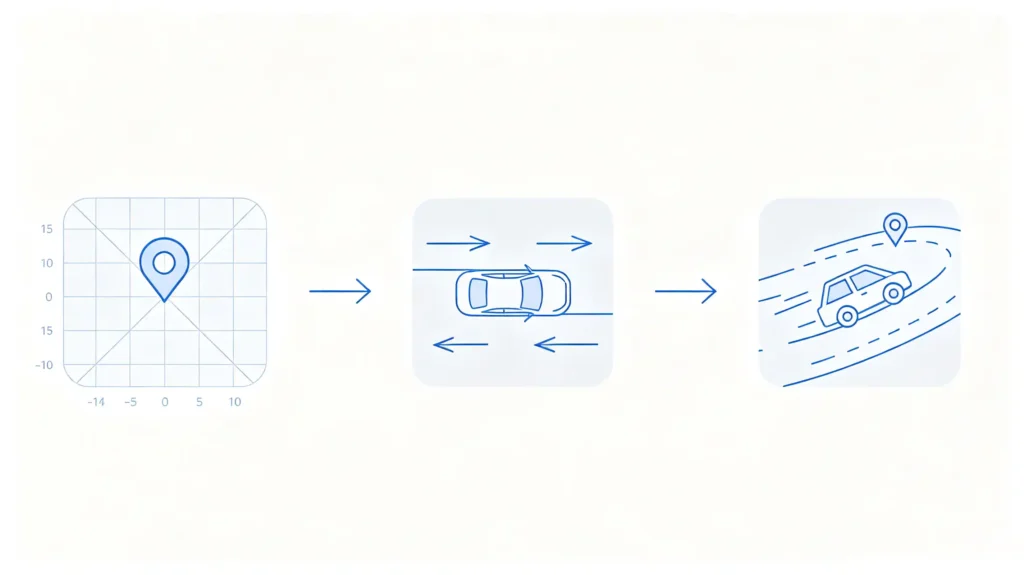
At a basic level, the logic is straightforward. When GPS is available, the system knows its exact position and heading with confidence. The moment GPS is lost, it switches to estimation. It tracks speed and direction from the last confirmed position. It calculates forward from there. It is essentially adding up small movements over time: last known position, plus speed multiplied by elapsed time, adjusted for any changes in direction along the way.
Three Inputs
That estimate depends on three inputs. Vehicle speed, sourced either from a wheel speed sensor or GPS-derived speed data. Direction, typically from a gyroscope or steering angle sensor. Time, tracked internally.
Drift
The system runs this calculation continuously while GPS is unavailable. But the estimate is not perfect. Small errors in each measurement accumulate the longer the vehicle travels without a fresh GPS fix. This phenomenon is generally known as drift.
GPS Correction
Once GPS signal returns, the system corrects its estimated position against the newly available satellite fix.
The Practical Takeaway
The practical takeaway for buyers is that dead reckoning is fundamentally an estimation method. It is useful and often quite accurate over short distances. But its precision degrades the longer it runs without GPS to correct it.
On-Board Sensors and Vehicle-Data Used for Dead-Reckoning Positioning
Two Categories of Sensor Data
Dead reckoning pulls from two categories of sensor data. The distinction matters for accuracy.
Internal Sensors
Internal sensors, built into the head unit itself, center on the IMU (Inertial Measurement Unit). An accelerometer that measures acceleration to estimate changes in speed. A gyroscope that measures rotation to estimate changes in direction. The limitation here is that internal IMU readings drift over time on their own. Small measurement errors compound with each calculation cycle.
Vehicle-Sourced Data
Vehicle-sourced data, accessed via the CAN Bus, tends to be considerably more accurate. A wheel speed sensor provides genuine vehicle speed rather than an estimate. A steering angle sensor gives direct steering input. Gear position indicates whether the vehicle is moving forward or in reverse. A yaw rate sensor measures the vehicle’s actual rotation rate.
The Practical Difference
The practical difference between these two approaches is significant. IMU-only dead reckoning is workable as a baseline but accumulates drift faster. Combining IMU data with CAN Bus signals meaningfully improves accuracy and slows that drift.
What to Ask
For any buyer evaluating dead-reckoning capability, whether a system can actually access CAN Bus vehicle data — and for which vehicle models — is one of the more consequential questions to ask. For foundational context on CAN Bus, see our what is CAN BUS guide.
GPS and Dead-Reckoning Sensor-Fusion Workflow
What Is Sensor Fusion?
Sensor fusion is the process of combining data from multiple sources to produce a more accurate position estimate than any single source could deliver alone. It runs in a fairly consistent sequence.
Step 1: GPS Absolute Position
GPS provides an absolute position whenever satellite signal is available.
Step 2: Dead Reckoning Relative Position
Dead reckoning contributes a relative position change — how far and in what direction the vehicle has moved — for the periods when GPS is not available.
Step 3: Fusion Algorithm
A fusion algorithm, commonly a Kalman filter, combines both inputs. It weights each based on how reliable it currently is.
Step 4: GPS Correction
Once GPS signal returns, that same algorithm corrects the dead-reckoning-derived position estimate against the newly confirmed fix.
What Is a Kalman Filter?
A Kalman filter, at a practical level, is a mathematical method for blending noisy, imperfect measurements from different sources into a single best estimate. It adjusts how much weight to give each source depending on conditions.
The Real-World Result
The real-world result tracks with how long GPS has been unavailable. A short signal loss sees dead reckoning hold position with minimal drift. A longer loss allows more drift to build up before GPS returns and triggers a correction. The quality of the fusion algorithm itself — not just the raw sensor data feeding it — is a meaningful factor in how well a system performs through these transitions.
Dead-Reckoning Real-World Performance in Tunnels, Parking Garages and Urban Canyons
Short Tunnels
Performance varies noticeably by environment and duration. In short tunnels under roughly a kilometer, dead reckoning generally holds position with minimal drift.
Longer Tunnels
Longer tunnels give drift more time to accumulate. A vehicle can exit tens of meters off from its actual tracked position.
Multi-Level Parking Garages
Multi-level parking garages present a similar challenge. Dead reckoning tracks movement reasonably well within the structure. But accumulated drift means the system typically needs to re-acquire GPS once the vehicle is back outside to fully correct its position.
Urban Canyons
Urban canyons add a different complication. Signal reflections off buildings cause multipath errors even when some GPS signal is technically present. Dead reckoning helps fill the resulting gaps. But position accuracy in that environment generally does not match what a clear, open-sky GPS fix delivers.
Industry Benchmark
As a rough industry benchmark, dead-reckoning error tends to accumulate at somewhere around 5–10% of distance traveled without GPS. A full kilometer without signal could translate to a position error in the range of 50 to 100 meters. For more on GPS accuracy, see our car GPS accuracy guide.
What This Means for Buyers
That is a meaningful number for a buyer to keep in mind. Dead reckoning is genuinely useful for bridging short-to-moderate gaps in coverage. But it is a short-term solution rather than a substitute for GPS over extended outages.
B2B Evaluation Considerations for Dead-Reckoning Capabilities
Evaluation Framework
Turning this into an evaluation framework, buyers should check seven things before finalizing a navigation system order.
- Sensor inputs — which ones the system actually uses, including whether it has internal IMU support and genuine CAN Bus data access
- Fusion approach — what combines that data, such as a Kalman filter
- Real tunnel test performance — how the system actually performs, not a datasheet claim
- Position drift — how much builds up over a measured distance without GPS
- CAN Bus dependency — whether full dead-reckoning performance depends on CAN Bus access for the target vehicle model. For more on CAN Bus integration, see our car stereo CAN Bus adapter guide.
- GPS re-acquisition speed — how quickly the system re-acquires and corrects position once GPS returns
- Sample testing — under real-world conditions before committing to volume
CAN Bus Access
CAN Bus access is worth particular attention here. It directly affects dead-reckoning accuracy and depends on vehicle-specific protocol support.
FAQ
Does dead reckoning deliver unlimited accurate positioning when GPS satellite signals are completely lost?
No. Dead reckoning is an estimation method. Its accuracy degrades the longer it runs without a GPS correction. Errors from speed and direction measurements accumulate over distance rather than staying constant. It is genuinely reliable for short gaps like a typical tunnel. But position drift builds up meaningfully over longer outages. This is why it functions as a bridge between GPS fixes rather than a standalone replacement for satellite positioning.
What practical performance difference exists between IMU-only dead reckoning versus CAN-Bus wheel-speed-aided dead reckoning?
IMU-only dead reckoning relies on an internal accelerometer and gyroscope. Both accumulate drift relatively quickly since their measurements are indirect estimates. Adding CAN Bus data — particularly wheel speed and steering angle pulled directly from the vehicle — provides more accurate, direct measurements that slow drift accumulation considerably. In practice, a system with genuine CAN Bus access will generally outperform an IMU-only system over the same distance without GPS.
Why can two navigation units with advertised dead reckoning show large differences in real-world tunnel position tracking?
The gap usually comes down to which sensor inputs the system actually uses. It also depends on how good its fusion algorithm is. A unit relying only on internal IMU data will drift faster than one that also pulls CAN Bus signals like wheel speed and steering angle. The quality of the fusion algorithm blending these inputs matters too. A well-tuned implementation corrects for sensor noise more effectively than a basic one. This happens even when both systems technically support “dead reckoning” on paper.
Can aftermarket Android head-unit dead-reckoning function work without accessing vehicle CAN-bus sensor data?
Yes, but with reduced accuracy. A head unit can run dead reckoning using only its internal IMU — accelerometer and gyroscope — without any CAN Bus connection. This still provides some positioning continuity during GPS loss. The tradeoff is faster drift accumulation compared to a system that also reads wheel speed and steering angle from the vehicle. IMU-only estimation has fewer accurate reference points to work from.
Conclusion
Dead-reckoning quality depends on sensor inputs, CAN Bus access, and fusion algorithm implementation working together. These differences do not always show up on a basic spec sheet.